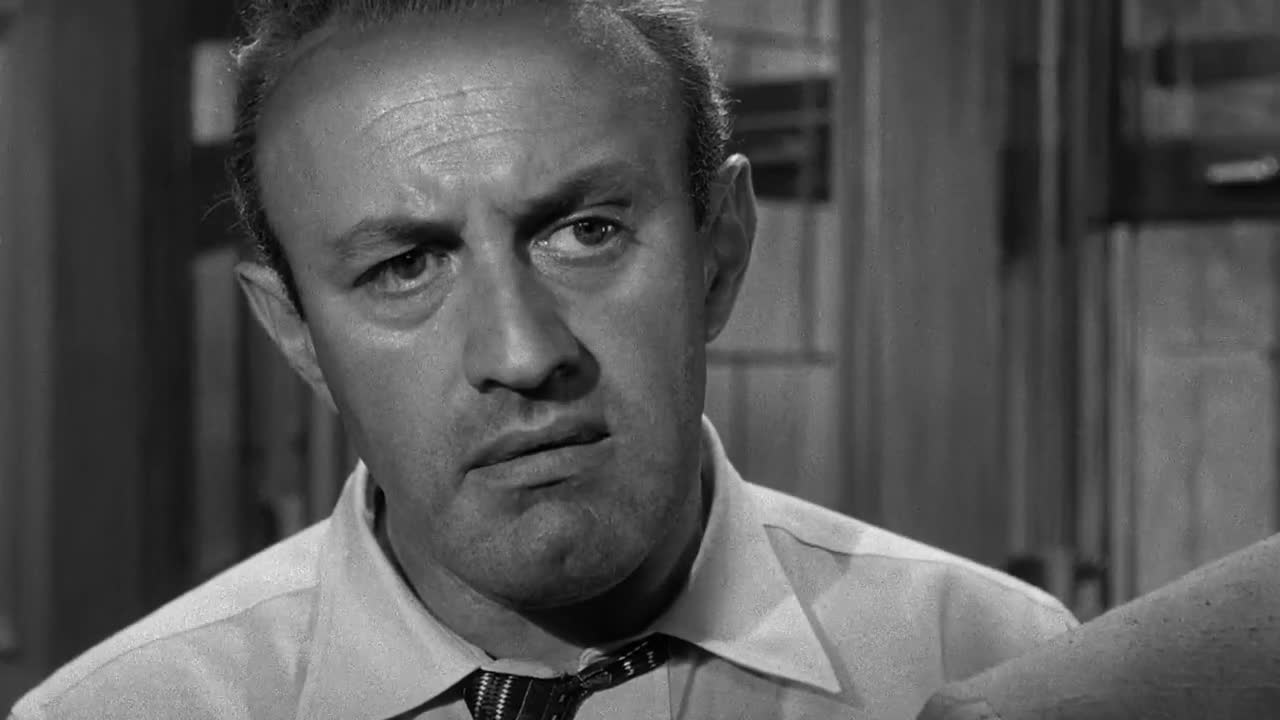
“Aren't you asking us to accept a pretty incredible coincidence?”
The question pins the word coincidence onto the argument and makes it pay for itself.
Neutral
Capítulo 5 de 17 · 5'00"
The jurors argue about the murder weapon, a switchblade the boy supposedly bought and that the shopkeeper called one of a kind. Then one juror produces an identical knife he bought the night before. "It's the same knife," he says — and the prosecution's "incredible coincidence" starts to look like no coincidence at all.
The Case Rests on Two Witnesses
❝ Monólogo · 6 frases Juror 8 on possibility
He builds a whole chain out of a dropped knife and pries the verdict open with possibility.
❝ Monólogo · 4 frases Juror 8 buys a knife
A walk, a pawnshop, six dollars; the plain price lands louder than any speech.
In the jury room, the men re-examine the case, one fact at a time. They question whether the defense lawyer pushed hard enough, note that the whole case rests on two witnesses, and study the unusual switchblade said to be the murder weapon. Then a juror pulls an identical knife from his pocket and explains he bought it for six dollars at a pawnshop near the boy's home.
The scene is a lesson in how quickly certainty can be built — and broken. The prosecution's case rests on two witnesses and one unusual knife, and most jurors treat that as enough. One juror keeps testing it: if the witnesses could be wrong, and if the knife isn't unique, the story collapses. He proves the second point in the most physical way possible, producing a switchblade just like the murder weapon, bought for six dollars near the boy's house. "Aren't you asking us to accept a pretty incredible coincidence?" someone had asked. Now the coincidence is on the table. The knife also exposes the jury's own rule-breaking, since buying or selling one is illegal, and the reaction — "you pulled a real bright trick" — shows how much the demonstration unsettles them. What they call a trick is really evidence.
A1–C2 es la escala MCER. Las tarjetas por encima del nivel elegido se atenúan y la reproducción no se pausa en ellas.
“Aren't you asking us to accept a pretty incredible coincidence?”
The question pins the word coincidence onto the argument and makes it pay for itself.
Neutral
“Oh, come on. Nobody can know a thing like that.”
A dismissive word and a plain truth drain the certainty right out of the question.
Informal
“Listen, you pulled a real bright trick. Now, supposing you tell me what it proves.”
A compliment wrapped around a question: the soft blade cuts deeper than a shout.
Informal
“It's against the law to buy or sell switchblade knives.”
A flat legal fact lands like a challenge, shifting who has to explain the knife.
Formal
Now are you trying to tell me that this knife... really fell through a hole in the boy's pocket... someone picked it up off the street, went to the boy's house... and stabbed his father with it just to test its sharpness? No. I'm just saying it's possible the boy lost his knife... and that somebody else stabbed his father with a similar knife.
I went out walking for a couple of hours last night. I walked through the boy's neighborhood. I bought that at a little pawnshop just two blocks from the boy's house. It cost six dollars.
Siguiente · 06hang a juryLa escena: Juror 8 Proposes Another VoteTo prove the murder weapon wasn't unique. If he could buy an identical knife near the boy's home for six dollars, then the knife found in the father's chest doesn't single the boy out.
No — it proves the knife evidence is weaker than it seemed. It shows the weapon could have belonged to someone else, which is enough to raise reasonable doubt.
Buying or selling switchblades is illegal, and he says so plainly: it was the only way to test whether the weapon in evidence was really one of a kind.
It means the juror is accusing him of a clever stunt meant to sway the room. The phrase is sarcastic, but the 'trick' is actually physical proof.
Because it fits the story they already believe: a violent boy, a distinctive knife, and a shopkeeper saying he had only ever stocked one. The second knife is what makes them question it.