“This is ridiculous. Just nervous heartburn. I always get it the first day of a trial.”
He denies being ill while diagnosing himself perfectly, all bluster and self-knowledge.
Informal
Chapter 15 of 27 · 4'23"
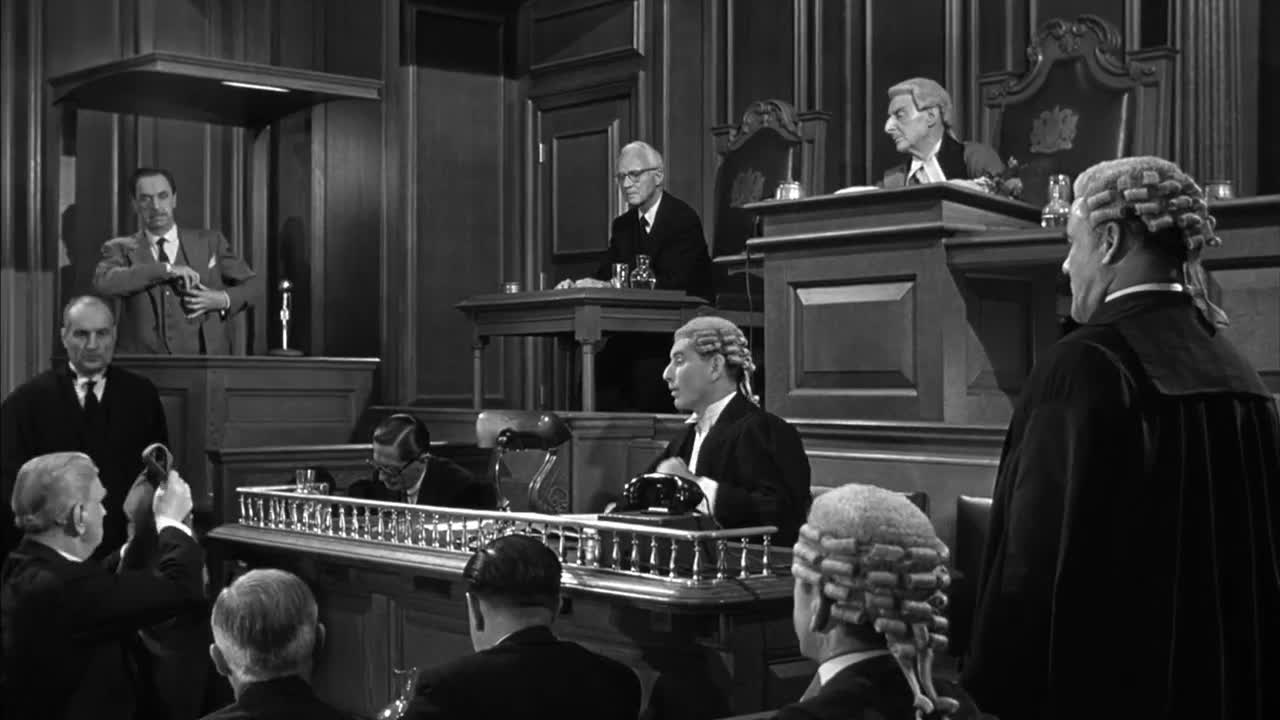
The court hears how Mrs French died: one blow, no struggle, a staged break-in, and Leonard's fingerprints. Underneath, the case rests on a single word — whether the attacker caught her "by surprise." Sir Wilfrid pounces when Myers calls the assailant "the murderer," and the judge makes Myers rephrase. It is a battle over grammar that could decide a man's life.
❝ Monologue · 4 lines objection speech
One objection doubles as a grammar lesson, exposing the gender hidden in murderer.
Myers Puts Words in the Witness's Mouth
At home, a doctor treats Sir Wilfrid with calcium injections, nitroglycerin and hourly pills, while Miss Plimsoll confiscates his cocoa — he's not above lacing it with brandy. Then it moves to the Central Criminal Court, where Inspector Hearne describes Mrs French's death: one blunt blow, no signs of a struggle, a staged break-in, and fingerprints belonging to the victim and Leonard Vole.
The murder facts do the talking: "Death was instantaneous, caused by one blow from a heavy and blunt instrument," and "None. Just the one blow." No struggle, nothing stolen, and a window broken from the inside — the prosecution's own evidence hints the scene was arranged. Myers wants the inspector to agree the killer took Mrs French "by surprise," letting him suggest a planned, cowardly attack; Sir Wilfrid blocks him, pointing out the assailant might as well be female. When Myers keeps answering his own questions, the judge sides with Sir Wilfrid: "the presence of the witness would seem superfluous." Meanwhile the medical framing keeps Sir Wilfrid alive and under watch — he wins the round but is being managed by everyone around him.
A1–C2 is the CEFR scale. Cards above the level you pick fade, and playback will not auto-pause on them.
“This is ridiculous. Just nervous heartburn. I always get it the first day of a trial.”
He denies being ill while diagnosing himself perfectly, all bluster and self-knowledge.
Informal
“It may interest you to know that I am descended from a warrior family which traces its brave past back to Richard the Lion-Hearted.”
Claiming Richard the Lion-Hearted as kin is pompous and touching, a sick man's defiance.
Formal
“Mr Myers, Sir Wilfrid has joined us just in time to catch you on a point of grammar.”
The judge quietly awards the point and turns grammar itself into the weapon.
Formal
“After all, if he insists on answering his own questions, the presence of the witness would seem superfluous.”
A polite conditional delivers the insult, and one word, superfluous, ends the exchange.
Formal
My lord, I must object. My learned friend refers to the assailant as "the murderer". We have not yet determined whether the assailant was a man or a woman. It could quite conceivably have been "the murderess".
Up next · 16account forThe scene: The Bloodstained Jacket in CourtThe glass outside does not match a window forced from the outside, and nothing was stolen — details that undercut the idea of a burglary gone wrong.
Inspector Hearne. Myers calls the attacker "the murderer" before anyone is convicted, and Sir Wilfrid seizes on the wording, noting it could have been a "murderess".
The judge only asks Myers to rephrase, since a witness should give facts, not opinions. Myers then withdraws the question, so the point stands but the trial goes on.
Unnecessary. Sir Wilfrid jokes that if Myers keeps answering his own questions, there is no point having a witness at all.
A surprise attack implies planning and suggests the victim could not resist, strengthening the case that this was deliberate murder rather than a bungled burglary.