
“Nobody has ever quoted me back to me before.”
Why it's great
The doubled back-to-me turns a writer's private thrill into one plain sentence.
Register
Neutral
Use it yourself
My student quoted me back to me in class today.
Chapter 13 of 20 · 2'33"
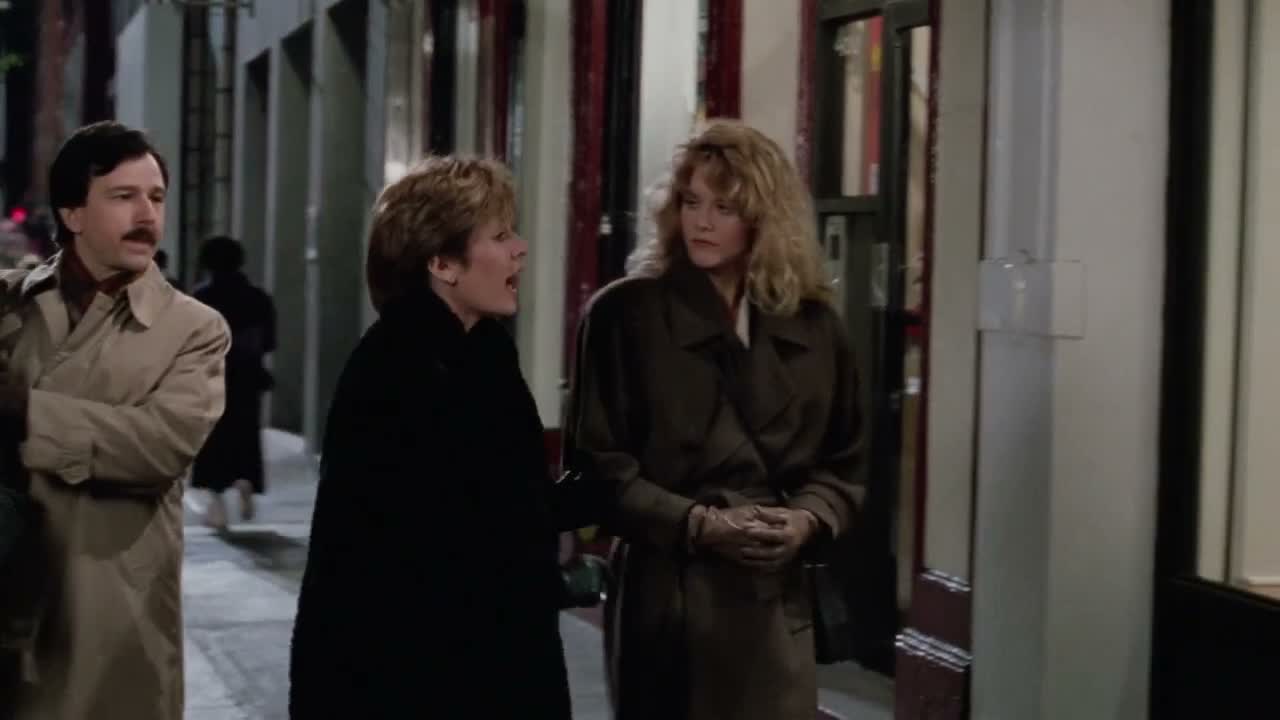
Harry and Sally fix up Marie and Jess, and the four meet for dinner. Harry's theory about a good personality as a polite way of saying not attractive sets the tone. Then Sally realises her magazine article is being quoted back to her: "Nobody has ever quoted me back to me before."
❝ Monologue · 8 lines Harry's Good Personality Theory
Sally Hears Her Own Article Quoted
Harry and Sally introduce their friends Marie and Jess over dinner, hoping the two will hit it off. The evening becomes a comedy of mismatched talk: Harry mocks the phrase good personality, and Sally's own magazine article is quoted back to her without anyone knowing she wrote it.
The blind date is really a mirror held up to Harry and Sally. They have spent years insisting they cannot be friends, and here they sit as a comfortable pair while their friends fumble through the same awkwardness. Harry's joke about a woman being described by her good personality is his theory of attraction in miniature, and Sally's reaction shows she knows the joke and its cruelty. The best moment belongs to Sally, who hears her own writing praised by the man quoting it: "Nobody has ever quoted me back to me before." It is a small, real pleasure in a scene about performance — everyone is trying to impress someone, and the only honest note is the surprise of being recognized.
A1–C2 is the CEFR scale. Cards above the level you pick fade, and playback will not auto-pause on them.
“Nobody has ever quoted me back to me before.”
The doubled back-to-me turns a writer's private thrill into one plain sentence.
Neutral
“He's the reason I became a writer, but that's not important.”
The line drops a big confession and then waves it away, which is exactly how people really talk.
Informal
“I've never quoted anything from a magazine in my life.”
The over-the-top never-in-my-life makes the small admission funny and disarming.
Informal
“"She has a good personality," that means she's not attractive.”
It translates dating euphemism into plain truth and exposes the code everyone uses.
Informal
When someone's not that attractive... they're always described as having a good personality. If you had asked me, "What does she look like?" and I said... "She has a good personality," that means she's not attractive. But just because I happened to mention she has a good personality... she could be either. She could be attractive with a good personality... or not attractive with a good personality.
 Up next · 14call off the dogsThe scene: Harry and Sally Shop for a Gift
They are friends who want their friends to be happy, and the dinner doubles as a test of their own ideas about attraction. Neither admits they are also enjoying each other's company.
He claims it is a polite phrase people use when someone is not attractive. The joke is that a compliment about character often hides a comment about looks.
A man at the table quotes her writing back to her, not knowing she wrote it. She says nobody has ever done that before, so the recognition means more than the praise.
A newspaper columnist Harry admires and says inspired him to become a writer. Sally says she is not a big fan, which is one of the small disagreements that fill the dinner.