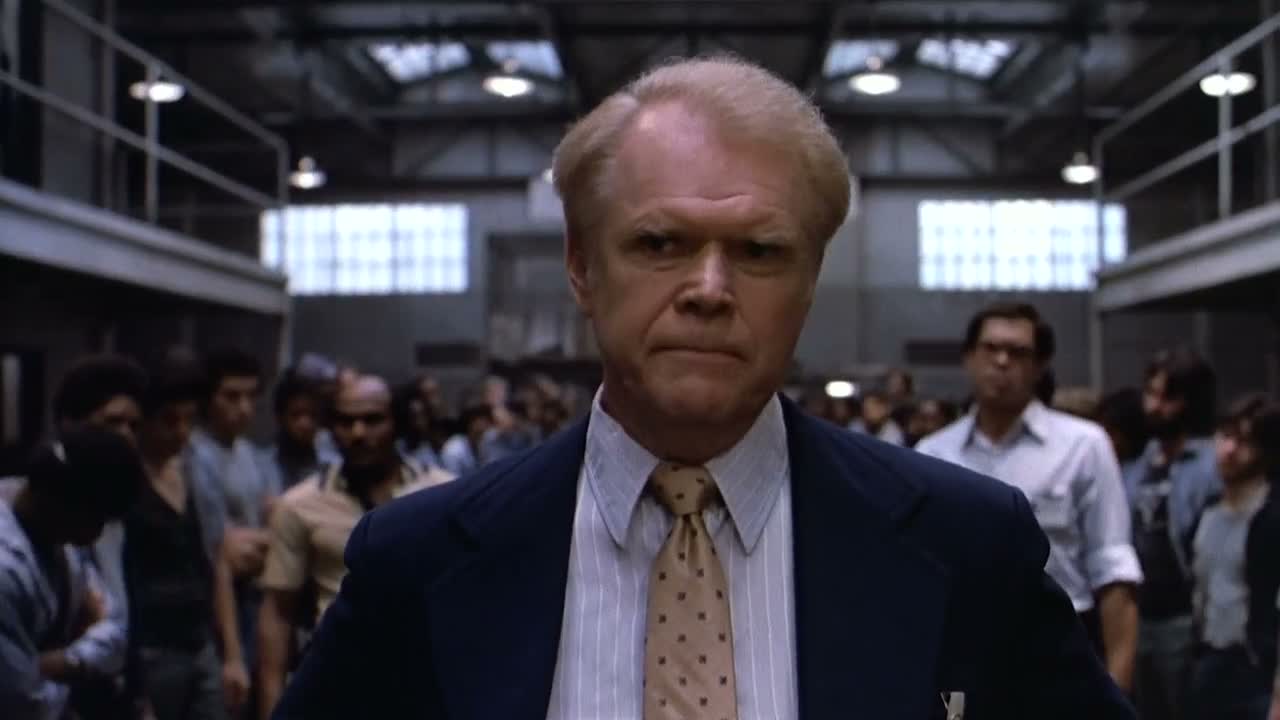
“I see you're responsible for the death of an eight-year-old boy.”
The heaviest fact, a dead child, is saved for last, so the accusation lands without a raised voice.
Formal
Chapter 3 of 9 · 2'39"
An official reads a young man named Mick his long record and refuses his excuse — "It was an accident." He answers that Mick would have killed someone eventually. Then the tone changes, and someone offers to listen whenever Mick wants to talk.
❝ Monologue · 6 lines The Charges Are Read to Mick
The Hard Talk Turns Gentle
At what looks like an intake or hearing, Mick is confronted with his past: a child's death and a long list of charges, from a stolen vehicle to assault and breaking and entering. Each time he says it was an accident, the official rejects it. Then a gentler voice offers to listen if Mick ever wants to talk.
The scene is built on one word: accident. Mick repeats it as a shield, and the official takes it apart line by line — a child's death, a stolen car, a weapon, breaking and entering — until the excuse collapses under its own weight. "You would've killed somebody sooner or later," he says, which is less a prediction than a verdict. The sarcasm in "You're a real class act" makes the contempt plain, and "don't bullshit yourself" removes any remaining politeness. What follows matters just as much: once the record is done, the tone softens. Someone tells Mick he is there if Mick ever wants to talk, about this "or anything else." The scene sets up its own question — whether a boy this far gone can still be reached — and leaves both answers open.
A1–C2 is the CEFR scale. Cards above the level you pick fade, and playback will not auto-pause on them.
“I see you're responsible for the death of an eight-year-old boy.”
The heaviest fact, a dead child, is saved for last, so the accusation lands without a raised voice.
Formal
“You're a real class act.”
It borrows praise for a man who just robbed an old woman, so the compliment becomes the insult.
Informal
“How you never did any time here before is a miracle.”
It frames his clean record as a miracle, mocking both him and the system in one breath.
Neutral
“And now you're telling me what just happened was an accident?”
He hands the excuse back as a question, which is how you refuse to believe it out loud.
Neutral
“You would've killed somebody sooner or later.”
The past deduction states his nature as settled fact, which is colder than any insult.
Neutral
“Well, when you do have an answer, let me know.”
It gives him all the time in the world and still keeps the door, and the pressure, open.
Neutral
“How do you feel about what went down?”
It skips blame and asks for feeling, which is harder to dodge than a direct accusation.
Neutral
Hey, boy, let me tell you something. That was no accident. You would've killed somebody sooner or later. Only it happened sooner, you see? So, don't bullshit yourself. Don't bullshit me.
Up next · 04get to the bottom ofThe scene: Officials Interrogate the InmatesIt is the only defense he has. If the death can be framed as an accident, he is not responsible, so he repeats the phrase even as the official lists charge after charge against him.
Someone handling his case at intake or a hearing; the scene never makes the title explicit. He reads the charges, rejects the excuse, and later says he is there to listen.
He means the outcome was inevitable given Mick's history: even if this particular death was unintended, someone was going to get hurt eventually.
Both. After hours of hard accusation, the tone turns and someone offers to listen whenever Mick is ready to talk, about this or anything else.