
“- Did you like it then? - How could I not?”
Why it's great
A rhetorical answer lets him praise while hating every note.
Register
Informal
Use it yourself
Did I enjoy it? How could I not?
Chapter 8 of 25 · 4'17"
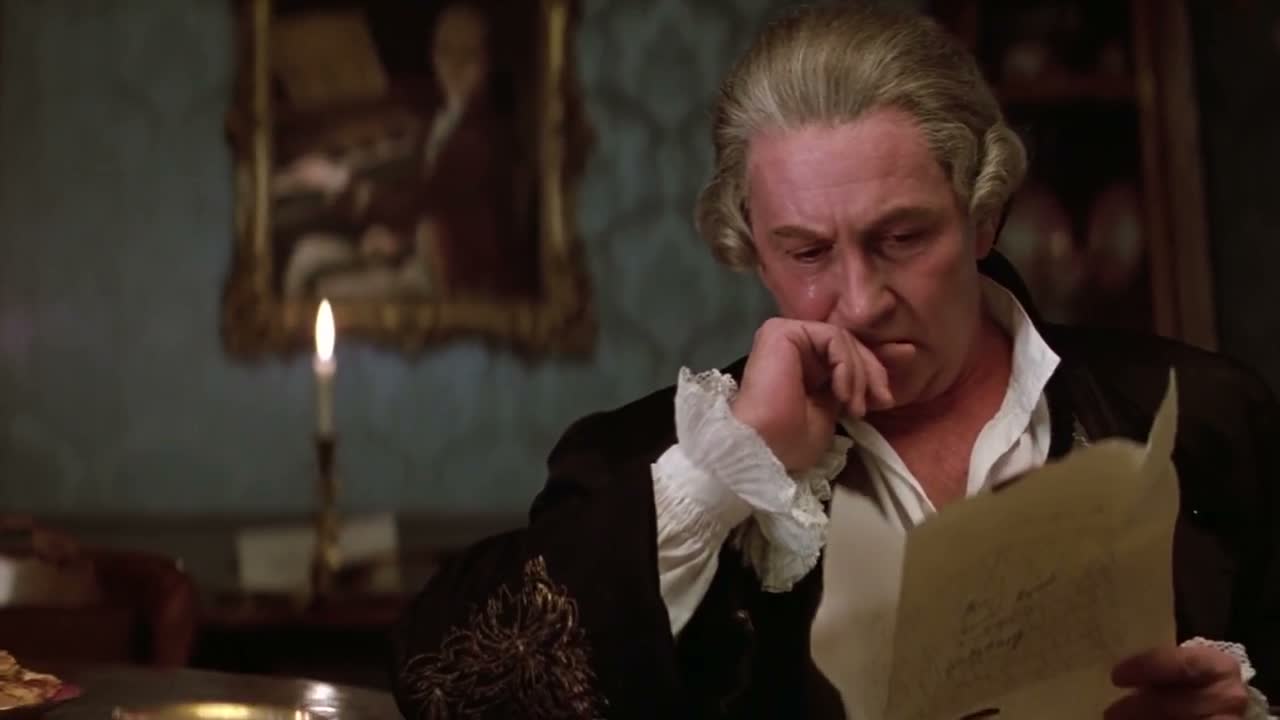
Salieri congratulates Mozart on the opera, then realises that the woman he loved had already slept with him. As Leopold begs for his son's career, Salieri asks God, "Why choose Mozart to teach me lessons in humility?" — then the film cuts to the wedding.
❝ Monologue · 5 lines Salieri's hatred
From a filling heart to violent thoughts, a few lines show a man turning.
Leopold Pleads for His Son
After the success of his opera, Mozart is congratulated by Salieri and the court, though the praise comes with sneers about the woman he is about to marry. Elsewhere, Leopold pleads with the Archbishop to give his son another chance, and writes urging Mozart to postpone the wedding. The film then cuts straight to the marriage ceremony.
This stretch is where Salieri stops being merely envious and starts to hate. Watching Mozart's opera succeed, he can almost accept that God gave the gift to someone else; what he cannot accept is that the same man took Katerina, the woman he calls "my darling girl." His monologue turns the loss into theology — "Why choose Mozart to teach me lessons in humility?" — as if God were deliberately humiliating him. Meanwhile Leopold, the other man losing control of Mozart, is reduced to begging the Archbishop for "one more chance" and taking all the blame himself. A letter cannot stop the wedding, and Salieri's prayer to send Mozart back to Salzburg goes unanswered.
A1–C2 is the CEFR scale. Cards above the level you pick fade, and playback will not auto-pause on them.
“- Did you like it then? - How could I not?”
A rhetorical answer lets him praise while hating every note.
Informal
“Why choose Mozart to teach me lessons in humility?”
It dresses jealousy up as theology, pious and resentful at once.
literary
“Your son is an unprincipled, spoiled,conceited brat!”
Three stacked adjectives plus brat release all the archbishop's fury.
Informal
“But don't blame him. The fault is mine,entirely.”
The father takes all the blame himself, protecting his son in one line.
Formal
“I write to you with urgent news. I'm coming to Vienna.”
Urgent news opens the letter, and a father's note becomes an order.
Formal
My heart was filling up... ...with such hatred for that little man. For the first time in my life, I began to know... ...really... ...violent thoughts.
 Up next · 09come flockingThe scene: Mozart Refuses the Committee
He isn't jealous of the music alone. Katerina Cavalieri, the woman he loved, has been with Mozart — "The creature had had my darling girl" — so the triumph onstage and the loss in his private life arrive in the same evening.
He suspects God is using Mozart to humble him, testing whether he will forgive an unbearable offense. Rather than accept the lesson, he resents that God picked Mozart — the last person he could learn from — as the teacher.
His son has been dismissed and needs a way back into court employment. Leopold takes the blame on himself — "The fault is mine, entirely" — and asks for one more chance, even while the Archbishop calls Mozart an unprincipled, spoiled brat.
No. Leopold's letter demands that he take no further steps towards marriage until they meet, but the film cuts straight to the wedding vows, so the warning arrives too late to change anything.