
“All I have is just an office with my name on the door.”
Por qué es buena
He deflates a grand title into a nameplate on a door, and the modesty is the point.
Registro
Neutral
Úsala tú
All I have is just a desk and a long title.
Capítulo 8 de 27 · 4'53"
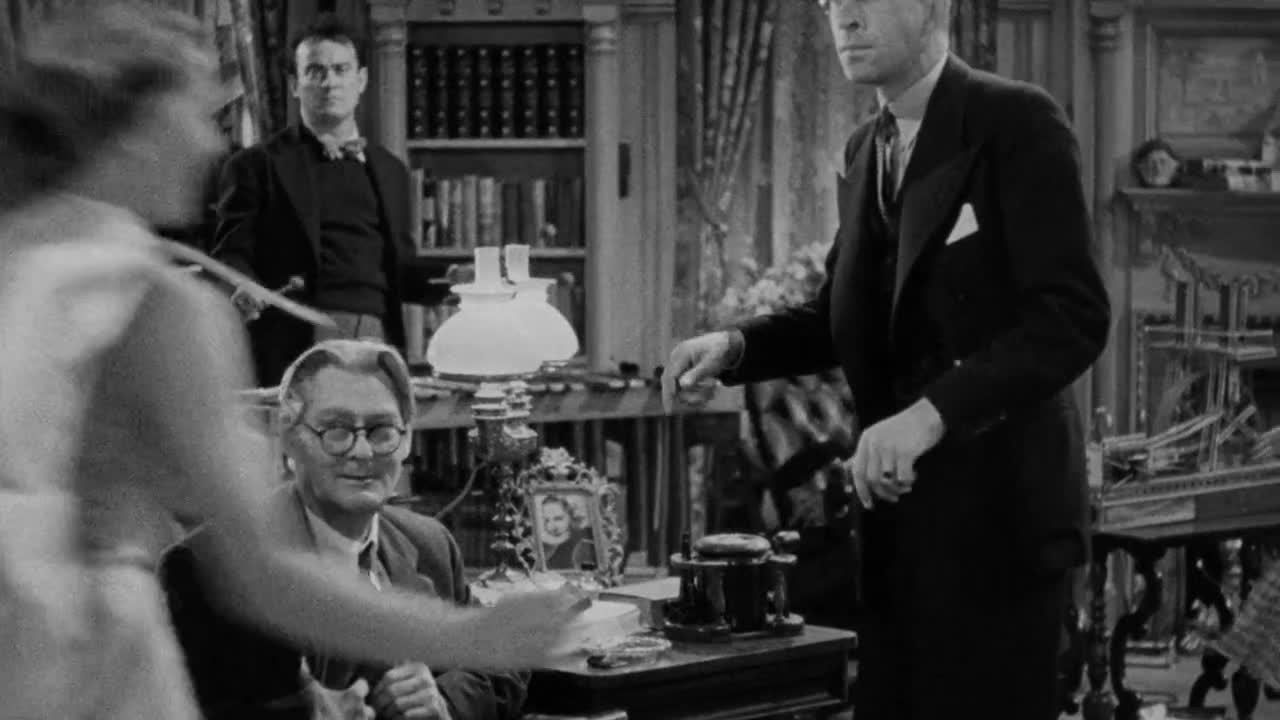
An income-tax agent comes to the Sycamore house to tell Grandpa he has never paid tax in his life. Grandpa refuses on principle, and when pressed he turns it into an argument about what the government actually gives him: "What do I get for my money?"
Grandpa Refuses to Pay Tax
❝ Monólogo · 5 frases Grandpa Questions the Government
An agent from the Internal Revenue Department arrives to ask Grandpa why he has never filed an income tax return. Grandpa says he simply does not believe in it, and turns the visit into a debate about what the government gives him in return. Meanwhile Tony arrives as a guest.
The chapter is the film's philosophy put on trial, and Grandpa wins by refusing to play the game. The tax agent expects a legal discussion and gets a moral one instead, because Grandpa treats the government as a shop: "What do I get for my money?" He is not greedy; he is asking what he is buying. The scene's comedy comes from the mismatch between official language and Grandpa's plain questions, and its seriousness comes from the fact that he cannot be answered. When he says "Not with my money," it is not a stunt but a whole view of what a person owes and what he does not.
A1–C2 es la escala MCER. Las tarjetas por encima del nivel elegido se atenúan y la reproducción no se pausa en ellas.
“All I have is just an office with my name on the door.”
He deflates a grand title into a nameplate on a door, and the modesty is the point.
Neutral
“Whether you believe it or not, you owe the government 22 years back income taxes.”
The concessive opening lets the number land like a blow, and the flat delivery makes it worse.
Formal
“Mind you, I don't say that I'm going to, but just for the sake of argument, what's the government going to do with it?”
He denies the premise, then argues inside it anyway, which forces the other man to answer.
Formal
“Why, I wouldn't mind paying for something sensible.”
Refuses blind payment without becoming unreasonable.
Neutral
Now, suppose I do pay you this money. Mind you, I don't say that I'm going to, but just for the sake of argument, what's the government going to do with it? - What do you mean? - Well, what do I get for my money? For instance, if I go into a department store and buy something, why, there it is. I can see it. But what are they going to give me?
 Siguiente · 09got another thing comingLa escena: Tony Meets Alice's Family
He says he does not believe in it. He has never filed a return, and when asked for his income he guesses around eighty-five dollars.
Twenty-two years of back income taxes. The agent says the amount is serious, but Grandpa argues that such an old claim should be barred.
He says that when he buys something in a store he can see what he got. With taxes he cannot see what he is paying for, so he asks what the government gives him.
Tony Kirby arrives as a guest, and the family welcomes him warmly, introducing him to Alice's father, grandfather, sister and brother-in-law.