
“I left home at two. I had to ask a policeman in the end, I got so lost.”
Por qué es buena
The flat 'in the end' admits defeat after the story has already given her away.
Registro
Informal
Úsala tú
I had to ask a stranger in the end, I was so lost.
Capítulo 11 de 25 · 3'59"
Mary shows up hours late, lost and apologetic, and turns her embarrassment into a surprise: she has finally bought a car. She is thrilled with the deal, but the whole plan exposes how scattered she is — "that hadn't even crossed my mind" about the insurance — and the party quietly moves on around her.
❝ Monólogo · 7 frases Mary Arrives Late With a New Car
Mary Greets Everyone at the Party
Mary arrives at the gathering hours late, explaining that she got lost and had to ask a policeman for directions. She has bought a second-hand car as a surprise and is proud of her bargaining, but she forgot to arrange insurance and has not driven since 1984. The friends greet her, pass around the baby, and carry on.
The chapter is built around a gap: Mary wants to be the one who arrives with good news, and she is the one who cannot find her way to a house she has visited 'loads of times.' Her car is meant to mark a new independence, and she is proud of the deal — 'I was really chuffed with myself' — but every detail undercuts it, from the three-hour journey to the insurance she never arranged. Her line, 'Oh, I'm so stupid. Why do I always spoil everything?' is the fear she keeps joking about. Then the party absorbs her: people greet her, pass the baby, and the talk turns to engine sizes she cannot answer. The cheerfulness is real, and so is the loneliness under it; the scene lets both sit at the same table.
A1–C2 es la escala MCER. Las tarjetas por encima del nivel elegido se atenúan y la reproducción no se pausa en ellas.
“I left home at two. I had to ask a policeman in the end, I got so lost.”
The flat 'in the end' admits defeat after the story has already given her away.
Informal
“Oh, I'm so stupid. Why do I always spoil everything?”
A self-reproach and a rhetorical question make her panic feel honest, not staged.
Informal
“I thought you were going to miss me out, Mary.”
A mock complaint in the past future: you almost forgot me, so please notice me.
Informal
“And had I sorted out the insurance? Well, that hadn't even crossed my mind!”
A mock-check followed by an admission that the whole thing slipped her mind.
Informal
Yeah. But, they wanted cash. So I had to go to the cash point on Wednesday and Thursday and Friday. So, I couldn't collect it till after work on Friday. But they rang on Friday morning to find out what time I was going to go round with the money. And had I sorted out the insurance? Well, that hadn't even crossed my mind! So, I spent the whole of my lunch break on Friday sorting that out and it was really expensive because I haven't driven since 1984. But I didn't tell you on Thursday, Gerri, because I knew I was coming here today and I wanted to surprise you all.
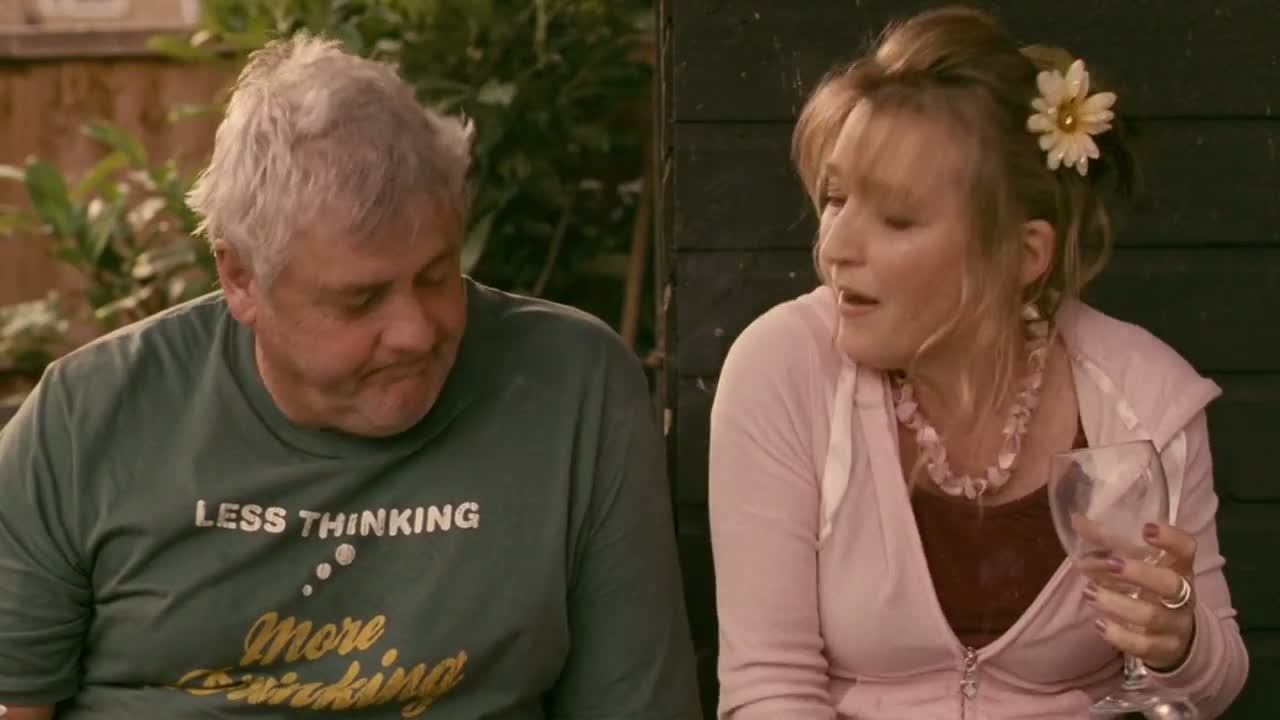 Siguiente · 12the making ofLa escena: Mary Shows Up in Her New Car
She gets lost driving there, even though she has visited many times, and eventually has to ask a policeman for directions. She left home at two and it takes her three hours.
It means a thought appeared in your head. Mary says the insurance 'hadn't even crossed my mind,' meaning she never even considered it when buying the car.
She wants it to be a surprise that marks a new start. She is proud of bargaining the price down to 650 and says she is 'chuffed with myself.'
The men ask how many cubic centimetres the engine is, and she has no idea. She can only gesture with her hands, which turns her new car into another joke at her expense.
Jack says she is a bit under the weather this afternoon, so she has stayed home. The phrase is a common way of saying someone feels slightly ill.