
“A small plane went into the World Trade Center.”
Why it's great
One flat sentence records the first, wrong version of events before anyone knows better.
Register
Neutral
Use it yourself
A small plane went into the warehouse roof.
Chapter 7 of 17 · 2'59"
People see smoke pouring from the World Trade Center and the reports keep changing. The first word is a small plane, but nobody can make that fit what they're looking at. "A Cessna would have bounced off that." What looks like a bad accident is already something much larger, and the controllers are only starting to understand it.
❝ Monologue · 6 lines Captain Dahl's Calm Welcome Announcement
Air traffic controllers and people on the ground notice smoke rising from the World Trade Center on the morning of September 11, 2001. Early reports say a small plane hit the building. As they watch the footage, some argue the damage is far too big for a small aircraft. Meanwhile, Captain Dahl makes a routine welcome announcement to his passengers.
The scene is built on how ordinary the morning feels. Controllers trade routine updates and radio traffic while the news slowly hardens into something they can't explain away. The turning point isn't the first report of smoke; it's the moment someone looks at the image and says that it can't be a small plane. "A Cessna would have bounced off that." That line carries the whole dread of the sequence: whatever happened, it was deliberate, and it was aimed. Cut against it is Captain Dahl's calm, scripted welcome to the passengers — "If there's anything we in the cockpit can do to make your ride more enjoyable, please don't hesitate to ask." He has no idea yet, and the audience does, which is where the tension comes from.
A1–C2 is the CEFR scale. Cards above the level you pick fade, and playback will not auto-pause on them.
“A small plane went into the World Trade Center.”
One flat sentence records the first, wrong version of events before anyone knows better.
Neutral
“They were tracking the primary target, they've lost it.”
The shift from were tracking to have lost it turns a routine report into sudden failure.
Neutral
“I'll tell you what, that is not a small plane. No way.”
A judgment followed by a flat refusal to believe: the confidence lands in the last two words.
Informal
“A Cessna would have bounced off that. Look at the size of that hole!”
A counterfactual about a Cessna demolishes the small-plane theory without naming the truth.
Informal
“I got a bad feeling about this. I'll tell you right now.”
A movie-clean line that names dread early and refuses to take it back.
Informal
“If there's anything we in the cockpit can do to make your ride more enjoyable, please don't hesitate to ask.”
Warm, polished service English that sounds unbearably calm given what is happening on the ground.
Formal
That is your signal you are safe to move about the cabin. We got the seatbelt sign off. However, when you are in your seats I'll ask you to keep your seatbelts loosely fastened, as you never know when we'll get some bumps we're not expecting. I'll update you on the weather as we get a little closer. In the interim now, I'll ask you to sit back and enjoy the outstanding service of our fine flight attendants. If there's anything we in the cockpit can do to make your ride more enjoyable, please don't hesitate to ask.
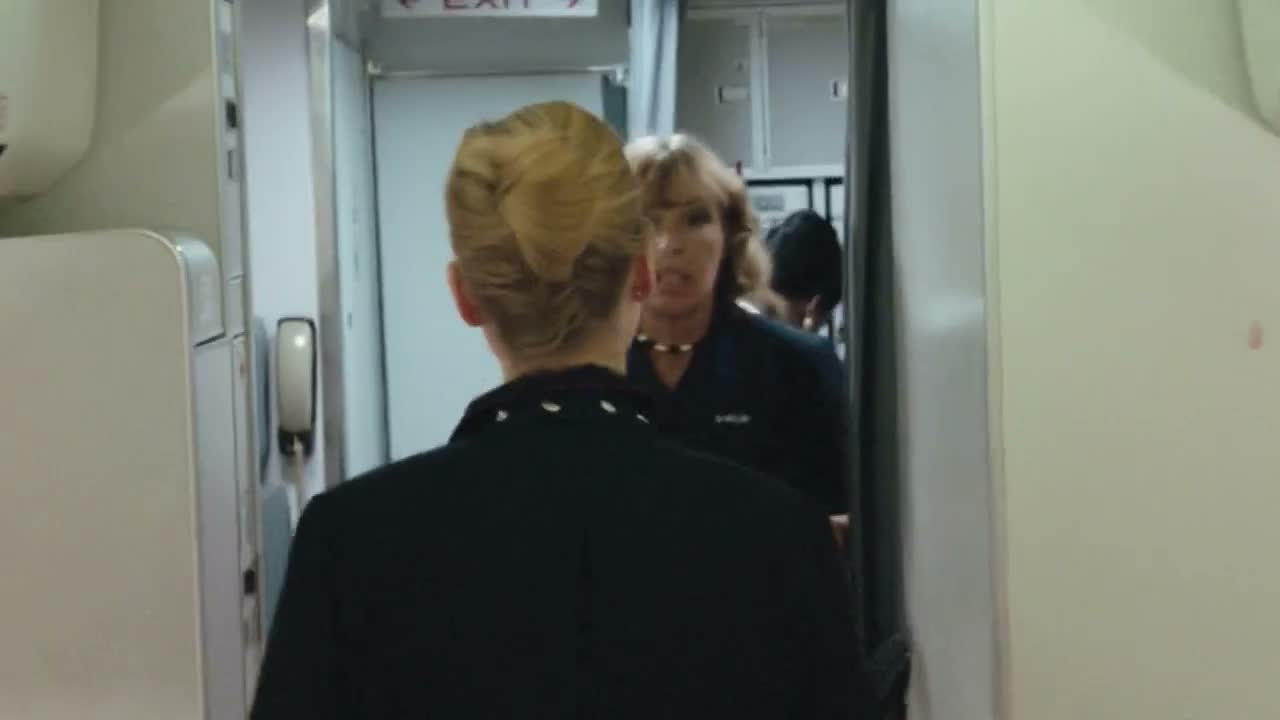 Up next · 08take care of itThe scene: Controllers Spot a Second Hijacking
The earliest reports describe smoke and a light aircraft, and a small plane is the easiest explanation for a single localized crash. The scene shows how quickly that guess falls apart as they see the size of the hole.
It's one of the people watching the footage, not a named character. The film deliberately keeps many of these voices unidentified, since the real air traffic control recordings are being recreated.
It means the aircraft has dropped off radar, so the controllers literally can no longer see its blip. That by itself doesn't confirm a crash, which is why they start calling around for a visual.
The film is built around reconstructions of the actual events, and many of these lines mirror real radio and phone traffic from that morning. The effect is to keep the perspective on the people reacting, not on the hijackers.
It shows the ordinary routine of the flight just before it is hijacked. The calm, friendly safety message lands with heavy irony because the audience already knows the plane never reaches its destination.