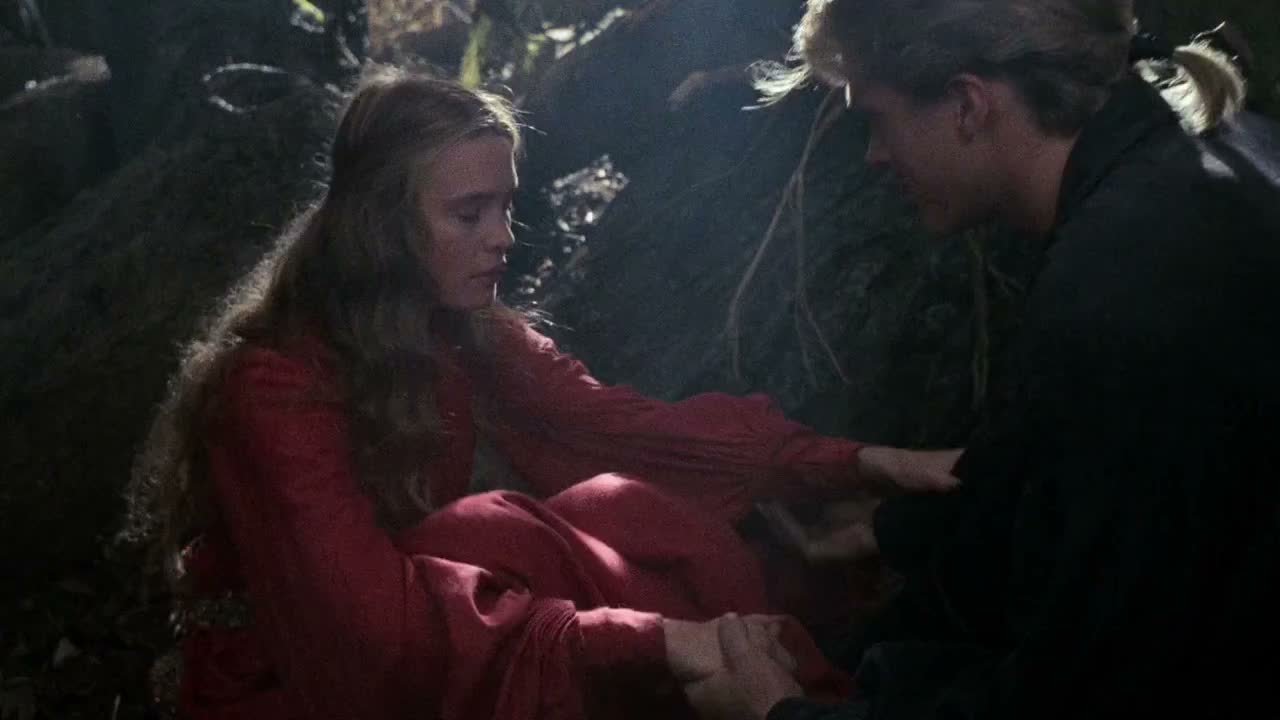
“It ends when you decide and we both drink and find out who is right and who is dead.”
Right and dead rhyme, so being correct and staying alive become the same test.
literary
Chapter 1 of 3 · 3'13"
On the surface the two men are playing a deadly guessing game: each must drink and find out who survives. "It ends when you decide and we both drink and find out who is right and who is dead" spells out the stakes. The real contest isn't the wine: it's who can out-think the other.
❝ Monologue · 7 lines The Battle of Wits Sets Its Deadly Rules
The Twist: Both Goblets Were Poisoned
Two men sit at a table with a goblet of wine each and turn a simple drink into a life-or-death puzzle. One asks where the poison is; the other lays out the rules, then talks himself through an endless chain of reasoning about which cup to choose. They drink, one laughs, and the twist lands.
The whole ritual is performance. The wine is barely the point; the two men are competing to see who can construct the more convincing chain of reasoning, and the fun is watching logic collapse under its own weight as each new deduction loops back to the same line. One insists he has "given everything away" when he has simply been stalling. The final laugh belongs to the man who switched the glasses "when your back was turned" — not because he read his opponent's mind, but because both cups were poisoned and he had spent years building immunity. Wit is the show; preparation is what actually keeps him alive.
A1–C2 is the CEFR scale. Cards above the level you pick fade, and playback will not auto-pause on them.
“It ends when you decide and we both drink and find out who is right and who is dead.”
Right and dead rhyme, so being correct and staying alive become the same test.
literary
“Truly you have a dizzying intellect.”
Dizzying turns the compliment into a complaint about being spun in circles.
Informal
“You fell victim to one of the classic blunders.”
Fell victim makes a loss sound like a famous trap he should have known.
literary
“The most famous is never get involved in a land war in Asia.”
Never turns a history joke into a rule, as if the list were already famous.
literary
“But only slightly less well known is this: never go in against a Sicilian when death is on the line!”
Slightly less pretends to be modest, then death on the line makes it a threat.
literary
“I spent the last few years building up an immunity to iocane powder.”
Building up an immunity makes the trick sound like quiet years of work.
Neutral
But it's so simple. All I have to do is divine from what I know of you. Are you the sort of man who would put the poison into his own goblet or his enemy's? Now, a clever man would put the poison into his own goblet because he would know that only a great fool would reach for what he was given. I'm not a great fool, so I can clearly not choose the wine in front of you. But you must have known I was not a great fool. You would've counted on it. So I can clearly not choose the wine in front of me.
The Princess Bride: your progress
Chapter 1 of 3 · about 7 min to go
Up next · 02life's little quirksThe scene: How Westley Became RobertsThe man who had built up an immunity. Both goblets were poisoned, so guessing the "right" cup made no difference; surviving came from years of exposure to iocane powder.
Because he has already switched the glasses while the other man's back was turned. The joke is the trick itself, set up in plain sight.
It is one link in the deliberately tangled reasoning. The speaker claims the powder comes from Australia, a land full of criminals, and that criminals are used to not being trusted.
Yes. "They were both poisoned" is the reveal. The loser drinks believing one cup is safe, while the winner has spent years making himself immune.
It means at serious risk, with death as the stake. The full line warns against going up against a Sicilian when death is on the line.