
“It's the details that sell your story.”
Why it's great
A cleft sentence that pins the whole craft of lying on one word: details.
Register
Neutral
Use it yourself
It's the small examples that win the interviewer over.
Chapter 18 of 22 · 3'15"
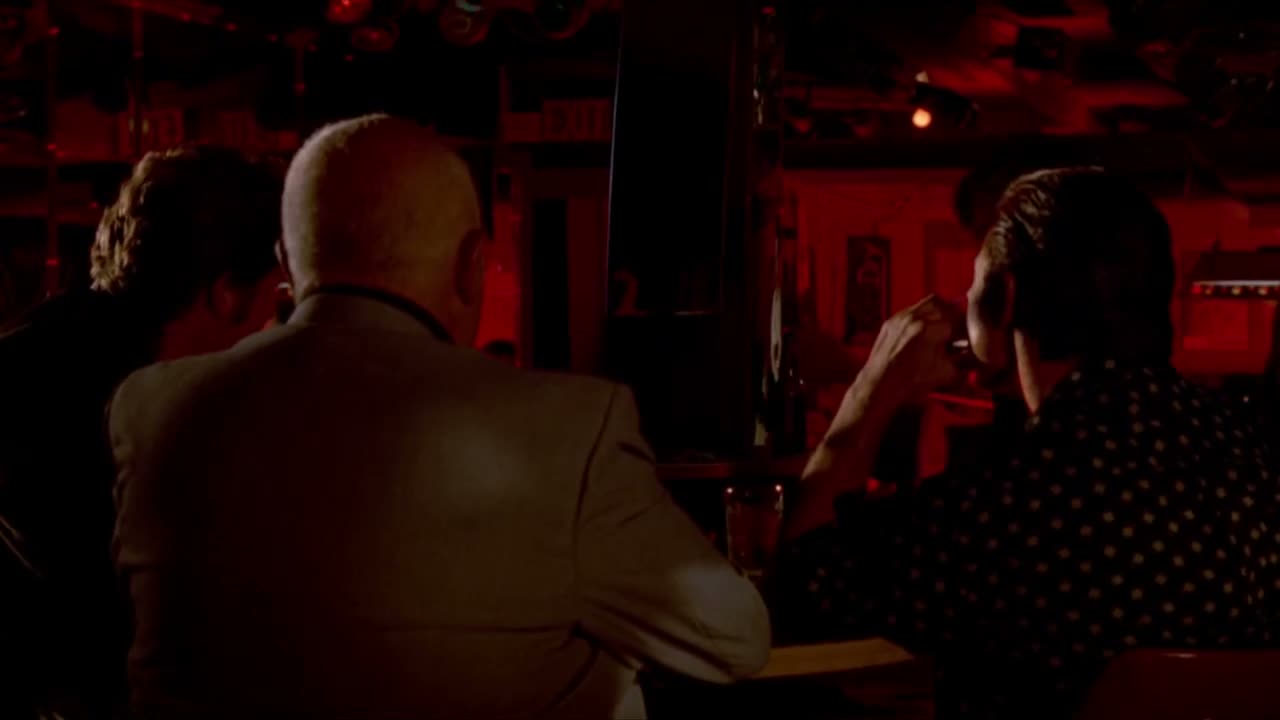
An older officer coaches Freddy on how to survive undercover: be a great actor, be naturalistic, and above all get the details right. 'It's the details that sell your story,' he says, walking him through the men's-room anecdote he has to memorise and make his own.
❝ Monologue · 13 lines The Details Sell the Story
❝ Monologue · 16 lines Freddy's weed-dealing bit
The anecdote drifts into comedy, turning a small errand into a whole cast of callers.
An experienced officer teaches Freddy how to pass as a criminal. He says an undercover cop has to be a great actor and must seem completely natural, because bad acting gets you killed. Then he hands Freddy a story to memorise, telling him the details are what make it believable, and that he must practise it until it sounds like his own.
The scene is a masterclass in lying, and it is delivered as practical advice. The officer's rule is simple: an undercover cop has to be a great actor, because 'bad acting is bullshit in this job.' But his real lesson is about specificity. A story does not become true by being dramatic; it becomes true by being detailed — the paper towels, the doors, the soap — until the listener stops asking questions. 'It's the details that sell your story,' he says, and then explains the method: say it again and again until it belongs to you. The film is showing us the craft behind Freddy's later performance, and it is also quietly telling us how to watch it: the more convincing the detail, the less we should trust the man telling it.
A1–C2 is the CEFR scale. Cards above the level you pick fade, and playback will not auto-pause on them.
“It's the details that sell your story.”
A cleft sentence that pins the whole craft of lying on one word: details.
Neutral
“Because if you ain't a great actor, you're a bad actor, and bad acting is bullshit in this job.”
A blunt either-or that turns undercover work into a survival test with no middle ground.
Informal
“The only way to do that, my brother - keep saying it and saying it and saying it and saying it and saying it.”
Repeating the phrase five times turns sheer drilling into the only method worth trusting.
Informal
“To do this job, you gotta be a great actor.”
To do this job frames the trade, gotta be delivers the rule—short and absolute.
Informal
“This particular story takes place in a men's room, so you gotta know all the details about the men's room.”
takes place fixes the setting, so draws the consequence—detail becomes a logical must.
Neutral
Now the things you gotta remember are the details. It's the details that sell your story. This particular story takes place in a men's room, so you gotta know all the details about the men's room. You gotta know if they got paper towels or a blower to dry your hands with. You gotta know if the stalls ain't got no doors or not, man. You gotta know if they got liquid soap or that pink granulated powdered shit they used to use in high school. You gotta know if they got hot water or not. If it stinks. If some nasty, lowlife, scum-ridden motherfucker, man, sprayed diarrhoea all over one of the bowls. You gotta know every detail there is to know about this commode. So, what you gotta do is take all them details, man, and make them your own. Ohh! And while you're doing that, you gotta remember that this story is about you, and how you perceived the events that went down. The only way to do that, my brother - keep saying it and saying it and saying it and saying it and saying it.
I still had a connection, which was insane cause you couldn't get weed any-fucking-where. Anyway...I had a connection with this hippy chick in Santa Cruz and all my friends knew it. They'd give me a call and they'd say, "Hey, Freddy..." They'd say, "Hey, dude, you getting some? "Can you get some for me too?" Like, they knew I still smoked, so they asked me to buy some for them when I was buying for me. But it got to be... Got to be, got to be... Got to be...every time I bought some weed, I was buying for four or five different fuckin' people. Finally I said, "Fuck this shit! I'm making this bitch rich." She didn't have to do jack shit. She never even had to meet these people. I was doing all the work. But then that got to be a pain in the ass. People calling me all the fuckin' time. I couldn't even rent a fuckin' tape without six fuckin' phone calls interrupting me. "When's the next time you're getting some?" Motherfucker! I'm trying to watch The Lost Boys. "When I get some, I'll let you know." Then these rinky-dink potheads come by - they're my friends and everything, but still, you know?
 Up next · 19snap out of itThe scene: Freddy Tells the Men's Room Story
It is a rehearsed anecdote about a drug deal that Freddy is told to memorise, so he can tell it convincingly if anyone asks how he got into crime.
Because an undercover cop must seem like a criminal at all times, so a bad performance can expose him and get him killed.
It means a convincing story depends on small, specific details, not on big dramatic claims, because details make a lie feel real.
He is told to keep saying the story over and over until it becomes his own and sounds natural.
For this story, everything about the bathroom: whether it has paper towels or a blower, whether the stalls have doors, what kind of soap there is, and so on.