
“It's been such a long time, Mike.”
Why it's great
It acknowledges the years apart without blame, which is why it sounds warm instead of cold.
Register
Neutral
Use it yourself
It's been such a long time since our last trip.
Chapter 10 of 16 · 3'33"
Two late-night phone calls, two very different stakes: Marge trades small talk with an old classmate, while Jerry is cornered by the man he paid to kidnap his own wife. "Blood has been shed, Jerry," the caller says, then raises the price. Jerry clings to "A deal's a deal" — as if words still mean anything.
Jerry Says 'A Deal's a Deal' — and Gets Shut Down
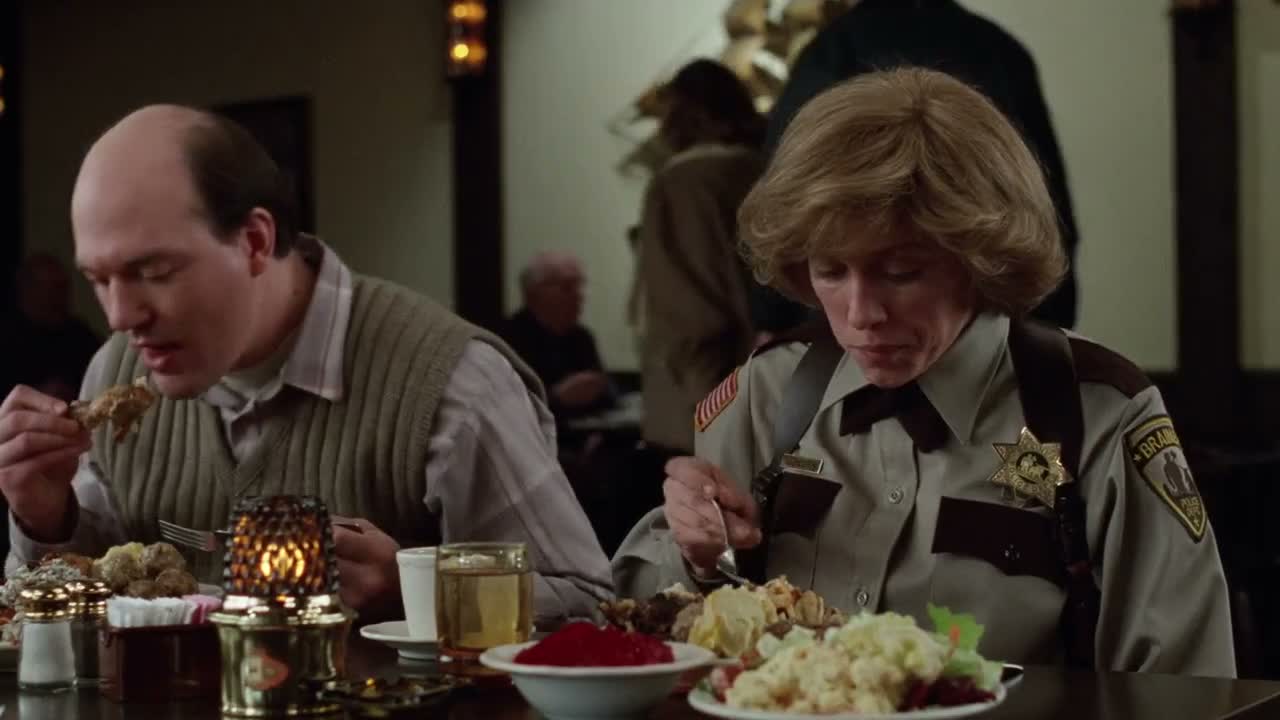
Late at night, Marge Gunderson takes a call from Mike Yanagita, an old classmate who saw her on the news. The film then cuts to Jerry Lundegaard at the car lot, pitching rust-proofing to a customer until a phone call pulls him away — the men he hired to kidnap his wife, calling with new demands.
The two calls sit side by side to show how far Jerry has fallen. Marge's conversation is ordinary and warm — an old friend reaching out, nothing hidden. Jerry's is the opposite: the men on the other end have his wife, three people are dead in Brainerd, and the price of his scheme has just gone up. What makes the scene sting is Jerry's attempt to keep the language of a normal business deal: "Now, we had a deal here. A deal's a deal." The answer he gets — "You ask those three poor souls up in Brainerd if a deal's a deal" — strips the phrase bare. Jerry assumes agreements hold; the caller reminds him that once blood is spilled, contracts mean nothing. His panic is not moral horror but the fear of being squeezed for money he does not have.
A1–C2 is the CEFR scale. Cards above the level you pick fade, and playback will not auto-pause on them.
“It's been such a long time, Mike.”
It acknowledges the years apart without blame, which is why it sounds warm instead of cold.
Neutral
“Blood has been shed, Jerry.”
The passive, almost formal phrasing makes the threat colder than any shout.
Formal
“Now, we had a deal here. A deal's a deal.”
It reduces a whole argument to a flat rule, which is exactly what makes it hard to answer.
Informal
“I'm not gonna debate you, Jerry. I'm not gonna debate!”
Repeating the refusal to argue turns rage into a cold, final line he will not cross.
Informal
 Up next · 11would you happen to knowThe scene: Marge Follows a Name
Because the plan went wrong. Three people were killed in Brainerd, so the men now want a bigger cut and use the murders as leverage: blood has been shed, so the original price no longer stands.
One of the men he hired to kidnap his wife. The caller knows about the Cierra and the deal, and only ever speaks of Jean as leverage, never as a person — enough to mark him as one of Jerry's own hires.
The scene suggests the money. He barely reacts to the deaths and fixates on the deal, insisting "A deal's a deal" and preparing to pay again — his panic is about being squeezed, not about what happened in Brainerd.
It is a legal term for events no one can control, like natural disasters. The caller uses it almost as a joke: he is calling the murders an unavoidable act of God, while really it is blackmail.