
“Don't point a knife at a person unless you want to use it!”
Why it's great
It sounds like a rule of common sense, yet it is really an accusation fired across the table.
Register
Informal
Use it yourself
Don't tease him unless you want to hurt him.
Chapter 7 of 15 · 2'59"
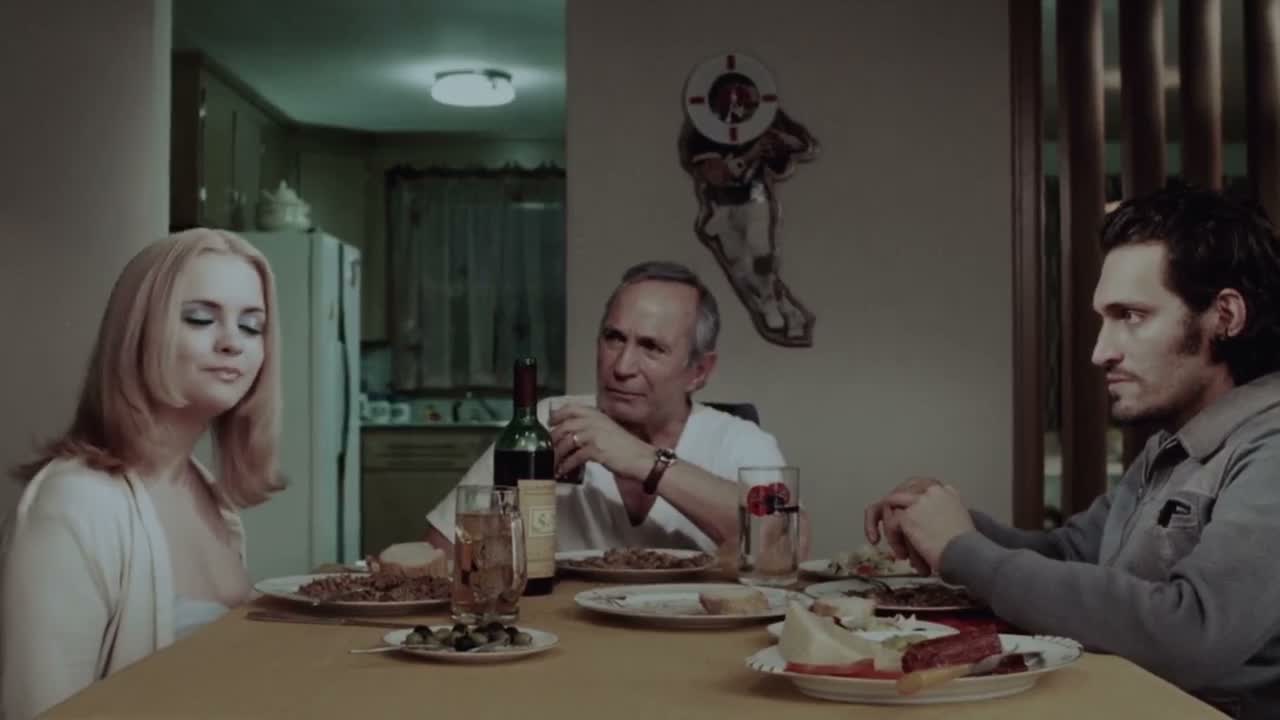
Billy brings his new wife to dinner with his parents, who serve tripe, admire 'the most beautiful voice,' and ask how the couple met. Then a knife on the table sets his father off — "Is that why you came here to stab me with that knife?" — and the meal turns into an accusation.
The Knife Accusation
❝ Monologue · 8 lines the CIA how-we-met story
The details pile up until the lie plays like a little film, and the family buys every frame.
At Billy's parents' house, the family sits down to a plate of tripe. His mother fusses over the food and his 'wife'; his father seethes. When Billy shifts a knife on the table, his father accuses him of pointing it at him, and dinner collapses into an argument. The wife covers the silence with a made-up story about meeting Billy at the CIA.
The table talk never reaches anything real. The mother's attention stays on the food — "I hope you like tripe" — and on smoothing things over, while the father reads a knife resting between them as an attack: "Is that why you came here to stab me with that knife?" When Billy answers with "Yeah, I pointed at you, it's always at you," he turns a petty table accusation into a verdict on their whole relationship. The mother keeps offering more tripe; the father keeps insisting on his meat; neither hears the other. The long CIA story the wife invents is the scene's real joke: the family that cannot see Billy is handed an even more flattering fiction, and swallows it.
A1–C2 is the CEFR scale. Cards above the level you pick fade, and playback will not auto-pause on them.
“Don't point a knife at a person unless you want to use it!”
It sounds like a rule of common sense, yet it is really an accusation fired across the table.
Informal
“Your father does have the most beautiful voice.”
The single emphatic does turns a cold room into a compliment, showing where the mother's loyalty lies.
Neutral
“God forbid I should have a piece of meat, right?”
He wraps real anger in mock piety, making a piece of meat sound like a forbidden luxury.
Informal
“The Italians call it "trippa." It's the intestines of the cow.”
Explaining a dish like a waiter while describing guts is deadpan comedy at its best.
Formal
I was working as a typist for the CIA, ...which is a special part of the government, ...and Billy is a top agent with the CIA. I'm sure you know that. You're probably so proud of him. He has hundreds of people working for him. And all the girls in the office were always telling me... ...how much they were in love with their boss. And of course, I had never seen him. I worked way down on the other side of the building.
 Up next · 08madly in loveThe scene: Billy Bets $10,000 on the Super Bowl
The father sees a knife on the table near Billy and reads it as a threat. It is less about the knife than about his sense that his son has come home hostile, and he escalates at once.
No. The story about working for the CIA is invented for the parents' benefit, a fantasy that makes Billy look important and explains why they supposedly married so fast.
Food is her way of managing the table and avoiding the conflict. By offering tripe and asking after the couple, she keeps the evening on safe ground rather than letting the anger land.
He is being sarcastic. He feels the family treats him as unworthy of good food, so he says the opposite of what he means, turning his complaint into a bitter joke.