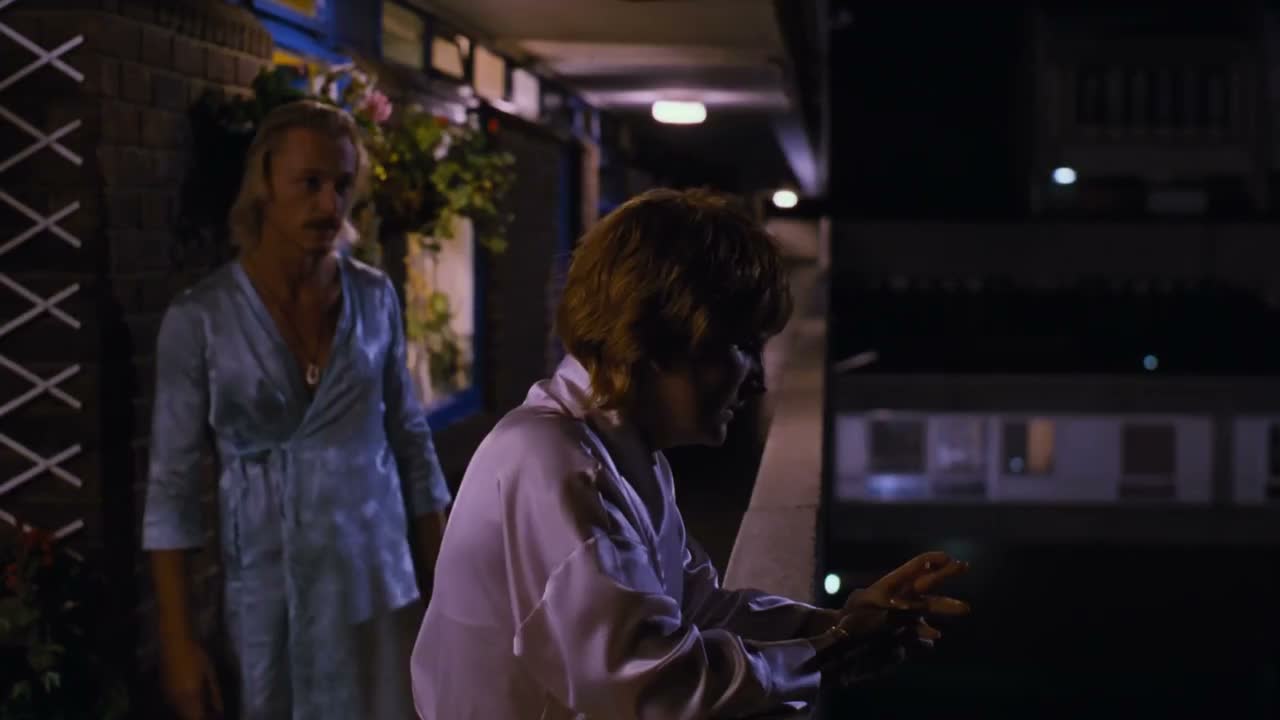
“Because sometimes, Jamie, I can put two and two together and make bloody four.”
She turns a maths idiom into plain arithmetic to say the truth is obvious.
Neutral
Chapter 9 of 11 · 2'53"
It looks like a mother grilling her son about a late night out — "You went to The Gloucester, didn't you?" But the real argument isn't about drinking. Sandra already knows Jamie is gay and is hurt that he lied; Jamie is terrified of saying it out loud. The whole fight circles the one thing neither of them will name.
Sandra Knows About the Gay Bar
Some Things Are Just Hard to Say
Late at night, Sandra waits up for Jamie and checks where he has been. When he is evasive, she says she knows he went to The Gloucester, a gay bar, and that a teacher phoned her about him being bullied. Jamie insists he only went for a drink. They argue about lying, then Jamie admits some things are hard to say, and Sandra says she knows.
Sandra is doing what a parent does when a child stops talking: she works from the outside in. "Someone at work saw you go in," she says, and then the line that gives the scene its sting — "I can put two and two together and make bloody four." She is not trying to trap Jamie; she wants him to trust her with something he can barely say. Jamie's defence is deflection: "I went for a drink. Big deal," and complaints that other kids do worse. Underneath, both are frightened of the same sentence. When Jamie finally offers "Some things are just hard to say," it is the first honest thing either of them says, and Sandra answers, "I know. I know that," which is her way of saying she has already accepted him.
A1–C2 is the CEFR scale. Cards above the level you pick fade, and playback will not auto-pause on them.
“Because sometimes, Jamie, I can put two and two together and make bloody four.”
She turns a maths idiom into plain arithmetic to say the truth is obvious.
Neutral
“Some things are just hard to say.”
Seven plain words hold back everything the boy cannot yet name.
Neutral
“You know a lot about me, don't you?”
A soft question that admits she has read him all along.
Informal
“You think I'm too young. You think it's just a phase.”
Two parallel You think clauses voice the parent's unspoken dismissal, and just a phase names the cliché being rejected.
Informal
Up next · 10fight forThe scene: Leah's Drunk Award SpeechShe puts the clues together: he went to The Gloucester, a gay bar, and someone from work saw him go in. She is not guessing wildly; she is telling him the truth is already obvious to her.
He insists he only went for a drink "with Ste," and says going to the bar does not mean he is gay. He is not inventing a story, but he is withholding the one thing she is asking about, which is why she calls it lying.
The teacher told her that Jamie keeps getting hit at school. Sandra brings it up to show how much she has been kept out of his life, and to push him to tell her what is really going on.
She means she has worked out that Jamie is gay by connecting the things she has seen and heard. It is her way of saying she is not stupid and he does not have to spell it out.
He feels cornered and exposed. He came home expecting to keep his night private, and instead his mother has named the thing he is not ready to say, so he lashes out and tells her to go back to bed.