
“"This is the Zodiac speaking.”
Por qué es buena
A broadcast-style self-introduction that turns a name into a reign of fear.
Registro
Formal
Úsala tú
Hi, this is your new neighbor speaking.
This is your host speaking, live from the studio.
Capítulo 7 de 30 · 4'58"
The Zodiac letter arrives with proof of the taxi killing and a new threat against children. The newsroom's first question is whether any of it can be printed — “Is this on the record?” — while police try to keep the school-bus threat quiet before the story breaks anyway.
❝ Monólogo · 6 frases The Zodiac Letter Read Aloud
The Story Breaks and the City Panics
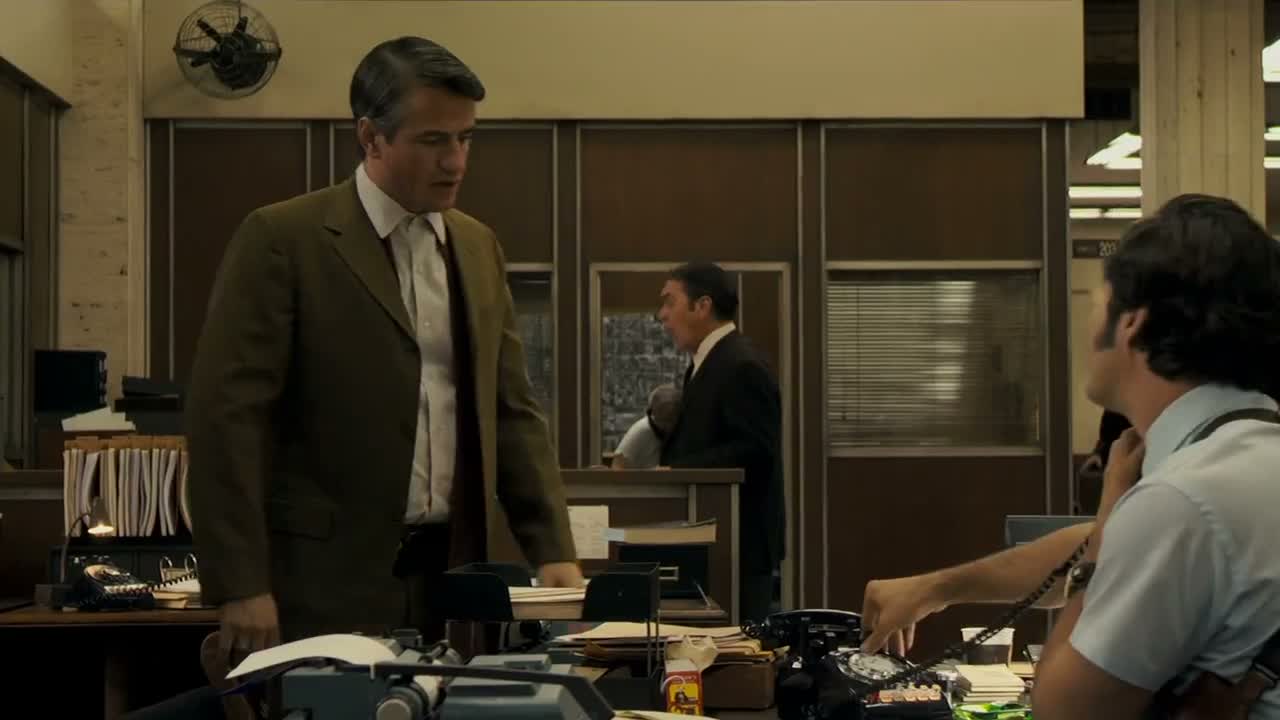
A letter claiming to be from the Zodiac confesses to the murder of a taxi driver, includes a blood-stained scrap of the victim's shirt as proof, and threatens to shoot children on a school bus. Detectives compare handwriting and blood, the newsroom debates what it can publish, and the story finally breaks with a police tip line.
The letter is a performance designed to prove the writer is the Zodiac, and the scene is about how institutions handle that performance. The blood-stained cloth is the price of credibility; the school-bus threat is the lever that forces a response. “Is this on the record?” lays out the newsroom's dilemma in one line: the public wants the truth, and publishing the truth may also spread the threat. The compromise — print the letter but cut the school-bus line, then keep the staff quiet — collapses almost immediately. What the scene really dramatizes is the impossible middle: you cannot both calm a city and keep a killer's promise secret.
A1–C2 es la escala MCER. Las tarjetas por encima del nivel elegido se atenúan y la reproducción no se pausa en ellas.
“"This is the Zodiac speaking.”
A broadcast-style self-introduction that turns a name into a reign of fear.
Formal
“"To prove this, here is a blood-stained piece of his shirt.”
A victim's shirt as a calling card, offered with the calm of a paperwork attachment.
Formal
“"School children make nice targets.”
Children described as good targets—the coldest possible way to announce an atrocity.
Neutral
“"I think I shall wipe out a school bus some morning.”
A massacre announced like a morning errand, and the casual tone is the weapon.
Formal
“It is you waiting in the hall if you speak again.”
A punishment stated as a rule, with a precision that is both strict and funny.
Informal
"This is the Zodiac speaking. "I am the murderer ofthe taxi driver "over by Washington Street and Maple Street last night. "To prove this, here is a blood-stained piece of his shirt. "I am the same man who did in the people in the North BayArea. "The S.F. Police could have caught me last night "if they had searched the park properly "instead of holding road races with their motorcicles."
 Siguiente · 08skip townLa escena: Police Bicker Over the Zodiac Case
He mails a blood-stained piece of the driver's shirt along with the letter, and claims the details match earlier killings. Police then check whether the blood and fabric actually match the taxi driver.
The letter threatens to shoot children on a school bus, and running that detail could set off a city-wide panic. Editors debate printing the confession while cutting the school-bus threat, then quietly drop the plan to hide it.
Fingerprints on the letter could belong to the Zodiac, but they could also come from anyone at the paper who handled it. Taking elimination prints lets investigators set those aside and focus on unknown prints.
It means the information can be officially quoted and printed. When a reporter asks 'Is this on the record?', they are asking whether the source's words can be attributed and published.