
“As soon as I get to the bottom of this, I'll get the next plane.”
Por qué es buena
It sets a condition for leaving, so the whole refusal becomes one cool sentence.
Registro
Neutral
Úsala tú
As soon as I get the keys, I'll text you the address.
Capítulo 7 de 17 · 2'57"
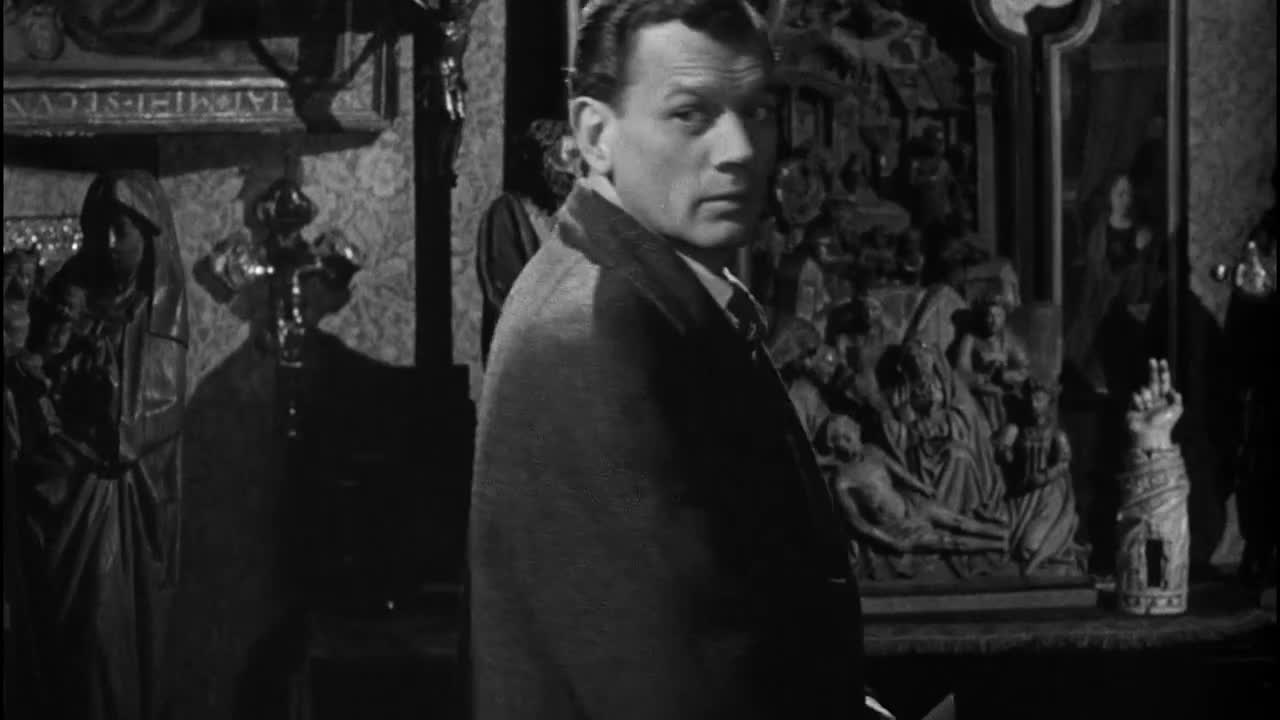
Calloway and Paine search Anna's flat and take her papers and letters. Martins protests on her behalf, but Calloway is unmoved: 'I'm not interested in whether a racketeer like Lime was killed by his friends or by an accident.' The exchange ends with a warning and a piece of gallows humour from Martins.
Calloway Is Done With Harry Lime
Leave Death to the Professionals
Calloway and Sergeant Paine arrive at Anna's flat to confiscate her papers and letters. When Martins objects, Calloway makes clear he does not care how Harry Lime died, only that he is dead. Martins vows to get to the bottom of it, and later learns that Anna's papers are forged.
The scene is a collision of two kinds of certainty. Calloway works by paperwork: he takes the letters because they might matter, hands out receipts, and refuses to be drawn into the mystery — 'I'm not interested in whether a racketeer like Lime was killed by his friends or by an accident.' His line to Martins is a warning wrapped in a proverb: 'Death's at the bottom of everything, Martins. Leave death to the professionals.' Martins answers in the only language he has, the pulp western, asking to reuse the line, and insists he cannot be pushed out because his papers are in order. That confidence is the scene's quiet irony: by the end, Anna's papers turn out to be forged, and the one man sure of his documents is the one whose friend was not what he claimed.
A1–C2 es la escala MCER. Las tarjetas por encima del nivel elegido se atenúan y la reproducción no se pausa en ellas.
“As soon as I get to the bottom of this, I'll get the next plane.”
It sets a condition for leaving, so the whole refusal becomes one cool sentence.
Neutral
“Death's at the bottom of everything, Martins. Leave death to the professionals.”
It flips Martins' own catchphrase into a pun about death and quietly ends the argument.
literary
“I suppose it wouldn't interest you to know that Harry Lime was murdered.”
The polite 'I suppose' makes the accusation more cutting, not softer.
Formal
“I'm not interested in whether a racketeer like Lime was killed by his friends or by an accident.”
Listing both possibilities and dismissing them together shows Calloway's total detachment.
Neutral
“Mind if I use that line in my next western?”
He turns an insult into material, showing a writer's reflex and quiet confidence.
Informal
“You can't chuck me out. My papers are in order.”
The slang and the bureaucratic phrase sit together, and the contrast is the joke.
Neutral
 Siguiente · 08come to the pointLa escena: Martins Questions Dr Winkel
Because they are evidence. Harry wrote them, and anything connected to him might help the police understand what he was involved in, so Calloway has them examined.
Because he sees the search as unfair. He thinks the police are harassing a woman who is already grieving, and he argues they have not even gathered proper evidence against Harry.
Because Lime was a racketeer, so in his view the question of who killed him matters less than the fact that he is gone. Calloway wants the case closed, not solved.
Because she is from Czechoslovakia and fears being handed back to the Russians. The forged identity is her protection, which is why losing the papers puts her in real danger.
It means the police are accustomed to searching people's homes and taking their belongings. Paine compares the job to a doctor's, something done without pleasure but as routine.