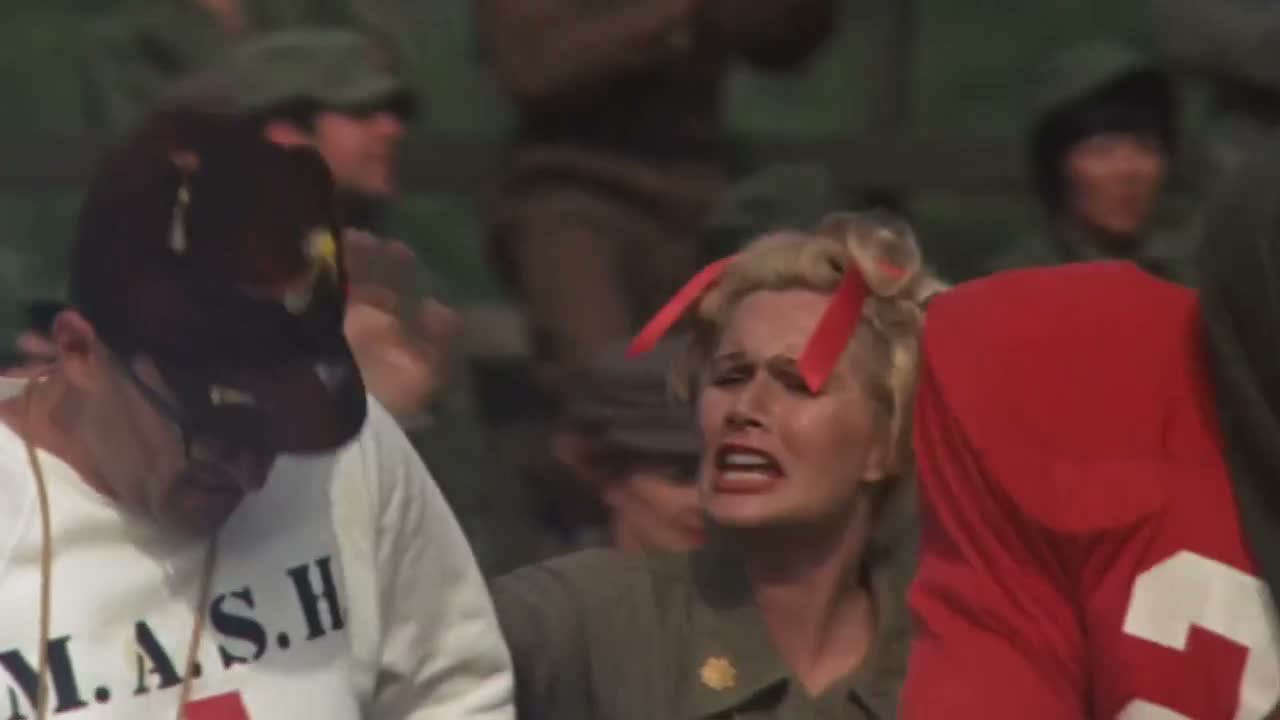
“I remember him from the pros. They call him "Super Bug." Had one year with the Rams before the army.”
It sizes up the opposition in a few offhand words, which is what makes it feel serious.
Informal
Capítulo 19 de 22 · 2'10"
It's a football game, but the real sport is gambling. The camp has money riding on the result, so a routine play becomes a crisis when a lineman ends up carrying the ball. "Judson can't run!" someone yells, and the botched play threatens both the score and the bets.
❝ Monólogo · 4 frases The Camp Scouts the Other Team
At a football game between the MASH unit and another team, the men have big bets on the outcome. Their opponents have a former pro nicknamed "Super Bug," so the plan is to get him off the field. Then the camp's own lineman, Judson, ends up with the ball and falls, blowing the play.
The scene treats a football game as a financial operation. Money is on the line — "We got a lot of money on this game" — so everyone cares about margin as much as winning, which is why the order goes out to "ease up" and not let the score get lopsided. That is a strange instruction in a sport, and it tells you what the game is really for: not glory but the payout. The comedy then comes from a plan collapsing in the simplest way, when a lineman who is not supposed to run ends up with the ball and goes down. His protest — "I'm not a goddamn runner. I'm a lineman." — is the joke and the truth at once. The unit is improvised, unsentimental, and more interested in the bet than the banner.
A1–C2 es la escala MCER. Las tarjetas por encima del nivel elegido se atenúan y la reproducción no se pausa en ellas.
“I remember him from the pros. They call him "Super Bug." Had one year with the Rams before the army.”
It sizes up the opposition in a few offhand words, which is what makes it feel serious.
Informal
“We can't do anything with him in there.”
A flat admission that one player has shut down everything they try.
Informal
“We gotta stick to our strategy. But the first thing you guys have to do is get him out ofthe ball game.”
It states the strategy and then names the real goal, all in the same breath.
Informal
“Let's ease up just a little bit. Uh, we don't want the score too lopsided.”
Said while cheating, it pretends to be sportsmanship and lands as farce.
Informal
“I'm not a goddamn runner. I'm a lineman.”
Two short angry sentences draw the whole joke: the wrong man has the ball.
Informal
“What the hell you think you are, a cannon?”
The cannon image turns a bad play into a joke and a jab at once.
Informal
You gotta come in now. We can't wait till the second half. We gotta stick to our strategy. But the first thing you guys have to do is get him out ofthe ball game. Hey, Davidson. Yeah. Let's ease up just a little bit. Uh, we don't want the score too lopsided.
Siguiente · 20pulled somethingLa escena: Rivals Double the Football BetBecause they have money on the game. The instruction to "ease up" and avoid a lopsided score comes from wanting the bet handled carefully, not from mercy, which is the joke the scene runs on.
An opposing player who used to play professionally and spent a year with the Rams before the army. He is so much better than the camp's players that their whole plan is built around getting him off the field.
A play goes wrong and the ball reaches a lineman, who is not supposed to carry it at all. He tries, falls, and the mistake becomes the comic centerpiece of the first half.
It is the huddle where a football team gathers to call the next play. The phrase is also used loosely for any quick group discussion — getting people "in a huddle" to decide something.
Not really. It is mostly an excuse for gambling, posturing and comedy. The teams and the stakes are treated as low entertainment rather than a serious contest.