
“Four hundred? This is not a track meet, this is a football game!”
Por qué es buena
It defines the farce by contrast, one wrong sport against the right one.
Registro
Informal
Úsala tú
This is not a rehearsal; this is opening night.
Capítulo 20 de 22 · 2'32"
The game turns ugly when the other team injures the star player, and both sides argue about who played dirty. Then the real contest surfaces: a bet offered again at longer odds. "Are you prepared to back that up with odds?" one side asks, and the other answers by doubling the stake.
This Is Not a Track Meet
The Old Knute Rockne
Double the Bet
A football game against a rival unit turns rough when the other team's tactics injure the 4077th's best player, leaving both sides accusing each other of playing dirty. At the end, the argument becomes a wager again, with longer odds demanded and the bet doubled on the spot.
The football game is a proxy for everything else the unit cannot control, and it goes wrong in the usual way: the other side plays dirty and the star man is hurt. What follows is less a sports climax than a negotiation. Both camps accuse each other of cheating — 'You guys pulled something out there' — and then move straight back to the money. The offer to double the bet, and the demand for odds, turns a grudge into a market. The humour is that nobody pretends the game matters for its own sake; it was always a scheme, and losing the ringer only changes the price. The scene ends on a handshake over numbers rather than a final score, which is the film's attitude in miniature.
A1–C2 es la escala MCER. Las tarjetas por encima del nivel elegido se atenúan y la reproducción no se pausa en ellas.
“Four hundred? This is not a track meet, this is a football game!”
It defines the farce by contrast, one wrong sport against the right one.
Informal
“All right, Bub, your fuckin' head is coming right off.”
It turns a threat into a piece of repair work, brutal and absurd at once.
Informal
“Guess I have to give them the old Knute Rockne at halftime.”
Naming the famous coach mocks the very pep talk he is about to give.
Informal
“Mash 'em, smash 'em, kill, kill, kill!”
The chant rhymes its way from sport to slaughter, and the camp's absurdity peaks.
Informal
“What's the matter with him? What's the matter? Hell, you oughta know.”
A pointed reply turns the question back on the asker, exposing the fake innocence.
Informal
“Oh, the hell I don't. We were beating you without him, and we'll go on beating you.”
The double negative answers the challenge and doubles the bravado in one move.
Informal
“Are you prepared to back that up with odds?”
It converts trash talk into a real stake, moving the argument onto money.
Neutral
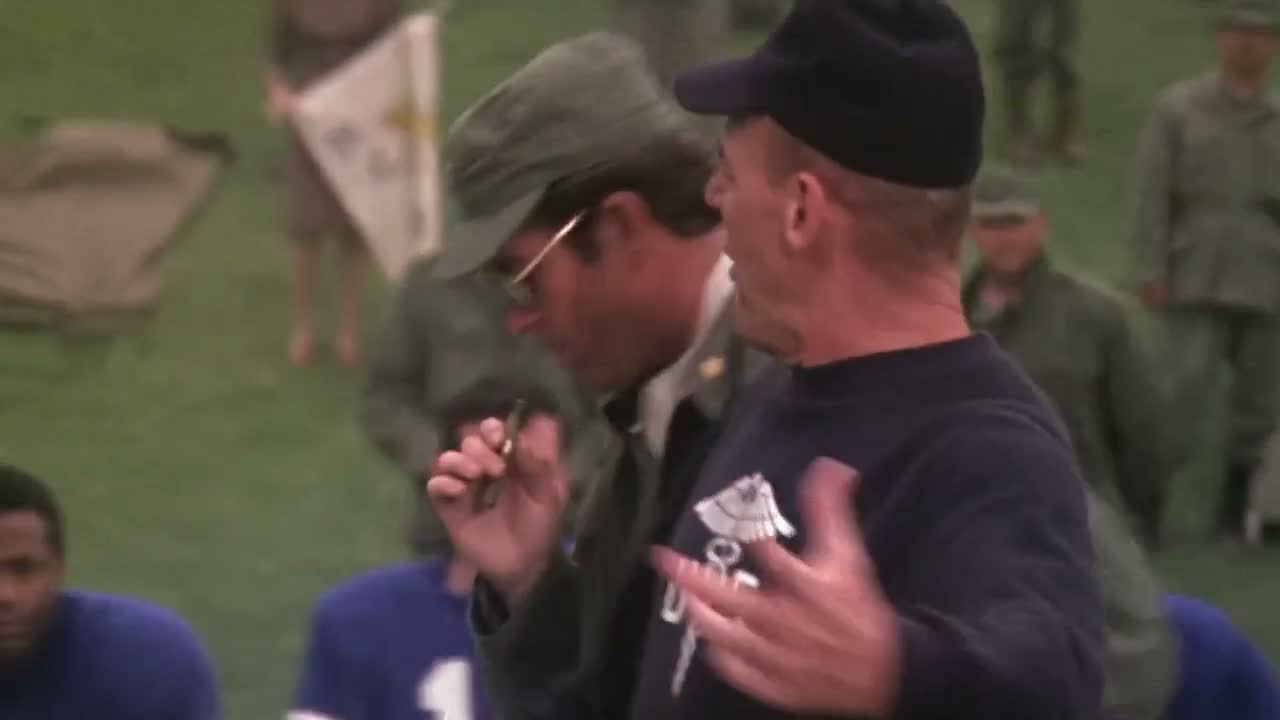 Siguiente · 21an old pro trickLa escena: The Football Game Turns Into a Brawl
The film never shows a fair contest; the rival unit targets the ringer once he starts winning. The injury is treated as deliberate dirty play, which is why the sidelines erupt with accusations of cheating.
It converts a boast into a bet. By offering three-to-one and doubling the stake, the speaker is daring the rival to put money behind his claim that the ringer did not matter. The scene ends on that negotiation.
Not really. It was set up as a gambling scheme, with a ringer transferred in and bets pressed on both sides. The match is a show staged for the wager, which is why the ending is about odds rather than the score.
It is an escape from the war, a project to pour energy and money into. The same impulse that filled a bet and a transfer request shows the men inventing stakes and rules of their own, separate from the army's.