
“I knew the story before he told me.”
Por qué es buena
He had the story before it was told; nothing here is news to him.
Registro
Neutral
Úsala tú
I knew the news before she announced it.
I knew the ending before he finished the story.
Capítulo 8 de 19 · 2'29"
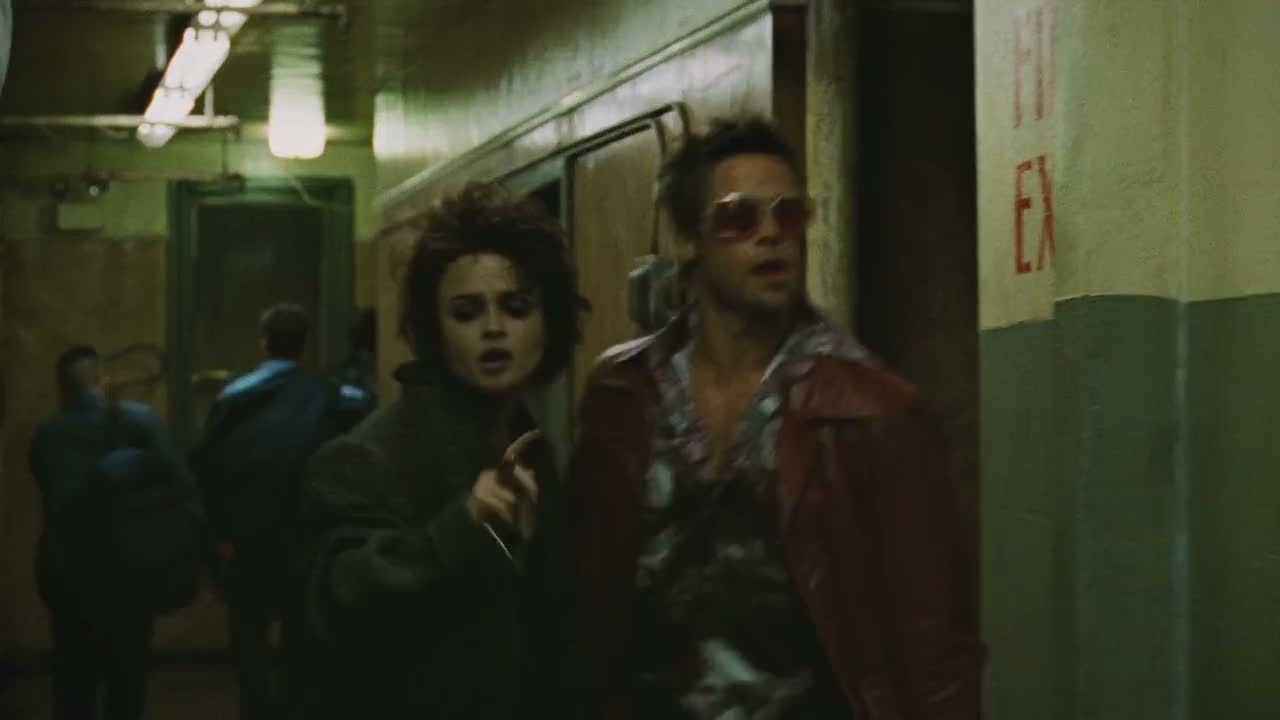
The Narrator notices that Tyler's door is closed for the first time in two months, and somewhere in the house someone is dying. A voice narrates the death like a nature documentary — "Have you ever heard a death rattle before?" — while a countdown runs. Under the comedy, the question he cannot answer is why Tyler cares at all.
❝ Monólogo · 5 frases The Death Rattle Countdown
The Narrator comes home and finds Tyler's door shut for the first time in two months. Inside the house, Marla Singer is dying, the phone is off the hook, and someone is counting down as if narrating a death. The Narrator is less shocked by the death than by Tyler's reaction to it.
The scene plays the death as a comedy routine, and the joke is the narrator's own detachment. He notes a closed door as if it were an omen, then describes the sounds of dying with the calm of a host: "Have you ever heard a death rattle before?" Even the countdown — "Prepare to evacuate soul" — treats a dying friend as a spectacle. But the line that matters is the one he cannot joke away: "How could Tyler, of all people, think it was a bad thing that Marla Singer was about to die?" For the Narrator, Tyler is the man who celebrates destruction, so caring about Marla does not fit the picture. What unsettles him is not that someone might die but that Tyler's reaction breaks the rule he has built around him. The closed door is the first sign that the Tyler he thinks he knows is not the whole story.
A1–C2 es la escala MCER. Las tarjetas por encima del nivel elegido se atenúan y la reproducción no se pausa en ellas.
“I knew the story before he told me.”
He had the story before it was told; nothing here is news to him.
Neutral
“Have you ever heard a death rattle before?”
Death offered as an experience to tick off; the calm is the horror.
Neutral
“Do you think it'll live up to its name?”
Death rated like a show against its title; the flippancy is the point.
Informal
“I'd been here for two months and his door was never closed.”
One door, closed for the first time in two months: abnormality without explanation.
Neutral
“I can hardly believe anything from last night.”
Disbelief stretched over a whole night; the flat tone sells the chaos.
Neutral
Have you ever heard a death rattle before? Do you think it'll live up to its name? Or will it just be a death hairball? Prepare to evacuate soul. Ten, nine, eight...
 Siguiente · 09posing as a house petLa escena: Tyler Warns Jack About Marla
Because in two months it never has been. The closed door breaks a pattern he has come to rely on, so it reads as a sign that Tyler is doing something he wants hidden.
She is dying from a drug overdose. The phone is off the hook, someone is counting down as she fades, and the Narrator is shocked that Tyler seems to care.
Because Tyler is the one who preaches self-destruction and mocks self-improvement. For him to treat her death as a bad thing does not fit the role the Narrator has given him.
One of the people in the room narrates the death like a countdown, from ten down to three, treating the moment as a performance until it is interrupted.
Because the situation has escalated out of control. The mention of the police marks the point where the private chaos of the house becomes something the outside world has to deal with.