
“You don't need me to tell you that marriage is a novel, not a short story.”
Por qué es buena
Marriage as a long novel, not a short story: a whole philosophy of time in one image.
Registro
literary
Úsala tú
Parenting is a novel, not a short story.
Capítulo 9 de 18 · 1'37"
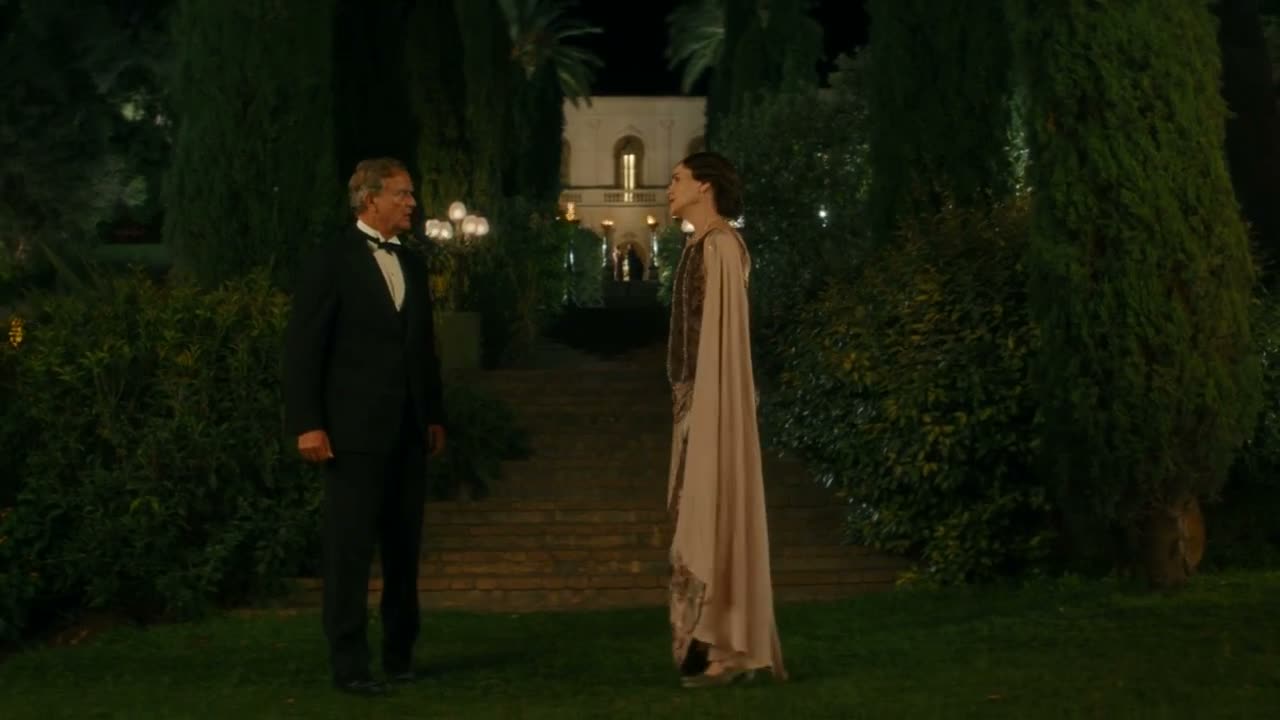
Late at night, Mary tells Jack Barber about the two men she married: the first killed in a crash the day their son was born, the second steady and practical. When he suggests trouble in paradise, she answers with a line of her own: "marriage is a novel, not a short story."
❝ Monólogo · 4 frases How she talks about Henry
Pragmatic, endurance, workmate: she turns romance into the day’s work and still leaves a door ajar.
Mary Explains Why Marriage Is a Novel
After dinner at Downton, Mary and the film director Jack Barber fall into a quiet conversation about marriage. Mary describes her first husband, killed in a car accident on the day their son George was born, and her second, the practical Henry. Barber asks whether there is trouble in paradise, and Mary explains her view of marriage as a long story.
The scene is a quiet confession dressed as small talk. Mary has already buried one husband and settled into another, and she measures them without sentiment: the first was romantic and full of dreams, the second is "much more pragmatic." When Barber asks "But there's trouble in paradise?" she does not deny it, and instead offers her theory that marriage "is a novel, not a short story," full of plot twists. The exchange matters because it lets Mary speak plainly about a life the house usually keeps buttoned up, and because Barber, an outsider from the film world, is the one who draws it out by asking what love has to do with it. Her sharp reply, that he sounds like a film man, puts the intimacy back behind the door.
A1–C2 es la escala MCER. Las tarjetas por encima del nivel elegido se atenúan y la reproducción no se pausa en ellas.
“You don't need me to tell you that marriage is a novel, not a short story.”
Marriage as a long novel, not a short story: a whole philosophy of time in one image.
literary
“Suppose it comes down to whether or not you love him.”
Everything reduced, gently, to a single yes-or-no: do you love him.
Neutral
“Moral, strong, full of dreams, determined to do his bit.”
A portrait built from four fragments: virtue, strength, dreams, duty.
literary
“Although I sometimes wonder what life would've made of him if he'd lived.”
Grief as a counterfactual: not what he did, but what life would have made of him.
literary
“As handsome as a prince in a fairy tale.”
A fairy-tale yardstick for beauty: comparison that keeps the beloved young forever.
literary
Oh, Henry's much more pragmatic. There are no dreams about him. He's a doer. And he must test his powers of endurance from morning till night. But he's a good workmate.
 Siguiente · 10more than capableLa escena: Robert Learns Cora Is Ill
Matthew Crawley, who was killed in a car accident on the day their son George was born.
She calls him much more pragmatic than her first husband, a doer with no dreams about him.
She means a marriage runs long and is full of plot twists, so trouble along the way does not define the whole of it.
Because he answers her marriage troubles with a neat romantic line, as if life were a screenplay.