
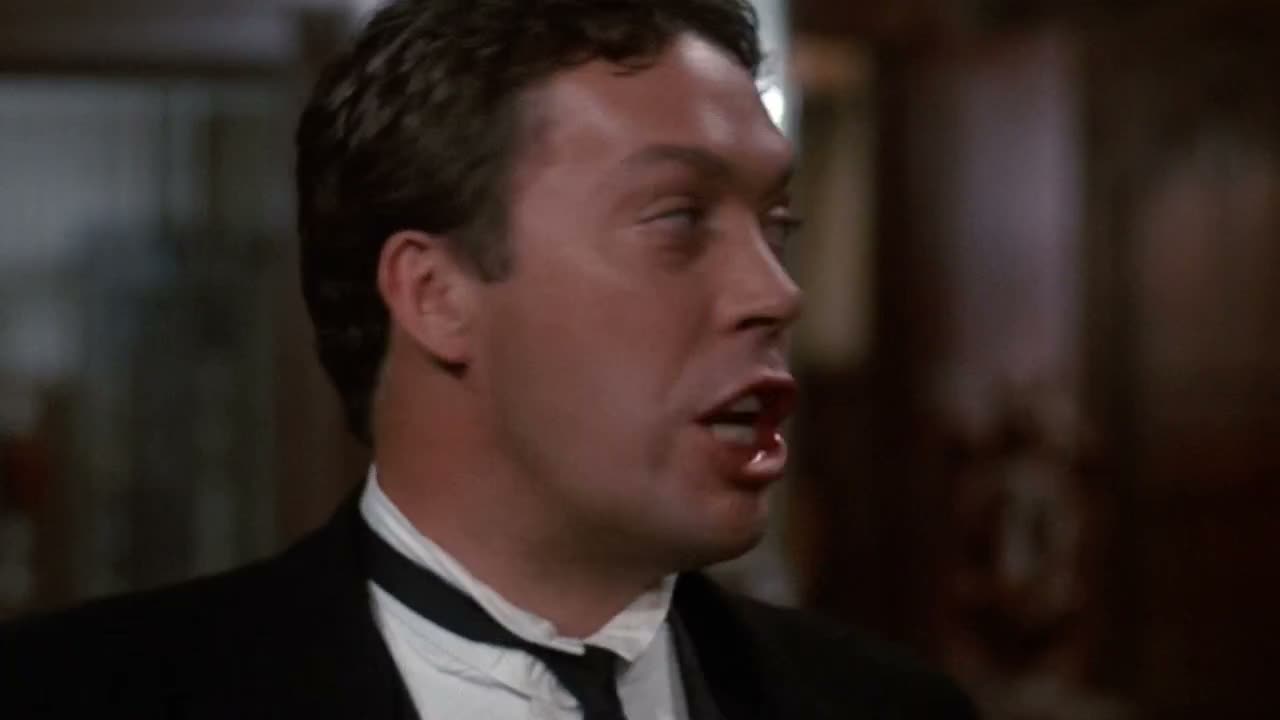
“But that doesn't make me a murderer.”
Por qué es buena
He owns the scandal but draws a hard line between a motive and the act itself.
Registro
Neutral
Úsala tú
Owning a gun doesn't make me a criminal.
Capítulo 15 de 17 · 3'01"
Wadsworth walks the room through the night's killings, and every detail quietly exposes a guest's secret: "He was on my payroll." The recap isn't just about who died — it's a trap closing around one person who was never with the group.
The Guests Confess Their Secrets
The Preacher at the Door
In the mansion's lounge, Wadsworth gathers the guests and reconstructs the whole night. He explains why each victim died — they were all linked to Mr. Boddy — then traces how the murderer stole the key, took a weapon and moved through the house, ending with the doorbell and three more deaths. Finally he names the one person who wasn't with them: Yvette.
Wadsworth isn't just tidying up loose ends — he's cornering everyone. The faster he names who slept with whom, who bribed whom, the clearer it becomes that the secrets themselves are the weapon. "Whoever killed Mr. Boddy also wanted his accomplices dead," he says, which reframes the whole night: the victims weren't random, they were Mr. Boddy's informants, and each one could have exposed a guest. The guests keep interrupting to defend themselves — "But that doesn't make me a murderer" — because they realize the recap is really a lineup. When Wadsworth ends on "The one person who wasn't with us," the room has already been sorted into suspects and alibis; only Yvette has none.
A1–C2 es la escala MCER. Las tarjetas por encima del nivel elegido se atenúan y la reproducción no se pausa en ellas.
“But that doesn't make me a murderer.”
He owns the scandal but draws a hard line between a motive and the act itself.
Neutral
“Whoever killed Mr. Boddy also wanted his accomplices dead.”
It ties both sets of killings into one plan: the blackmailer and everyone who knew him.
Neutral
“I got news for you. It's already here.”
One flat sentence flips the prophecy: the disaster the preacher warns about is already happening.
Informal
“Good evening. Have you ever given any thought to the kingdom of heaven?”
The most ill-timed greeting possible lands in the middle of a murder and turns absurd.
Formal
 Siguiente · 16a red herringLa escena: Wadsworth Reveals He's the Killer
Wadsworth explains that the killer wanted Boddy's whole network of informants dead, so no one left alive could reveal the secrets each one had gathered.
It's an old American saying. "You ain't just whistling Dixie" means someone isn't talking nonsense — they're absolutely right, which is why the guest agrees with the warning.
Wadsworth points to Yvette, the maid, as the only one unaccounted for during the murders — the same person he names when the recap ends.
No. It held photos and letters proving Boddy's informant network, and the murderer burned it — "Perhaps in the fire," Wadsworth guesses, since the study fireplace is the only place it could have gone.