
“Even Nazis can't kill that fast.”
Por qué es buena
It answers a death threat with arithmetic, turning terror into something merely too slow.
Registro
Neutral
Úsala tú
Even the best team can't ship that fast without cutting corners.
Capítulo 9 de 20 · 3'04"
On the surface it's a visa negotiation: give up the underground network and leave for Lisbon. Underneath, it's Strasser testing whether Laszlo can be bought with the one thing he wants. Laszlo answers with a line about men rising to replace him: "Even Nazis can't kill that fast."
❝ Monólogo · 4 frases Laszlo Refuses to Sell Out the Resistance
Strasser Reveals Ugarte Is Dead
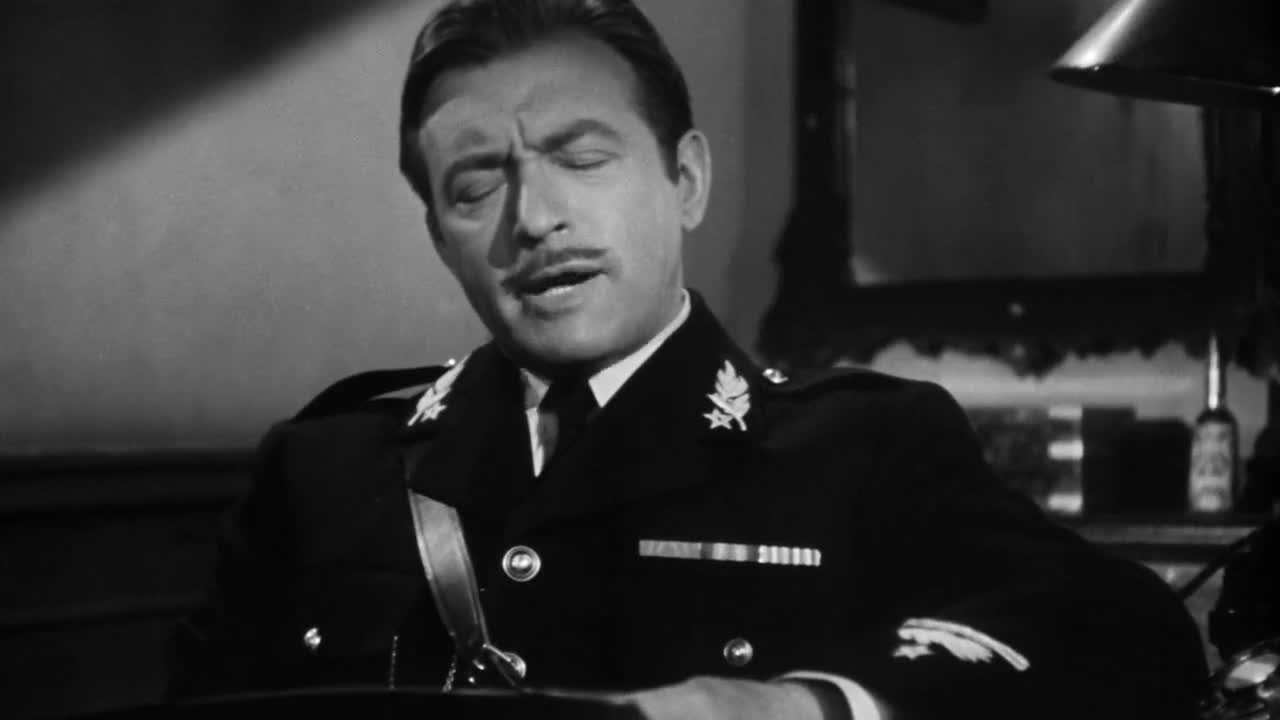
Major Strasser and Captain Renault first discuss whether Rick has the stolen letters of transit, then bring Laszlo and Ilsa in. Strasser sets a price: the names of resistance leaders in exchange for a visa. Laszlo refuses, arguing that others will rise to replace him.
Strasser thinks he's offering a trade, but what he's really offering is Laszlo's own surrender, priced in other people's lives. He opens with the visa and the promise of Lisbon, then adds that Renault's signature is needed on every document, making the offer sound almost routine. Laszlo's refusal isn't just bravery; it's a claim about how resistance works — leaders are replaceable, and killing them only proves it. He reminds Strasser he said nothing in a concentration camp, where the methods were worse. His line "Even Nazis can't kill that fast" turns the threat back on him, which is why Strasser shifts from bargaining to menace and hints at an 'accident' on the way to escape. Renault, meanwhile, keeps the talk polite, and the news that Ugarte is dead is delivered as small talk.
A1–C2 es la escala MCER. Las tarjetas por encima del nivel elegido se atenúan y la reproducción no se pausa en ellas.
“Even Nazis can't kill that fast.”
It answers a death threat with arithmetic, turning terror into something merely too slow.
Neutral
“From every corner of Europe, hundreds, thousands would rise to take our places.”
It widens one man's death into a continent-wide movement that no execution can stop.
literary
“Strange. Nobody's supposed to sleep well in Casablanca.”
A polite remark about sleep quietly indicts the whole city as a place of worry.
Neutral
“You would find the conversation a trifle one-sided.”
Polite understatement for talking to a dead man: the wit is in how little he raises his voice.
Formal
And what if you track down these men and kill them? What if you murdered all of us? From every corner of Europe, hundreds, thousands would rise to take our places. Even Nazis can't kill that fast.
 Siguiente · 10take someone into your confidenceLa escena: Ferrari Offers to Handle the Letters
It's bait. If Laszlo gives up the names of resistance leaders, the Nazis get the network, and Laszlo gets out of Casablanca — a trade that costs him everything he fights for.
He already refused in a concentration camp, where the pressure was worse, and he won't trade other people's lives for his own freedom now. His point is that the movement survives its leaders.
It means replacements will always outnumber the killings. Strasser can murder the leaders, but the resistance keeps refilling, so the murders won't achieve what he wants.
Because the deal failed. Switching to the idea of an 'accident' during an escape is his way of saying the Reich will get what it wants whether or not Laszlo cooperates.
Strasser reveals that Ugarte is dead. The line lands as both a threat and a warning to Laszlo: the man who could have helped him is gone, so his options are shrinking.