
“...and the prevailing wind happens to be from Vichy.”
Por qué es buena
It admits a loyalty by blaming the wind, so the confession never quite becomes one.
Registro
Neutral
Úsala tú
The prevailing wind here happens to be from the boss's office.
Capítulo 12 de 20 · 3'04"
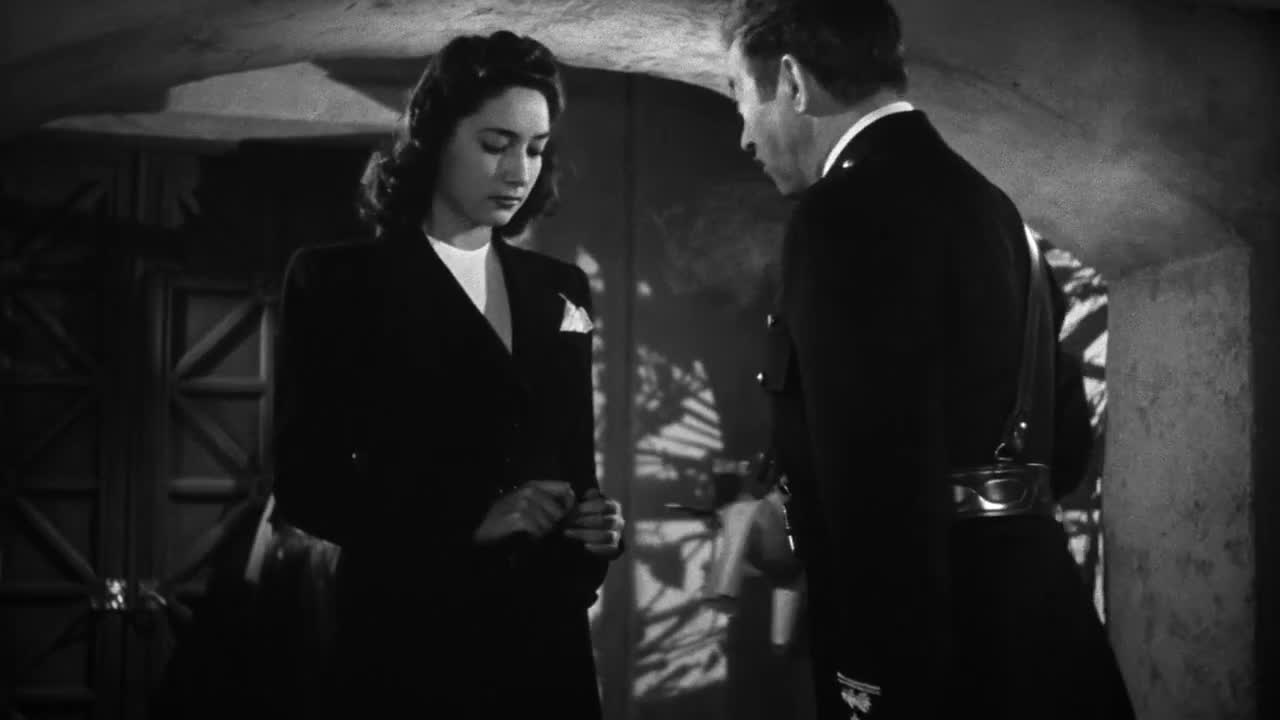
On the surface it's a status report: Strasser tells Renault the city is not under control. Underneath, it's two men revealing what they really are — Strasser worried about a prisoner, Renault cheerfully admitting, "I blow with the wind." The scene ends on the question of what to do with Laszlo.
Renault Admits He Has No Convictions
The Leuchtags Practice English for America
At Rick's café, Renault teases Rick about drinking his own stock and asks about the letters of transit; Rick turns the question back on him. Later, Strasser presses Renault about the unrest in Casablanca, and Renault admits he has no convictions. The scene closes with Carl serving a German couple bound for America.
Renault is the film's weather vane, and he says so out loud: "I have no conviction, if that's what you mean." That honesty isn't weakness to him, it's survival — he tells Strasser exactly how he operates and lets the German decide what to do with it. Strasser, meanwhile, has done the math on Laszlo and reached a dead end: keeping him stirs up the city, and releasing him exports the problem. The last beat, with the Leuchtags cheerfully butchering English on their way to America, quietly answers them both: for refugees, direction matters more than conviction.
A1–C2 es la escala MCER. Las tarjetas por encima del nivel elegido se atenúan y la reproducción no se pausa en ellas.
“...and the prevailing wind happens to be from Vichy.”
It admits a loyalty by blaming the wind, so the confession never quite becomes one.
Neutral
“It's too dangerous to let him go, it may be too dangerous to let him stay.”
One repeated word closes both exits, so the sentence quietly sentences the man.
Formal
“You will get along beautifully in America.”
A soft blessing hiding a goodbye: the plainer the words, the heavier they land.
Neutral
“I don't like disturbances in my place. Either lay off politics or get out.”
Two blunt options set the house rule: no politics, or the door.
Informal
 Siguiente · 13by the throatLa escena: Annina Asks Rick About Renault
He's saying he has no fixed loyalties and sides with whoever is winning. Right now the wind is from Vichy, so that's the government he serves — without pretending it's about principle.
Either way helps the resistance: if Laszlo stays he rallies support in Casablanca, and if he leaves he keeps leading the network elsewhere. Strasser can't find an option that removes the threat.
He wants the café to stay neutral. Telling the men to 'lay off politics or get out' keeps his business out of the war and protects the mixed crowd of locals, refugees, and officers he serves.
The German couple are practicing English before emigrating, and they mangle it cheerfully. Their scene puts a human, hopeful face on the refugees everyone else is arguing about as a political problem.
He suspects Rick is holding them, so he asks directly. When Rick fires back with 'are you Pro-Vichy or Free French?', Renault drops it rather than answer his own question.