
“I was really sorry to hear it.”
Por qué es buena
The standard condolence line, warm without overstepping.
Registro
Neutral
Úsala tú
I was really sorry to hear about your father.
Capítulo 1 de 18 · 2'10"
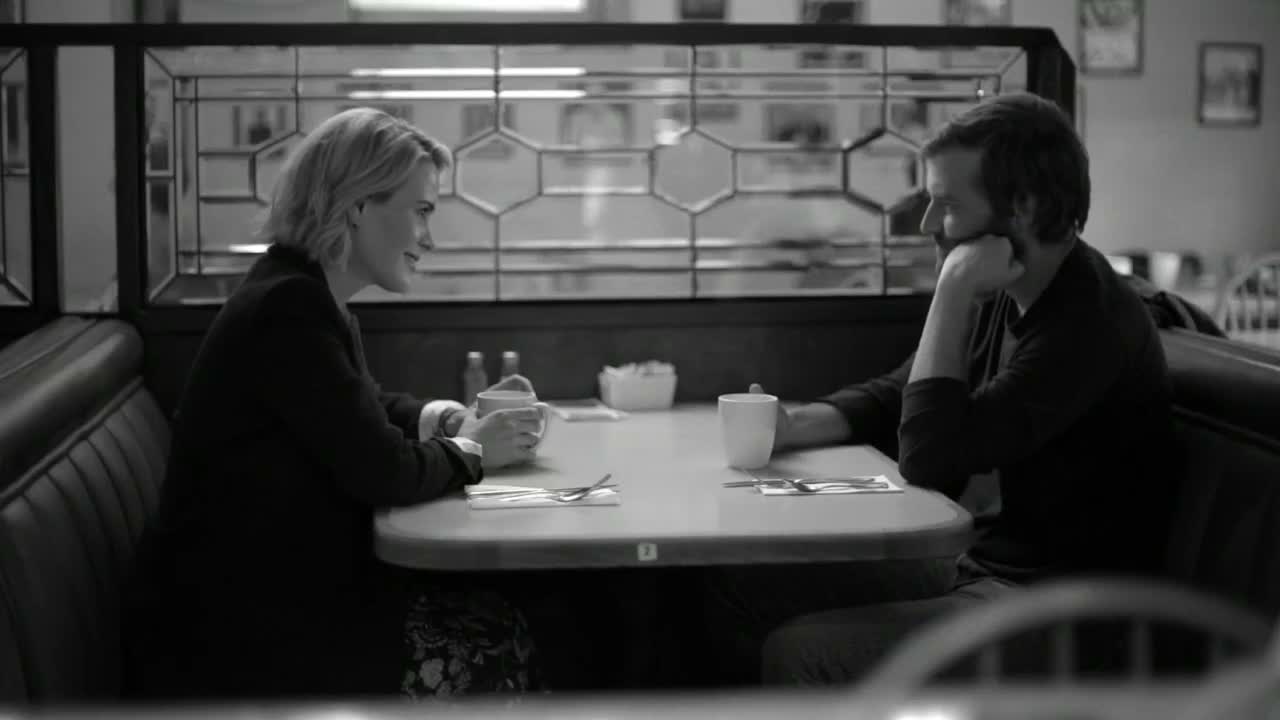
Two old flames catch up over coffee, but nothing lands plainly: one offers 'I was really sorry to hear it,' the other answers with a mother's illness and a house being emptied out. Every topic — drywall, Tucson, a sister's baby — is a way of asking what the other's life became without them.
❝ Monólogo · 5 frases The Drywall Speech: Steady, Consistent, Not Boring
Tucson, Warm Weather, and I Dig It
Jim and Amanda, once a couple, meet years later in a coffee shop. The talk opens on a death in the family and the house being cleared out, then drifts to work — drywall, odd jobs after Katrina — and to Tucson's warm climate. A question about marriage gets the reply, 'Married to the work,' and the tease 'Married to the dry wall?'
Reunion scenes run on what people won't say directly, and this one is built out of polite deflections. The condolences — 'I was really sorry to hear it' — are answered with logistics: a long illness, a house being emptied, plans to fix it up and maybe sell. Death is handled by talking about property. The same move repeats when the conversation turns to work: instead of saying a life went one way and another stayed put, they trade inventory — drywall, Katrina, Tucson, a sister's baby. The one line that comes closest to the truth is 'Married to the work,' and even that gets laughed off with 'Married to the dry wall?' Nothing here is cruel; it's two people being careful. Every light detail about warm weather and steady jobs is also an answer to the unasked question of whether either of them ended up where they meant to.
A1–C2 es la escala MCER. Las tarjetas por encima del nivel elegido se atenúan y la reproducción no se pausa en ellas.
“I was really sorry to hear it.”
The standard condolence line, warm without overstepping.
Neutral
“I do... I mostly do the dry wall stuff.”
He names his trade lightly, and that makes it sound solid.
Informal
“Yeah. It's good. It's steady and it's consistent.”
Two plain adjectives make an ordinary job sound dependable.
Neutral
“It's not boring. It's not boring.”
Saying it twice is a gentle way to refuse his self-mockery.
Neutral
“I end up in tuscon and it's great.”
End up sums up a drifting life in one offhand line.
Informal
“Really nice, warm climate and I dig it.”
Dig makes liking something sound easy and a little retro.
Informal
“Yeah. That's the grand parent pressure.”
A joke that carries the weight of family expectations.
Informal
I do... I mostly do the dry wall stuff. Uncle John runs the business, so I got caught up with him, like... You know, we did a bunch of work. In New Orleans after Katrina and then... It's boring as shit but...
Blue Jay: tu progreso
Capítulo 1 de 18 · quedan unos 47 min
 Siguiente · 02footloose and fancy freeLa escena: Jim Reunites with Amanda
They were together years ago and have run into each other back in their hometown. This coffee is their first real conversation since, and both are sizing up how the other's life turned out.
A parent has died after a long illness, so the family is emptying the house, thinking about fixing it up, and possibly selling it.
It means to like or enjoy something, older slang. Here it means the warm climate in Tucson suits them and they're happy there.
When asked whether they've married, the reply dodges with a joke: they're committed to their job instead. The other turns it into 'Married to the dry wall?'
One describes the work as 'boring as shit,' and the other pushes right back — 'It's not boring. It's not boring.' It is a small kindness: refusing to let the other write off their own life.