
“But we're not so smart when we're young.”
Por qué es buena
It forgives a childhood act with a truth everyone shares.
Registro
Neutral
Úsala tú
We're not so wise when we're young and eager.
Capítulo 5 de 13 · 3'55"
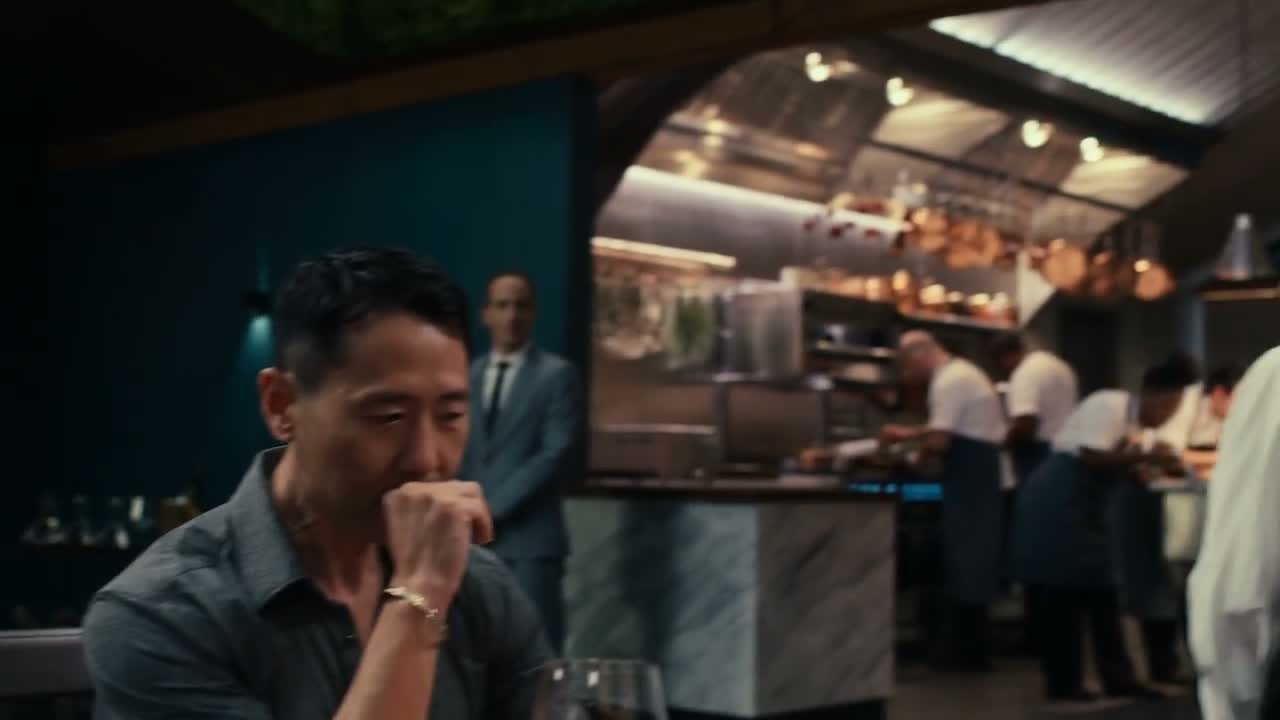
Over the course called Memory, the chef shares a childhood story about his drunken father strangling his mother with a phone cord, and serves it like a taco-night anecdote. "But we're not so smart when we're young," he says. Then the guests find their own faces lasered into the tortillas.
The Chef Recounts His Darkest Memory
The chef announces the next course, Memory, at his restaurant Hawthorn. To illustrate it, he tells the room about growing up in Waterloo, Iowa, where Tuesdays were taco nights. One such night, when he was seven, his drunken father choked his mother with a telephone cord, and the boy stabbed him in the thigh with kitchen scissors. Then the tacos arrive, each tortilla laser-engraved with a guest's photograph.
The horror of the story is not just its content but its delivery. The chef narrates his parents' violence in the same calm register he uses to describe a recipe, and the punchline is a threat: "Now I suppose I should've stabbed him in the throat that evening." The guests respond with nervous laughter, some calling it a dark sense of humor, one calling it a "backstory to what makes him a chef artist." Then the tortillas turn the joke back on them: the pictures are of the guests, taken without their knowledge, including shots of Tyler photographing his food that very night. What looked like an eccentric dinner becomes surveillance, and the phrase "evokes strong memories for us all" no longer sounds warm.
A1–C2 es la escala MCER. Las tarjetas por encima del nivel elegido se atenúan y la reproducción no se pausa en ellas.
“But we're not so smart when we're young.”
It forgives a childhood act with a truth everyone shares.
Neutral
“Anyways, because we're always innovating and we fear irrelevance”
It admits the real engine of change is the fear of becoming obsolete.
Formal
“We hope this taco night evokes strong memories for us all.”
The gentle phrasing carries a cruel payload, and the gap is the point.
Formal
“Now I suppose I should've stabbed him in the throat that evening.”
A casual now I suppose introduces a murderous regret, and the calm tone is what makes it terrifying.
Informal
 Siguiente · 06plausible deniabilityLa escena: Tortillas Expose EchoBrite's Crimes
He presents it as the memory behind the course, but he also uses it to unsettle the guests: he narrates real violence the way others narrate a family recipe, then jokes about finishing the job. The story is meant to make them laugh and squirm at once.
He says he only stabbed him in the thigh as a boy, and that he should have gone further. Nothing in the scene confirms what happened to the father afterwards, so the guests are left guessing.
The course is called Memory, and the chef has been documenting the guests himself. The images, including Tyler's photos from that night, show that nothing they do goes unseen — the joke is really surveillance.
Because he tells a story about his father strangling his mother and his own stabbing as if it were a warm favorite anecdote. Laughing at it is what he seems to want, which is exactly what makes it uncomfortable.