
“You should open your mouth a little wider when you speak.”
Why it's great
A polite tip that is really a pointed insult, delivered with a straight face.
Register
Neutral
Use it yourself
You should close your mouth a little more when you chew.
Chapter 17 of 18 · 2'42"
Wonka demonstrates Wonkavision by sending a chocolate bar across the room, where it arrives smaller but real. When he admits the machine might work on people with messy results, Mike jumps in and sends himself anyway. Mrs. Teevee is horrified by what comes out. "He's completely unharmed."
The Chocolate Bar Arrives
Mike Sent by Television
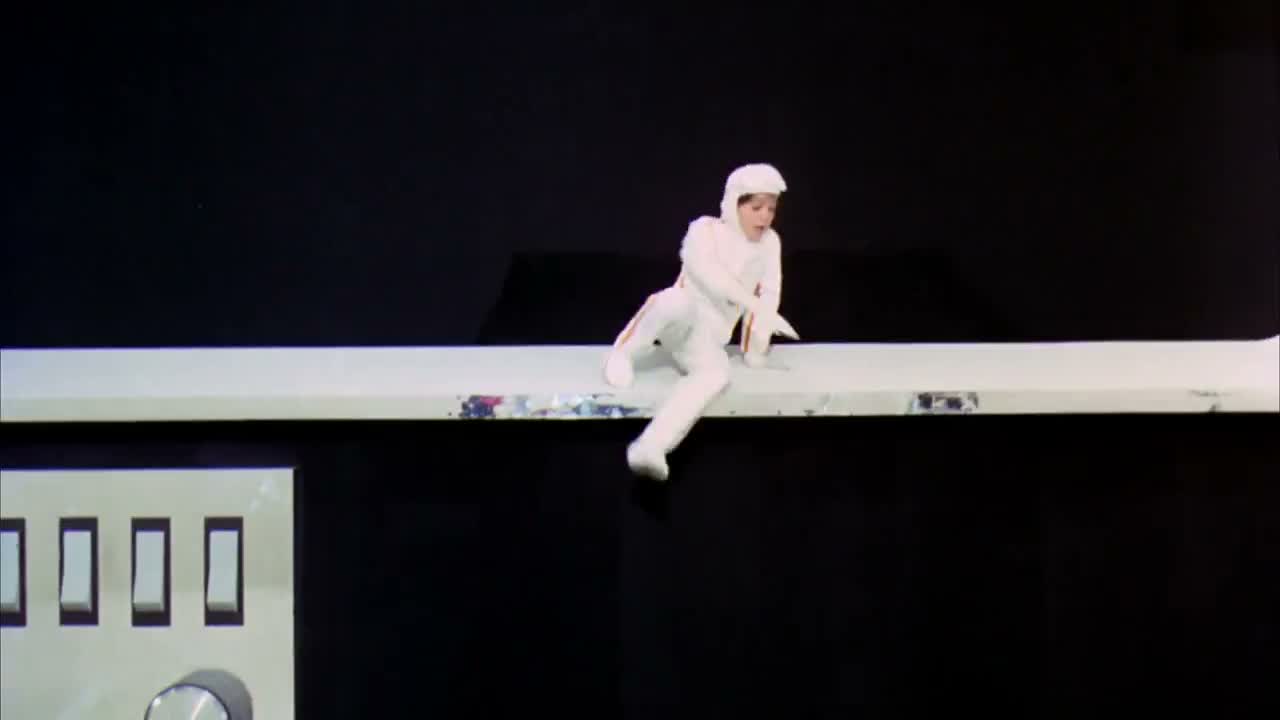
Willy Wonka shows the group Wonkavision, a machine that sends objects through television, and demonstrates it with a bar of chocolate that arrives smaller at the other end. He admits it might have messy results on people. Mike Teevee ignores the warning, steps into the machine, and is sent through the air, arriving as a tiny version of himself. Wonka calls him unharmed.
Wonkavision is the clearest case of the film's running joke about children who cannot wait and parents who cannot say no. Wonka explains the machine calmly and even names its flaw — it ends up smaller on the other end — and Mike's question about people gets an honest answer: "But it might have some messy results." That is the invitation Mike needs. Nobody actually stops him. Mrs. Teevee shouts "Get away from that thing," but she is already too far behind, and the other adults simply watch. The result is a boy turned into a tiny broadcast, still asking whether he is coming in clear. Wonka's verdict, "He's completely unharmed," is funny and troubling at the same time: the child is physically fine and completely transformed, and the film treats both facts as one gag. Nobody learns anything, which is exactly why the next room will be worse.
A1–C2 is the CEFR scale. Cards above the level you pick fade, and playback will not auto-pause on them.
“You should open your mouth a little wider when you speak.”
A polite tip that is really a pointed insult, delivered with a straight face.
Neutral
“" why can't I do it with a bar of chocolate?"”
A childlike why-not question that launches the whole absurd experiment.
Informal
“I shall now send this chocolate bar from one end of the room to the other.”
Mock-formal phrasing turns a simple test into a grand stage announcement.
Formal
“But it might have some messy results.”
It forecasts disaster in the mildest wording, which makes it funnier and scarier.
Neutral
“Look at me. I'm the first person in the world to be sent by television.”
A child's boast of being first in the world, taking absurd pride in the stunt.
Informal
“It's the greatest thing that's ever happened to me.”
The line calls a disaster the best thing ever, and means it, which is the joke.
Neutral
 Up next · 18do the trickThe scene: Wonka Sends Charlie Away
It sends an object as a television signal, so the item travels through the air in millions of pieces and reassembles at the other end, always a little smaller than it started.
Because that is what television does to anything sent through it. Wonka explains that a transmitted object always ends up smaller on the other end, which is why he used a huge bar.
It is a pun. A TV dinner is a ready meal eaten in front of the television, but here it jokes that Mike has just arrived by television, so he is a person sent through the set.
His mother shouts at him to get away from the machine, but he jumps in before anyone can reach him, and the other adults only watch, as they have throughout the tour.
Wonka says he is completely unharmed, and Mike acts excited, but he has been reduced to a tiny size. The adults' reaction shows that the result is not as fine as Wonka claims.