
旁白讲述拓荒迁徙
But the names and the marks and the land all had to be won.
· 西部开拓史 (1962)
AUDITION CUE SHEET & SCRIPT
西部开拓史 (1962)
旁白讲述拓荒迁徙
Lines: 39 | Words: 379
Time: 2m 39s
Target Pace: 143 WPM
| # | Time | Dialogue & Cue Beats | Acting Notes / Subtext / Blocking |
|---|---|---|---|
| 1 | 0:00 | This land has a name today and is marked on maps. | |
| 2 | 0:05 | But the names and the marks and the land all had to be won. | |
| 3 | 0:11 | Won from nature and from primitive man. | |
| 4 | 0:15 | Five generations ago, a mere 125 years back... | |
| 5 | 0:20 | ... this land was known only as the West. | |
| 6 | 0:24 | Known only to a handful of white men... | |
| 7 | 0:27 | ... lonely trappers wandering its vastness in search of beaver. | |
| 8 | 0:32 | They were known as mountain men, a new breed. | |
| 9 | 0:35 | Men like Jim Bridger, Franchère and Sublette, Linus Rawlings. | |
| 10 | 0:40 | More Indian than the Indians in all but blood. | |
| 11 | 0:44 | They held to no law but their own... | |
| 12 | 0:47 | ... drifted free as the clouds, settled nowhere, kept forever on the move. | |
| 13 | 0:53 | Their mocassined feet and unshod horses leaving no trace on the land. | |
| 14 | 1:00 | Like the Indians, with whom they were at peace... | |
| 15 | 1:03 | ... they wanted nothing beyond what they found, and little of that. | |
| 16 | 1:08 | The mountains, the forests, the harsh country... | |
| 17 | 1:12 | ... were as unchanging to them as the stars... | |
| 18 | 1:16 | ... and just as unyielding. | |
| 19 | 1:20 | Far behind the mountains, beyond the rolling plains... | |
| 20 | 1:25 | ... they had left the people of the East, people who were restless in another way. | |
| 21 | 1:31 | The kind who'd look at a mountain and see a watershed... | |
| 22 | 1:34 | ... look at a forest and see lumber for houses... | |
| 23 | 1:37 | ... look at a stony field and see a farm. | |
| 24 | 1:40 | Their faces and their instincts had been turned to the West... | |
| 25 | 1:44 | ... ever since Plymouth Rock and Jamestown. | |
| 26 | 1:47 | The trapper's road was the trail of a wolf or the bend of a canyon. | |
| 27 | 1:52 | But for whole families chaffing to follow the sun... | |
| 28 | 1:56 | ... there had to be broader ways. | |
| 29 | 1:58 | There were no roads into the wilderness, only rivers. | |
| 30 | 2:03 | And they flowed in the wrong direction: North or south. | |
| 31 | 2:06 | Or else they stopped at the Alleghenies. | |
| 32 | 2:09 | Until one day, a new river took source in the mind of a man named DeWitt Clinton. | |
| 33 | 2:16 | He conceived of a river that would go west. | |
| 34 | 2:20 | And in the way Americans have of acting out their dreams, it came to be. | |
| 35 | 2:25 | The Erie Canal left the Hudson above Albany... | |
| 36 | 2:28 | ... and carried clear across to the Great Lakes. | |
| 37 | 2:32 | People who yearned for virgin land and a new life... | |
| 38 | 2:35 | ... now had a highway to take them. | |
| 39 | 2:38 | And they moved along. |
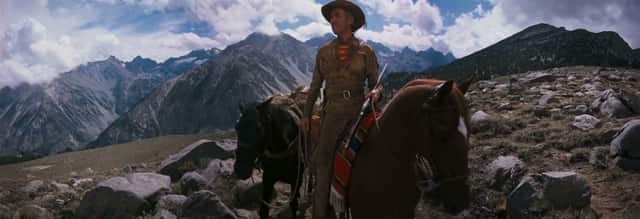
This land has a name today and is marked on maps.
这片土地如今有了名字,并被标注在地图上。
But the names and the marks and the land all had to be won.
不停顿,跟上原速
空格 播放/暂停 · ← → 上一句/下一句 · R 重播
为什么值得练
从山野孤行者到举家西迁,旁白把一段拓荒史讲得层层推进;适合练习沉稳叙述、长句断气和历史纪录片的英语语感。
旁白俯瞰美国西部开拓,先讲山地猎人自由漂泊,再讲东部家庭渴望土地,最后落到运河带来的迁徙之路。
跟读技巧
模仿旁白时先压低声线,'kept forever on the move' 要连贯轻快,到 'they moved along' 再放开节奏。
登录后收藏这段独白、记下练过的句子,下次接着练。
《西部开拓史》里的其他独白
 B211 句 · 40s
I don't like the way that fella's looking at us.
讲趣事反驳质疑西部开拓史 · 1962戏谑对峙反驳从一句不服气的纠正跳到荒诞山野奇遇,笑点很足。模仿时能练清口语连读、夸张停顿和“ain't”这类地道表达。 C17 句 · 21s
I'm a sinful man. Deep, dark, sinful.
坦白缺点后硬气告别西部开拓史 · 1962硬气自我成长他把自责说成玩笑,越轻描淡写越显得心虚。跟读时能练到自嘲语气、三连重音和故意收慢的尾句。 C117 句 · 1m 8s
The westward course was no smoother than that of true love.
讲述意外发现西部开拓史 · 1962反思权力与金钱从战争阴影讲到黄金消息传遍大陆,语气由沉稳转为兴奋。模仿时可练长句分层、地名节奏和重点词重音。 B27 句 · 23s
Many opportunities for an energetic young man.
分享信里的机会西部开拓史 · 1962充满希望励志打气从平静报信到描绘新机会,语气逐渐明亮。练习时重点练信息陈述、重音落点和希望感收尾。
更多独白
 B26 句 · 25s
you are the only ones who can do it
劝说团队先出成果人工进化 · 2009坚定职场说服理想被现实压住的一刻很抓人,模仿时能练到先让步再推进的语气,还能抓住 then we will talk 的重音落点,语气更地道。 B27 句 · 34s
A watched pot never boils
用英语解释冷知识密室逃生 · 2019机智轻喜剧从俗语切到量子冷知识,语气由轻松变笃定,模仿时能练设问、停顿和解释节奏。 B213 句 · 1m 15s
Something is wrong in this country
痛失亲人后控诉科伦拜校园事件 · 2002坚定心碎与告别父亲压制悲伤,把质问推向公共层面,情绪很有冲击力。跟读时能练到短句重复、重音落点和严肃英语表达的停顿。 B29 句 · 22s
I couldn't believe that I actually... Could represent an innocent man.
自责地讲述误判林肯律师 · 2011脆弱自我成长从硬证据转向自我怀疑,情绪很抓人。跟读时重点练短句急停和尾句放慢,把后悔说得不夸张却清楚。