
“We don't use the same methods that I hear you use on your prisoners,”
Por qué es buena
It draws a moral line first, so the threat that follows lands colder.
Registro
Formal
Úsala tú
We don't use the same methods that got you those numbers.
Capítulo 18 de 30 · 2'13"
A brigadier questions captured German officers about explosives and a bridge. He insists he won't use their methods — "we don't use the same methods that I hear you use on your prisoners" — but promises he has means of his own. When he leaves, a younger officer decides to try those means.
Answer the Brigadier
A Last Shot at the Prisoners
❝ Monólogo · 6 frases The Younger Officer Takes Over
A brigadier interrogates German prisoners about the dynamite they were carrying and the bridge they seem to know about. He refuses to use torture himself, but makes clear that he has other ways to get the truth. Before he leaves, a younger officer offers to take over and tackle the prisoners for him.
The scene is a study in two kinds of force. The brigadier is calm and almost polite, and he draws a line under himself: "We don't use the same methods that I hear you use on your prisoners." Yet the same sentence ends with a threat — he has means of his own — and the prisoners are left to guess what those means are. The comedy and the horror come from what follows. A younger officer takes the brigadier's manner as a model, copies his phrasing almost word for word, and turns it into something cruder: he is in command now, he says, and he knows how to deal with scum. The prisoners never tell him anything useful, but the scene already shows the direction the war is taking. What began as restraint becomes, in the next pair of hands, simply a licence to hurt.
A1–C2 es la escala MCER. Las tarjetas por encima del nivel elegido se atenúan y la reproducción no se pausa en ellas.
“We don't use the same methods that I hear you use on your prisoners,”
It draws a moral line first, so the threat that follows lands colder.
Formal
“And I know how to deal with you scum.”
A promise of competence plus a slur makes one short line feel like a closing door.
Informal
“And I can assure you that I have means to get what I want.”
It wraps a threat in courteous vocabulary, and the politeness makes it worse.
Formal
“I'm not a simple English gentleman.”
By refusing the label of gentleman, the speaker announces he is about to play rough, all in one short clause.
Neutral
“You spoke English an hour ago. Answer the Brigadier.”
It catches the man in his own contradiction and follows with a command, so the pressure comes from plain facts.
Neutral
“Quite safe to go now, sir. Your car's waiting.”
A calm reassurance about safety before a departure; the ordinary phrase carries the weight of the front.
Neutral
Now, listen. I am in command here now. And I know how to deal with you scum. I'm not a simple English gentleman. I'm a simple South African. And I can assure you that I have means to get what I want.
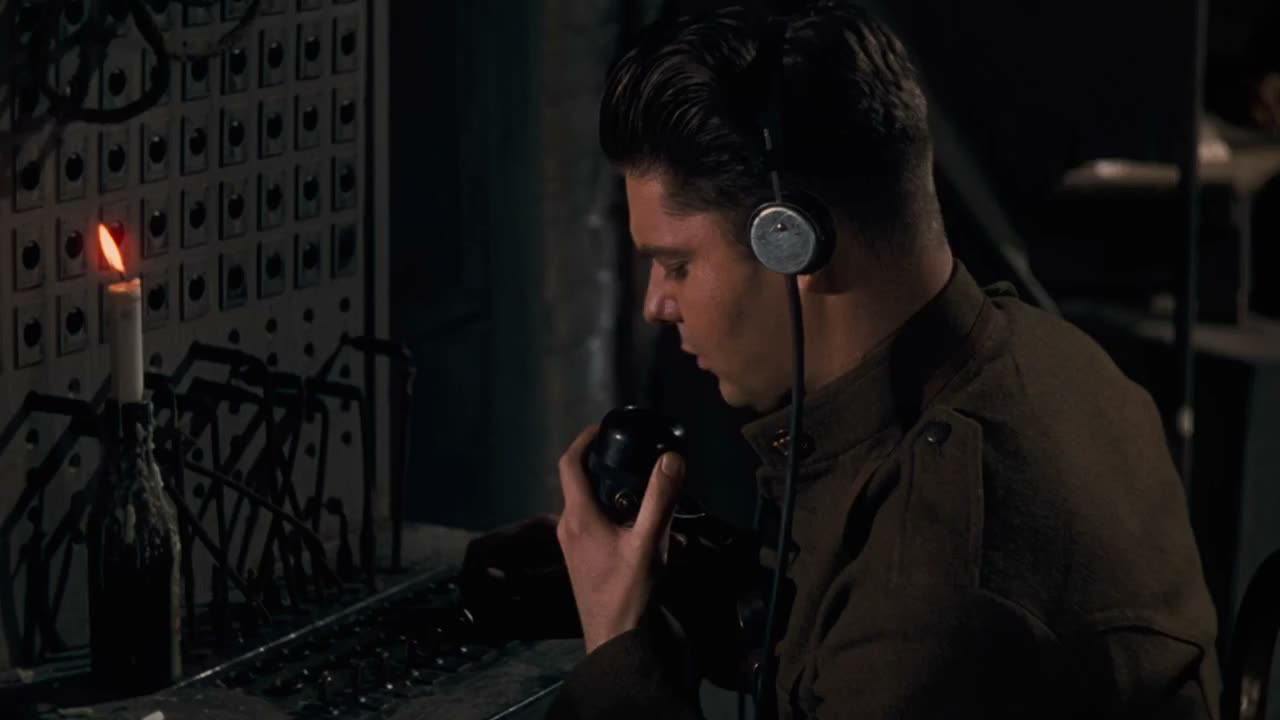 Siguiente · 19have kittensLa escena: Candy Can't Get a Train Home
Where the dynamite came from, what it was for, and what happened to three men taken prisoner two days earlier. The bridge is the detail that proves the prisoner knows more than he admits.
It means to pretend not to hear, usually to avoid answering. The officer uses it to tell a prisoner that his silence is obvious and will not work.
To claim a moral difference even while threatening. He wants the prisoner to know that he has ways of his own, so the distinction is about style rather than kindness.
He takes over the prisoners and copies the brigadier's phrases, but pushes them into open brutality. It shows how easily a tone of authority becomes an excuse to hurt.