“A circumstance has come to my attention, sir, which seems to me to put a different complexion on the case.”
Polite wrapping around a bombshell: one sentence quietly announces that the whole case just changed.
Formal
Capítulo 6 de 15 · 2'11"
Ong comes to the lawyer's office with information that costs him nothing and could sink the defence: a letter written by the accused on the day Hammond died, whose original is held by Hammond's widow. Joyce calls the idea "inconceivable," yet he does not send Ong away.
Ong Brings Joyce the Letter
Joyce Neither Refuses Nor Agrees
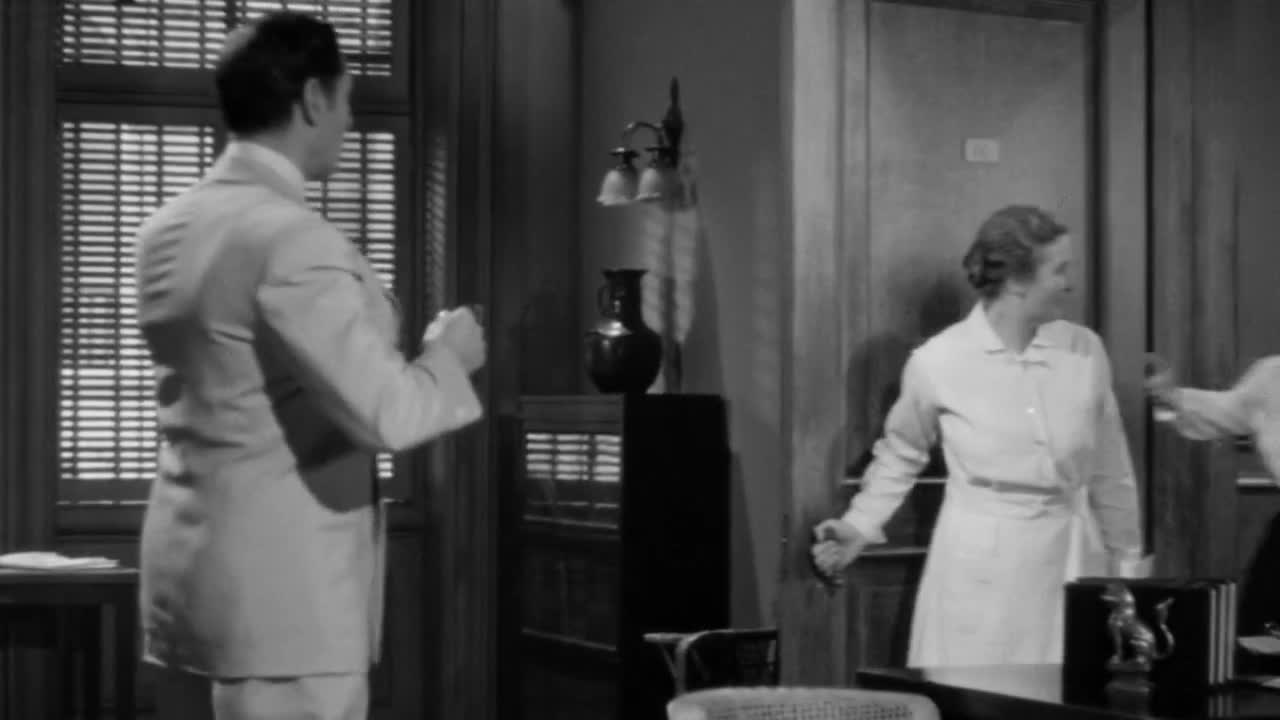
In his Singapore law office, Howard Joyce is visited by Ong Chi Seng, who says a letter exists from the defendant, Mrs. Crosbie, to Hammond, written on the day Hammond died. Ong has a copy; the original is held by Hammond's widow. Joyce is sceptical but agrees to consider the matter and to stay in touch with Ong's informant.
The scene is a transaction in which nothing is said outright and everything is understood. Ong has no authority and no name to give: he speaks of "a friend" and of information, never of proof, and he lets Joyce draw the conclusion himself. His report is precise where it matters — the letter was "written on the day of the late Mr. Hammond's death," which contradicts Leslie's claim that she had no contact with Hammond for weeks. Joyce resists the implication, insisting "it's inconceivable that Mrs. Crosbie should have written such a letter," but he neither rejects the news nor dismisses Ong. Instead he says he will "give the matter my consideration" and asks Ong to keep in touch. The polite formula is also a manoeuvre: by not acting and not refusing, Joyce keeps the letter in play while giving no one a hold over him.
A1–C2 es la escala MCER. Las tarjetas por encima del nivel elegido se atenúan y la reproducción no se pausa en ellas.
“A circumstance has come to my attention, sir, which seems to me to put a different complexion on the case.”
Polite wrapping around a bombshell: one sentence quietly announces that the whole case just changed.
Formal
“But the letter, sir, was written on the day of the late Mr. Hammond's death.”
The date alone does the work: a calm sentence that quietly destroys everything argued before it.
Neutral
“I have every confidence in the veracity of my informant, sir.”
No proof, just perfect faith in his source: a servant's answer kept formal to the last syllable.
Formal
“That's more than I have. Ong, it's inconceivable that Mrs. Crosbie should have written such a letter.”
He dismisses the clerk's faith in five words, then states his own verdict as fact.
Neutral
“I'll give the matter my consideration.”
A polite non-answer: it ends the meeting without agreeing to anything.
Formal
“It might be well to keep in touch with him.”
A soft yes that commits to nothing but keeps the channel open.
Formal
Siguiente · 07a hairsbreadthLa escena: Howard Confronts Leslie Over a LetterOng says a friend thinks the letter would interest the prosecutor. He is passing on information, hoping to gain something, while keeping himself out of the affair.
It was written on the day Hammond died, which contradicts Leslie's claim that she had not been in contact with him for weeks.
He knows Leslie and cannot believe she would write such a letter. He also has not seen the original, only a copy held by Ong.
It means to change the way something looks. Ong says the letter puts a different complexion on the case, meaning it would make the whole case appear different.
Hammond's widow has it. Ong only has a copy, which is why he wants Joyce to make sure the letter is genuine before anything is done with it.