
“All cardboard, all hollow, all phony, all clone with mirrors.”
Por qué es buena
Four alls in a row strip the glamour off a studio street in one breath.
Registro
Informal
Úsala tú
All lights, all filters, all staging — nothing real.
Capítulo 16 de 19 · 2'19"
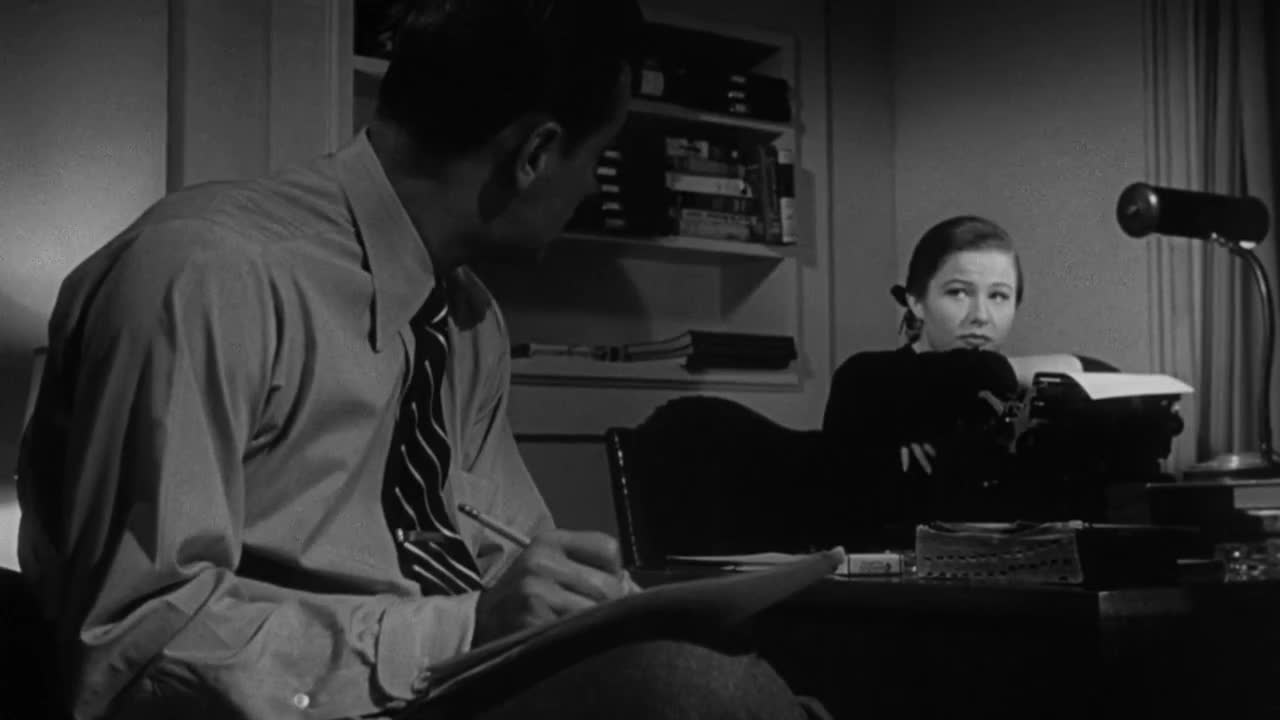
On a walk across the Paramount backlot, Betty Schaefer tells Joe Gillis why she never became a star: the studio disliked her nose, she had it fixed, and then they disliked her acting. She insists she prefers 'being on the other side of the cameras.' Joe teases her, they flirt, and he finally makes himself pull away.
Betty Tells Joe About Her Nose
Joe and Betty Flirt on the Backlot
Joe Gillis and Betty Schaefer walk along a fake backlot street at Paramount while Betty explains her family history: an electrician father, a mother in Wardrobe, a grandmother who did stunts. The studio once tested her, disliked her nose, and after surgery disliked her acting. She says she is happier behind the camera, and Joe teases her about her lost stardom.
This is the scene where Joe and Betty stop being coworkers and start being a possibility. Betty tells her nose story lightly, but it is a story about being rejected for the way she looked and then for who she was. Her line — 'What's wrong with being on the other side of the cameras?' — is both a defense and a choice, and she delivers it without self-pity. Joe, meanwhile, does what he does with everyone he likes: he mocks. 'Come clean, Betty,' he teases, inventing tears she never cried, and adds a compliment about her smell. Yet he also draws the line himself — 'you stay at least two feet away from me' — because he knows where this is going. The wit is real; so is the retreat.
A1–C2 es la escala MCER. Las tarjetas por encima del nivel elegido se atenúan y la reproducción no se pausa en ellas.
“All cardboard, all hollow, all phony, all clone with mirrors.”
Four alls in a row strip the glamour off a studio street in one breath.
Informal
“You know, I like it better than any street in the world.”
It calls the street fake and still loves it most, which is the whole movie in one line.
Neutral
“What's wrong with being on the other side of the cameras?”
A single rhetorical question defends everyone who works behind the lens.
Informal
“At night you weep for those lost close-ups, those gala openings.”
It honors the dream she lost by letting it still hurt at night, without ever mocking her.
literary
“Smart girl. Nothing like being twenty-two.”
It praises her and envies her age in two short beats, warm without flattery.
Informal
“The first time you see me coming any closer, I want you to take off a shoe and clunk me on the head with it.”
He turns his own weakness into a joke rule, flirting by pretending to need protection.
Informal
 Siguiente · 17wipe outLa escena: Betty Confesses She Loves Joe
The studio tested her, disliked her nose, and after she had it fixed still disliked her acting. Rather than keep chasing stardom, she took a job at the studio and worked her way up to reader.
It is where she played as a child, and her whole family worked at the studio. The artificial street feels more like home to her than any real one.
She says she does not, and asks what is wrong with being on the other side of the cameras. Working with stories still matters to her, just from behind the camera.
He is attracted to her and knows the danger of it. His joking rule, and the shoe she is told to hit him with, is his way of naming the attraction while holding it off.
It means to admit the truth. Joe teases Betty with 'Come clean, Betty,' pretending she secretly misses the stardom she says she never wanted.