
“It's just, your approbation means more to me than anybody's.”
Por qué es buena
The formal word betrays how much she needs his approval.
Registro
Neutral
Úsala tú
Your approval means more to me than anybody's.
Capítulo 4 de 15 · 2'45"
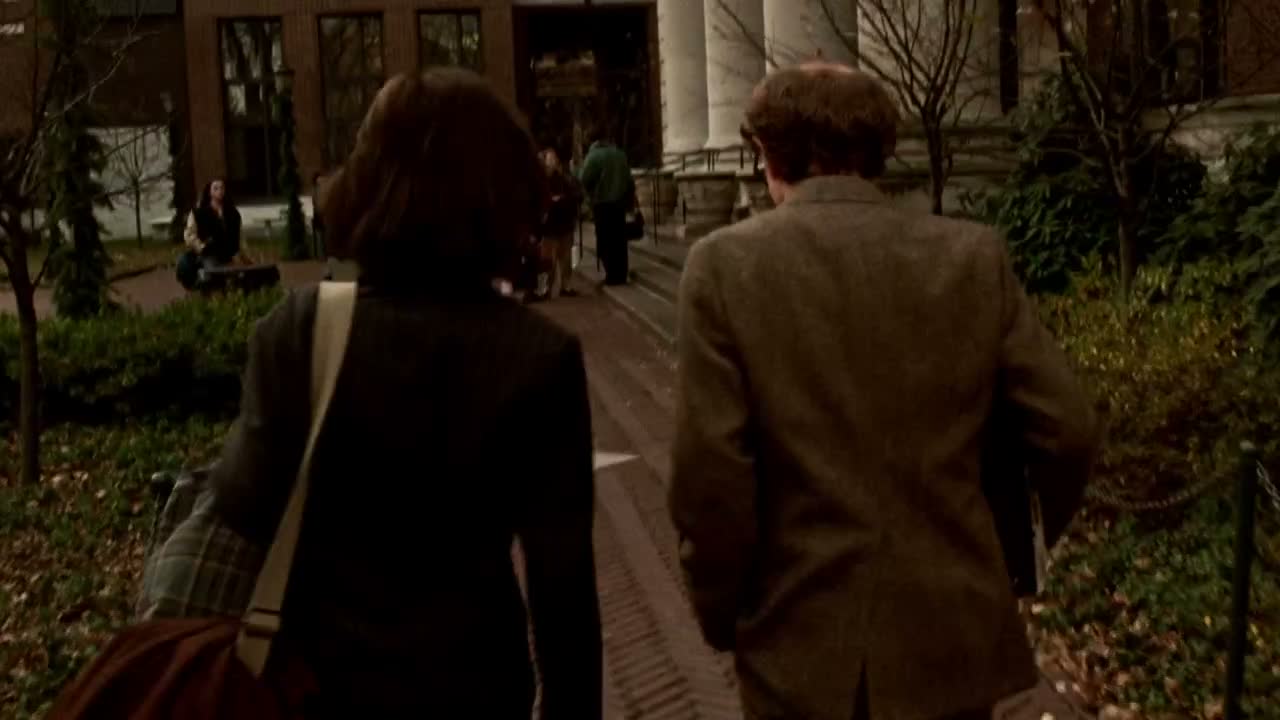
A professor tells his student that her short story was the best thing he read all term, and she is so moved she can barely hold back tears. "Your approbation means more to me than anybody's," she says. Then his praise turns into a string of personal questions she did not invite.
Gabe Praises Rain's Short Story
Why Are You Asking All These Questions?
After class, Gabe stops Rain to praise her short story as the best he has read this term, and she is overwhelmed. She tells him his opinion matters more to her than anyone's, and that he is the reason she started writing. But then he begins probing her background — her name, her family, whether she is an only child — and Rain pushes back.
The scene opens as flattery and slowly turns into something else. Rain's response is startling in its honesty: "your approbation means more to me than anybody's," and she says Gabe is the reason she began writing. That is a lot of weight to put on a teacher, and the conversation almost becomes tender. Then it does not. Gabe starts asking about her parents, her name, whether she is an only child, and finally why her family must be "stormy and tempestuous" for her to write so deeply. Rain's pushback — "Why are you asking all these questions?" — is the moment the student stops being flattered and starts managing her professor. Her answer to the writing question is just as deflating: it is not experience but a trick, like the story she wrote about Paris at ten without ever having been there.
A1–C2 es la escala MCER. Las tarjetas por encima del nivel elegido se atenúan y la reproducción no se pausa en ellas.
“It's just, your approbation means more to me than anybody's.”
The formal word betrays how much she needs his approval.
Neutral
“I mean, you're the reason why I wanted to start writing.”
One person becomes the origin of a whole vocation.
Neutral
“So how did you manage to write something so, so deep?”
The stutter reveals fascination more than critique.
Informal
“It's like, um, when I was ten, one time I wrote this whole story on Paris, and I'd never even been there, you know?”
Depth can come from imagination, not only from lived experience.
Informal
 Siguiente · 05penchant forLa escena: Gabe's Kamikaze Women Theory
Because Gabe's opinion matters more to her than anyone else's, and she says he is the reason she started writing. Being told her work is the best he read all term lands as a personal verdict, not just a grade.
He wants to know where her writing comes from. He assumes a story that deep must be rooted in a turbulent family life, so he asks about her name, her parents, and her history.
They move from her writing to her private life, and she does not accept the premise that she must have suffered to write well. Her pushback is her way of keeping the boundary.
She means talent is not automatic proof of experience. Her example is a story she wrote about Paris at ten without ever having been there, which undercuts Gabe's assumption.
It is an old story by Gabe that Rain's family used to quote. Its line about giving up hopes being like putting on a grey hat shows that his writing already shaped her before they met.