
“Suppose we did! That isn't what I got married for!”
Por qué es buena
It slams a newsroom victory against a failed marriage and lets the anger sit in the question.
Registro
Informal
Úsala tú
That isn't what I joined the team for.
Capítulo 2 de 18 · 5'02"
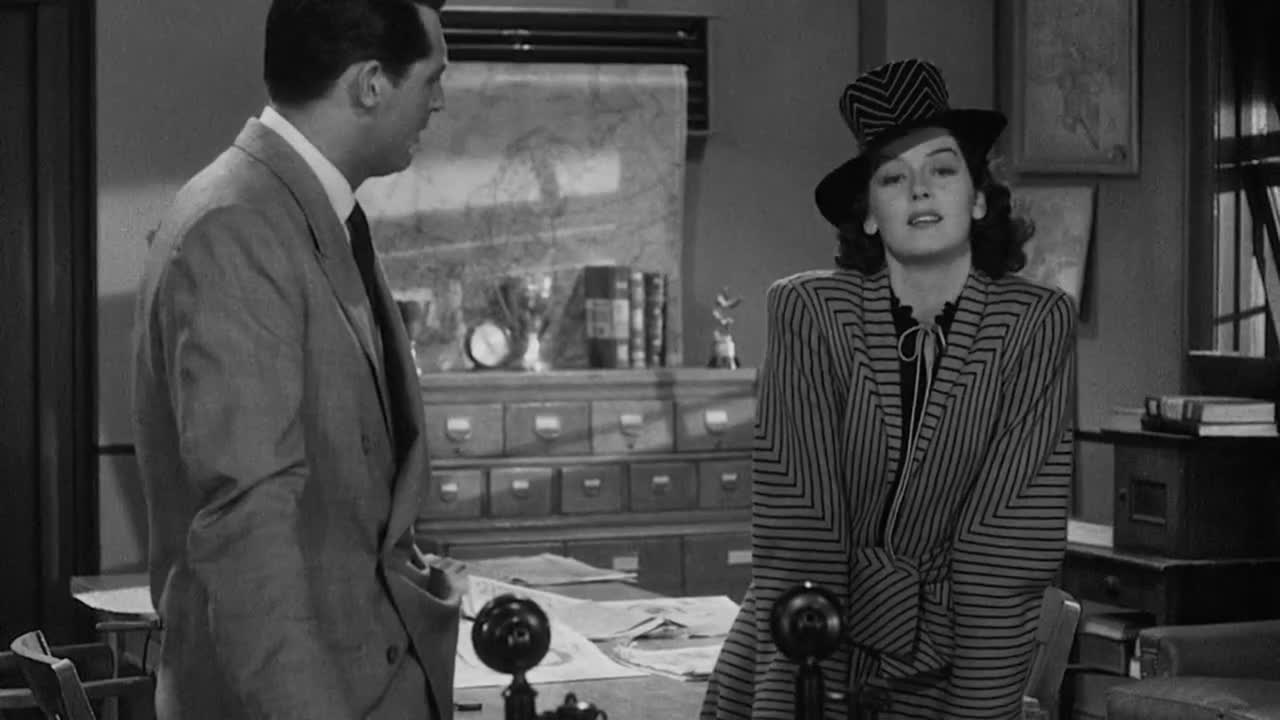
Hildy walks into the newsroom to tell her ex-husband and former editor that she's remarrying and leaving the business. Walter smiles through it, then starts bargaining — "Come back to work on the paper" — because to him the marriage was never the problem, the quitting is.
Hildy Cuts Both Ties
❝ Monólogo · 4 frases Hildy on reporters
She piles up concrete images of the job until the complaint turns into self-portrait.
In the opening scene, Hildy Johnson visits the office of Walter Burns, her ex-husband and the editor who made her a star reporter. She has an engagement ring and a plan to quit newspapers. Walter listens, jokes, and immediately begins trying to pull her back onto the paper.
The scene is a negotiation wearing the mask of a breakup. Hildy states the terms plainly — "You are no longer my husband and no longer my boss" — but Walter hears a challenge, not a goodbye. His whole strategy is to keep her talking: he revisits their ruined honeymoon, offers her the job back, claims he has no hard feelings, then dangles a raise and an exclusive story when sentiment fails. When he finally sees the engagement ring, he turns it into one more talking point. The comedy comes from the speed and the pleasure Walter takes in the fight; Hildy keeps insisting she's through, but she stays in the room, trading lines. What makes the scene durable is that both arguments are real: she wants an ordinary life, and he believes the newspaper is the only life worth having.
A1–C2 es la escala MCER. Las tarjetas por encima del nivel elegido se atenúan y la reproducción no se pausa en ellas.
“Suppose we did! That isn't what I got married for!”
It slams a newsroom victory against a failed marriage and lets the anger sit in the question.
Informal
“You are no longer my husband and no longer my boss.”
The repeated no longer cuts both ties in one breath, and the flatness is the point.
Formal
“I want to go someplace where I can be a woman.”
One plain wish exposes the cost of the job: she has to leave the trade to feel like herself.
Neutral
“Walter, you're wonderful in a loathsome sort of way.”
Praise and disgust in one breath, a whole marriage in a line.
Informal
“We're a team. The paper needs both of us!”
Calling work a team turns a job offer into an emotional plea.
Neutral
Peeking through keyholes, chasing fire engines... ...waking people up in the night to ask questions... ...stealing pictures off old ladies? I know all about reporters. Buttinskies running around with no money, and for what?
 Siguiente · 03take the wind out of someone's sailLa escena: Walter Meets Bruce Baldwin
To announce that she is quitting the newspaper and marrying Bruce Baldwin. She wants it understood in person, and she wants his calls and telegrams to stop.
He isn't ready to lose his best reporter. As long as Hildy keeps talking, he can keep offering — her old job, a raise, an exclusive story — and he knows the work still excites her.
She means she is finished with the newspaper business, not just with Walter. The scene keeps testing whether that decision is as firm as she says it is.
To turn an old grievance into a joke and keep the conversation going. Bringing up the coal-mine story reminds Hildy of the work they did together, which is exactly what he wants her to remember.
She says so repeatedly, but she keeps engaging, defending her reasons, and enjoying the sparring. The film leaves it deliberately open whether the decision or the habit is stronger.