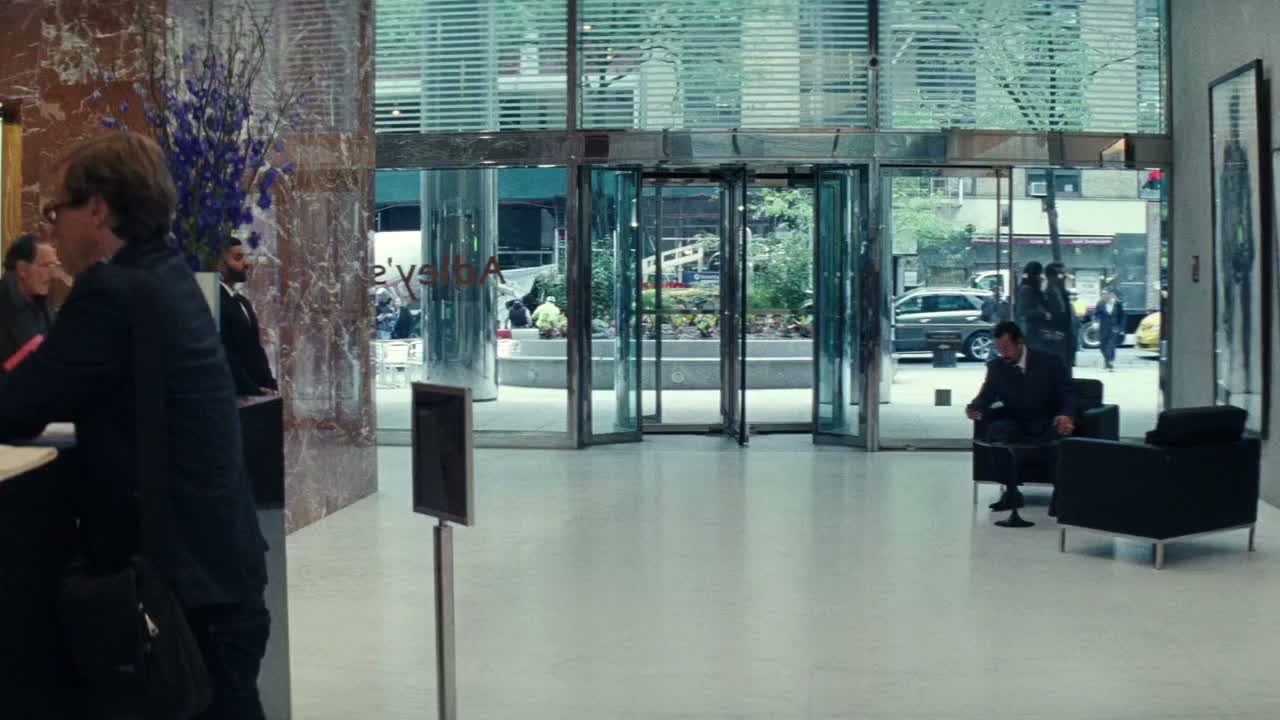
“This is not a nice position you put me in. I resent this very much.”
Displeasure stated with precision, not temper; the composure is the boundary.
Formal
Capítulo 9 de 14 · 4'11"
Before the auction, Howard asks Gooey to "jack up the bids" so the opal clears $250,000. Gooey refuses — "This is not a nice position you put me in" — yet the price still climbs past the estimate, pushed by a bidder who isn't there to win. The auction isn't a market; it's Howard's stage.
Howard Asks Gooey to Shill the Auction
❝ Monólogo · 8 frases The auctioneer's opening
He stacks estimate, romance, and opening bid until the room has nowhere to sit except in the number.
The Opal Sells for $190,000
At an auction house, Howard pulls Gooey aside and asks him to shill the bidding for his black opal, promising him 20% of the winning bid and insisting Kevin Garnett is obsessed with the stone. Gooey objects. Then lot 38 opens, the estimate is revised upward, and the bids run from $20,000 to $190,000, where Kevin wins it.
Howard can't fix the market, so he tries to fix the room. "I need you to jack up the bids," he tells Gooey, then offers a cut: "20% I'll give you for the winning bid, to be a partner with me." It's a clumsy bribe dressed as partnership, and Gooey sees it: "This is not a nice position you put me in. I resent this very much." Howard's answer is an admission — "I fucked up. I should've got my own appraisal, but I didn't have the time" — and a rationalization: the AGL says 500,000, KG is obsessed, so the higher price is support. Yet the room does exactly what Howard wanted: an offstage bidder keeps answering "against you, sir" until the opal sells for nearly ten times its opening bid. What looks like demand is choreography, and the seller is the one holding the strings.
A1–C2 es la escala MCER. Las tarjetas por encima del nivel elegido se atenúan y la reproducción no se pausa en ellas.
“This is not a nice position you put me in. I resent this very much.”
Displeasure stated with precision, not temper; the composure is the boundary.
Formal
“Well, this is support. This is support like you've never known.”
A self-serving definition repeated until it sounds true: rigging rebranded as loyalty.
Informal
“It's no longer yours, sir. It's against you, sir.”
Pressure by loss, not by asking: you no longer own it, someone is beating you.
Formal
“I have to move this along. We have a good bid at 190,000.”
A soft ultimatum: I'm moving on, and the current bid is already good.
Formal
We move on now, ladies and gentlemen, to lot number 38. Lot 38. We have a sale-room notice. I'm required to inform you all that this fine Ethiopian black opal, presented here before you all on your left, my right, is now offered with a revised estimate of $155,000 to $225,000 US. Ladies and gentlemen, it is a fine piece, a collector's work, and most importantly, it is windowed on either side to reveal the full spectrum of its dazzling color and the pinfire pattern within. So with that in mind, ladies and gentlemen, my colleagues are ready and poised on the phones, and you're all ready with your paddles. We shall start the bidding now at $20,000.
Siguiente · 10copaceticLa escena: Howard Owes Gooey After the AuctionTo push the price higher than it would go on its own. Howard needs the opal to sell for at least $250,000, so he wants a friendly bidder nudging the total up.
He knows it's dishonest and that it puts him in a bad spot. "This is not a nice position you put me in," he says — if he wins, he's stuck; if he's caught, he's implicated.
The opal sells for $190,000, well above the lowered estimate but below the $250,000 Howard wanted. Kevin Garnett wins it, still insisting he needs the stone.
Howard has someone bid against Kevin to drive the number up. The auctioneer's repeated "against you, sir" keeps the pressure on without ever naming who is on the other paddle.