
“Say the word, and I'll keelhaul them.”
Por qué es buena
A brutal old punishment becomes a playful favour; the man lives in one sentence.
Registro
Informal
Úsala tú
Say the word, and I'll talk to your landlord.
Capítulo 7 de 18 · 4'16"
Lucy's in-laws arrive with bad news—her income is gone—and a solution: come home and live with them. On the surface it's family concern; underneath it's a power grab over a widow who has finally chosen a life of her own. "I'll manage somehow," she says, and sends them off.
❝ Monólogo · 4 frases The mother's bad-news build-up
She lays bad news out as good, and the calm delivery makes the pressure feel gentle.
The In-Laws Think Lucy Is Losing It
Lucy Refuses to Go Home With Them
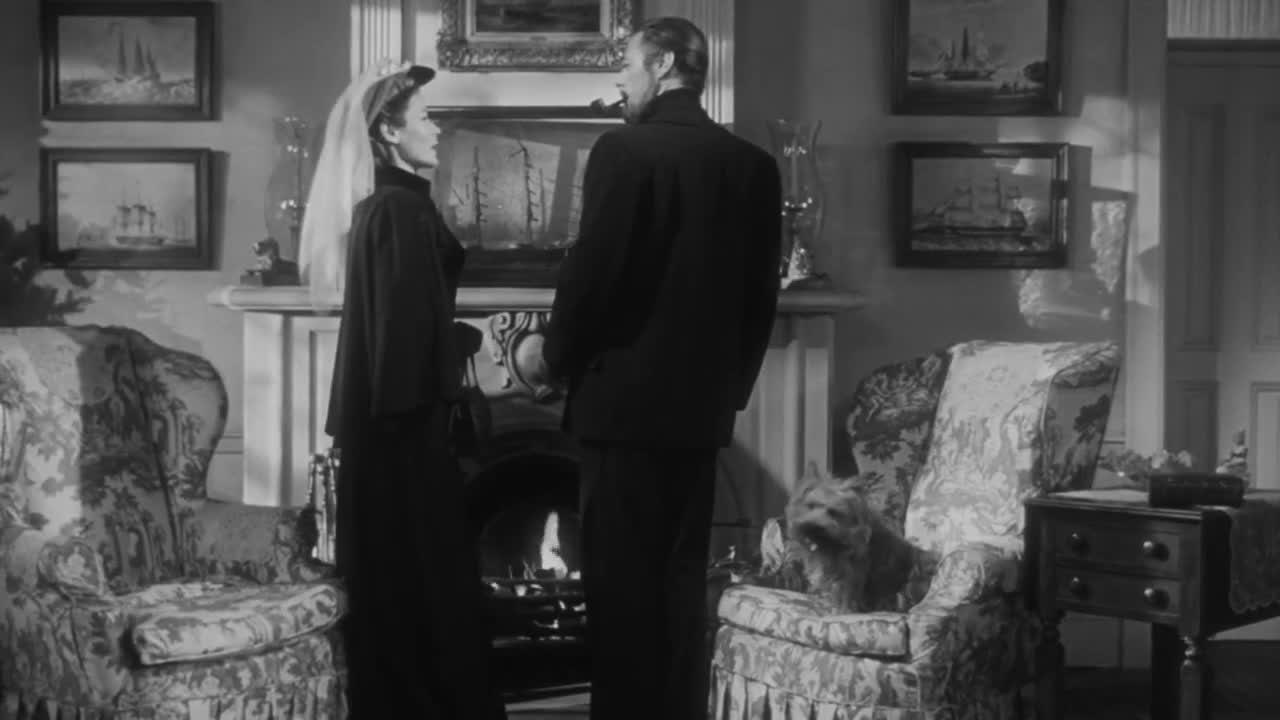
Lucy's mother-in-law and sister-in-law, Eva, show up unannounced at Gull Cottage. They mock the room and the portrait, then break the news: the gold mine that paid Lucy's bills has petered out and the dividends have stopped. They expect her to move back with them. Instead, Lucy thanks them and refuses.
The money is only the pretext. The in-laws have never accepted Lucy living alone, and the lost dividend gives them the excuse they wanted: she cannot afford independence, so she must come home. Captain Gregg, invisible to them, keeps needling from the side—"Don't do it, Lucy"—and even threatens to throw them out. But the decision stays Lucy's. Her answer is polite and absolute: "It's very kind of you to want me back, but I'm going to stay." The scene measures how far she has come: she will risk losing her last safety net rather than be managed again.
A1–C2 es la escala MCER. Las tarjetas por encima del nivel elegido se atenúan y la reproducción no se pausa en ellas.
“Say the word, and I'll keelhaul them.”
A brutal old punishment becomes a playful favour; the man lives in one sentence.
Informal
“Well, I could explain, I suppose, but you wouldn't believe me.”
It gives up before trying, and that surrender is exactly what shuts the question down.
Neutral
“The only charitable explanation is that the solitude has preyed on your mind.”
Wrapped in charity, the sentence calls her mad and loses nothing by it.
Formal
“I'm sorry. It's very kind of you to want me back, but I'm going to stay. I'll manage somehow.”
Thanks and refusal in one breath; the soft words make the no impossible to argue with.
Neutral
“So, please be good enough to shove off.”
Politeness sharpens the dismissal; the more courteous the words, the harsher the exit.
Formal
Oh, poor Lucy, we've such bad news for you. I suppose it's all for the best, everything considered. Don't you, Eva? And in my opinion, we're just in time.
 Siguiente · 08throw yourself atLa escena: Captain Gregg Dictates His Memoirs
Her income has collapsed—the mine 'petered out' and stopped paying dividends—so they insist she can't afford to live alone and must come back with them.
Yes—her dividends have stopped, which is why the family treats her as a 'pauper.' She admits she'll have to manage somehow, but she still refuses to give up the house.
Captain Gregg, the ghost of Gull Cottage. Only Lucy can see and hear him, and he keeps taunting the visitors—making them think Lucy is talking to herself.
He can't stand the in-laws bullying Lucy. 'Keelhaul' is pirate talk for a brutal punishment, so it's a joke-threat—but it also shows how fiercely he takes her side.
At this point she stays, and the family leaves angry. The film later explains how she manages to keep the house—her refusal here is the first step.