
“Frailty, thy name is Brandon.”
Por qué es buena
A Hamlet line bent into a friend's name: the mockery is literary and exact.
Registro
literary
Úsala tú
Frailty, thy name is Monday morning.
Capítulo 12 de 27 · 4'12"
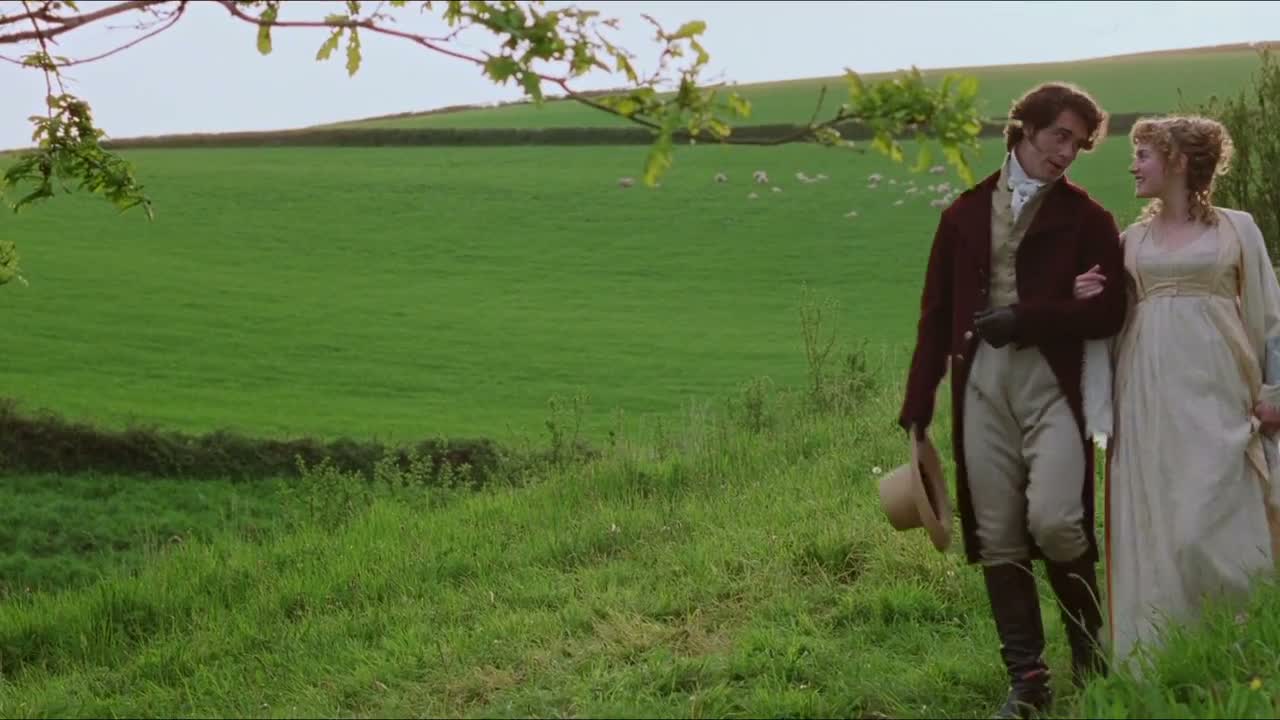
At the gathering, Colonel Brandon suddenly announces he must ride to London at once and leaves without explanation. The party gossips about him, and Willoughby delivers the joke, "Frailty, thy name is Brandon." Later Willoughby tells Marianne he would rebuild his own house to look like her cottage.
❝ Monólogo · 6 frases Willoughby Wants to Rebuild Combe Magna
During the party at Barton, Colonel Brandon abruptly announces that he must leave for London at once and rides off, refusing to wait. The guests discuss his strange departure, and Willoughby mocks him with a Shakespeare line. Afterwards Willoughby and Marianne walk and talk about the cottage, and he says he would rebuild his estate at Combe Magna to resemble it.
The scene is a study in how a party handles an absence. Brandon's sudden exit is treated first as a puzzle and then as a joke; Willoughby turns it into a performance with 'Frailty, thy name is Brandon,' which gets a laugh and shows how easily the group dismisses a man it does not need. The line also quietly sets up the real reason for Brandon's journey, which the film keeps secret for now. Meanwhile Willoughby is doing something more calculated: he tells Marianne he would rebuild Combe Magna to look like her cottage, and says it 'has one claim on my affections that none other can possibly share.' Coming from him, the compliment is perfect because it is exactly the kind of romantic speech she wants to believe.
A1–C2 es la escala MCER. Las tarjetas por encima del nivel elegido se atenúan y la reproducción no se pausa en ellas.
“Frailty, thy name is Brandon.”
A Hamlet line bent into a friend's name: the mockery is literary and exact.
literary
“You're a very wicked pair. Colonel Brandon will be sadly missed.”
She scolds the jokers, then quietly defends the man they mocked, in two neat sentences.
Informal
“If I do not have you married by teatime, I shall swallow my own bonnet.”
A bonnet offered as a wager turns matchmaking into comedy without losing its force.
Informal
“Now, that I will never consent to.”
Fronting the object gives the refusal a stubborn, spoken force that a plain no lacks.
Formal
“For then I should be as happy at Combe as I have been at Barton.”
The as ... as frame quietly puts his own estate beside hers, and the compliment does the rest.
literary
“This has one claim on my affections that none other can possibly share.”
He never says love; the cottage carries the claim, and the restraint makes it stronger.
literary
Were I rich enough, I would pull down Combe Magna... and rebuild it like this cottage. With dark narrow stairs... a poky hall and a fire that smokes, I suppose. Especially the fire that smokes. For then I should be as happy at Combe as I have been at Barton.
 Siguiente · 13force a confidenceLa escena: Willoughby's Abrupt Farewell
He says he must go to London at once and cannot lose a minute, offering no explanation. The film later reveals the reason for his haste.
He mocks the awkwardness of Brandon's sudden exit with the line 'Frailty, thy name is Brandon,' which amuses the group and dismisses the man they do not miss.
He says he would rebuild Combe Magna to look like it, and that the cottage has a claim on his affections nothing else can share.
It means to stake a confident promise on something. The speaker jokes she will swallow her own bonnet if Marianne is not married by teatime.
She loves the cottage exactly as it is, down to its narrow stairs and smoky fire, and will not allow a stone to be added to its walls.