
“Because Barbie can be anything, women can be anything.”
Por qué es buena
The film's thesis in one parallel line: if Barbie can be anything, so can women.
Registro
Neutral
Úsala tú
Because a girl can build it, a woman can run it.
Capítulo 1 de 26 · 2'52"
The film opens with a deadpan history of the doll: baby dolls, girls playing at mothers, and then Barbie changing everything. The narrator credits her with giving women everything, then undercuts it: "Who am I to burst their bubble?" The irony is baked in from the first line.
❝ Monólogo · 14 frases Who Am I to Burst Their Bubble
A narrator walks through the history of dolls, from baby dolls to Barbie, who arrives with her own money, house, car and career. The voiceover credits her with letting women be anything, then admits that this is mostly how the Barbies of Barbie Land see it, and refuses to spoil their illusion.
The whole film's argument is set up in this voiceover, and so is its irony. The narrator praises Barbie for changing everything — "Because Barbie can be anything, women can be anything." — yet the celebration keeps tipping into a wink. The Barbies believe that living in Barbie Land means the struggles are over: "At least that's what the Barbies think." And the voice refuses to correct them: "Who am I to burst their bubble?" That refusal is the film's promise and its warning. What sounds like a tribute is quietly an invitation to notice what the cheerful story leaves out, and to ask who gets to live in it.
A1–C2 es la escala MCER. Las tarjetas por encima del nivel elegido se atenúan y la reproducción no se pausa en ellas.
“Because Barbie can be anything, women can be anything.”
The film's thesis in one parallel line: if Barbie can be anything, so can women.
Neutral
“Who am I to burst their bubble?”
A rhetorical question that confesses the bubble exists while pretending not to touch it.
literary
“Girls can grow into women, who can achieve everything and anything they set their mind to.”
Growing up is the small half; the claim about limitless achievement is the big one.
Neutral
“She might have started out as just a lady in a bathing suit, but she became so much more.”
Start her low, then flip with but: the power lives in the blank left by so much more.
Neutral
“She has her own money, her own house, her own car, her own career.”
Independence itemized: four owns in a row make it concrete instead of abstract.
Neutral
“All of these women are Barbie, and Barbie is all of these women.”
A chiasmus folds every woman into one name, then hands the name back.
literary
“Thanks to Barbie, all problems of feminism and equal rights have been solved.”
The irony is in the past tense: all solved, thanks to a doll.
Formal
Yes, Barbie changed everything. Then, she changed it all again. All of these women are Barbie, and Barbie is all of these women. She might have started out as just a lady in a bathing suit, but she became so much more. She has her own money, her own house, her own car, her own career. Because Barbie can be anything, women can be anything. And this has been reflected back onto the little girls of today in the Real World. Girls can grow into women, who can achieve everything and anything they set their mind to. Thanks to Barbie, all problems of feminism and equal rights have been solved. At least that’s what the Barbies think. After all, they’re living in Barbie Land. Who am I to burst their bubble? And here is one of those Barbies now, living her best day every day.
Barbie: tu progreso
Capítulo 1 de 26 · quedan unos 89 min
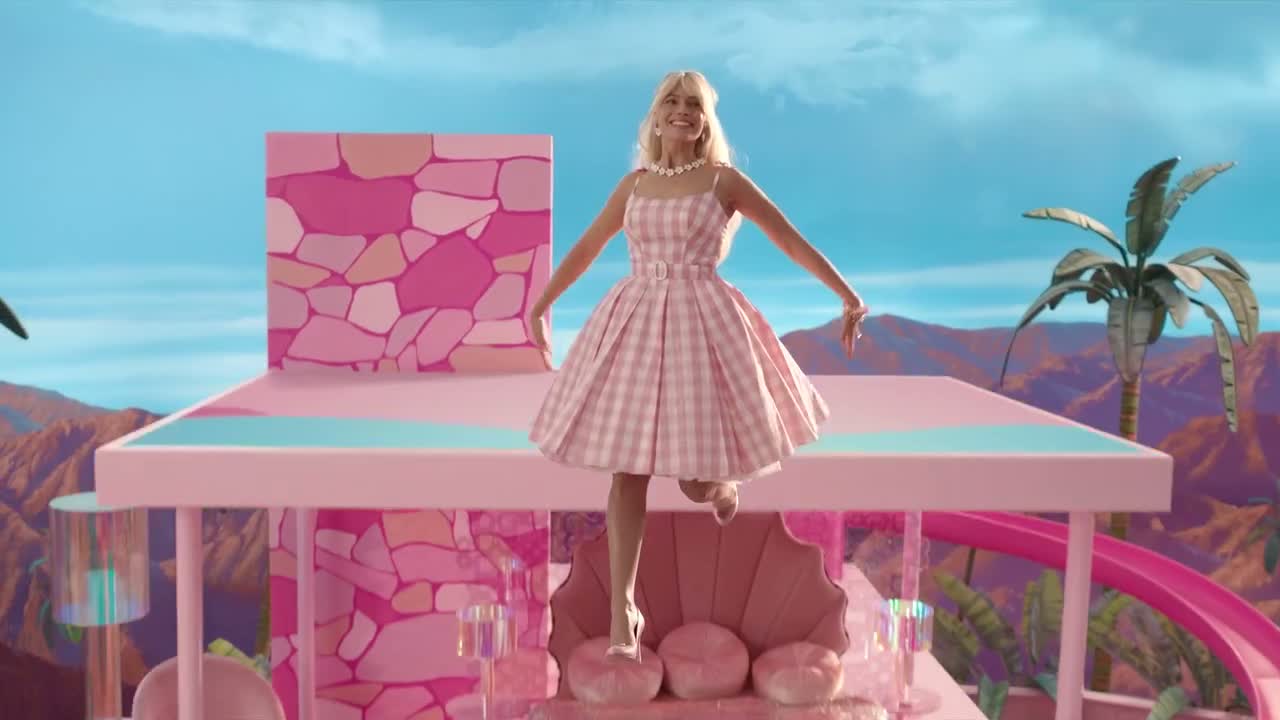 Siguiente · 02the voice of a generationLa escena: Barbie's Perfect Day in Barbie Land
Because the film is setting up a joke. The cheerful claims that Barbie solved everything are undercut by the narrator's own asides, so the audience knows the perfect world is not the whole story.
It means to destroy someone's happy illusion. The narrator says she will not tell the Barbies that their world is not as solved as they believe.
An unseen voice telling the history of the dolls and of Barbie. It walks from the first baby dolls to Barbie Land, setting up the film's world before the story begins.
It introduces Barbie Land's belief that Barbie changed everything for women, while quietly signalling that this belief is about to be questioned.
Because they live in Barbie Land, a place built on the idea that every problem has been solved. The narrator says they think the work is done, even if the film will disagree.