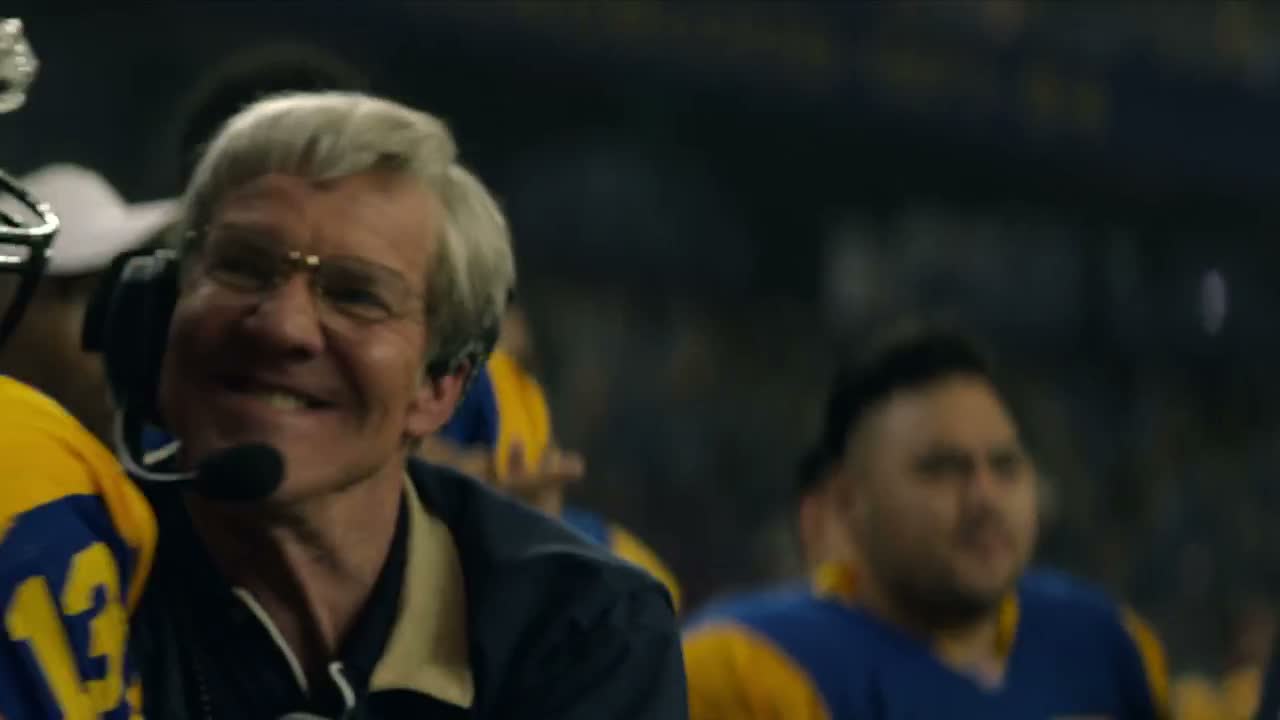
“I never would've put you on that field if I didn't fully believe you were a champion.”
It reframes every hard practice as proof of belief instead of punishment.
Informal
Capítulo 25 de 27 · 3'44"
Before sending Kurt in, Coach Martz explains the pressure: he had to know Kurt was ready, and he'd never put him on the field unless he believed Kurt was a champion. Kurt answers with his first NFL touchdown and a comeback that leaves the broadcast saying, "I have never been so happy to have been proven so wrong."
❝ Monólogo · 9 frases Coach Martz Explains the Pressure
Kurt Warner's First NFL Touchdown
Coach Martz pulls Kurt aside and admits why he was so hard on him: he needed to be sure Kurt was ready, and he wouldn't have played him unless he believed he was a champion. Sent into the game, Kurt steadies the huddle, owns a mistake, then throws his first NFL touchdown and leads a comeback.
The scene is built around a reversal. For weeks the coaches were hard on Kurt, and now the reason turns out to be belief rather than doubt: 'I never would've put you on that field if I didn't fully believe you were a champion.' That reframes everything that came before. On the field, the proof is in the small things — steadying the huddle, saying 'That last one was on me,' taking the checkdown before the big throw. The broadcast, which had doubted the arena-league kid, ends up eating its words: 'I have never been so happy to have been proven so wrong.' It's a scene about how pressure can be a form of trust, and how the only answer to it is to go do the job.
A1–C2 es la escala MCER. Las tarjetas por encima del nivel elegido se atenúan y la reproducción no se pausa en ellas.
“I never would've put you on that field if I didn't fully believe you were a champion.”
It reframes every hard practice as proof of belief instead of punishment.
Informal
“I have never been so happy to have been proven so wrong.”
It turns being wrong into a compliment to the other person.
Neutral
“When was the last time you saw shovel pass to a wide receiver like that?”
A rhetorical question that praises the play without ever saying great.
Informal
“Oh, you're gonna love this.”
A curtain-raiser that hooks the audience in four words, with all the punch in the delivery.
Informal
Kurt, listen to me. You know why I was so hard on you? Why I put all that pressure on you? I had to know that you were ready. Had to be sure. And guess what? You are. I never would've put you on that field if I didn't fully believe you were a champion. Now, you get back out there and you get this job done. Let's go. Let's get after it.
Siguiente · 26on the ropesLa escena: Kurt Warner's Breakout GameHe says he had to know Kurt was ready. It wasn't doubt; he wouldn't have put Kurt on the field unless he fully believed he was a champion.
He steadies the huddle, admits a mistake with 'That last one was on me,' and then throws his first NFL touchdown while leading a comeback.
It means the team will support and protect him no matter what happens. It's the reassurance Kurt gets as he takes the field.
He says 'That last one was on me' to steady the huddle and show leadership, instead of letting the team lose confidence after the mistake.
Throwing his first NFL touchdown. The broadcast notes he goes six of ten for 74 yards during the stretch where the Rams come back.