
“As a species we re fundamentally insane”
Por qué es buena
It relocates the horror from the monsters to human nature itself.
Registro
Neutral
Úsala tú
As a species we are fundamentally insane about money.
Capítulo 7 de 11 · 4'53"
The room is dark and the fear has found a voice. Someone keeps "preaching" to the trapped crowd, and a quieter voice warns David that once something happens, anyone will "cut and run." The real argument is whether civilization is still there when the lights are off, or just a story people tell themselves.
❝ Monólogo · 8 frases The Argument About Civilization in the Dark
❝ Monólogo · 4 frases The species, indicted
Hyperbole and questions make the crowd fight sound both stupid and lethal.
The power is out in the supermarket and the survivors are sitting in the dark. A woman is preaching to the crowd, whipping up fear, while others try to keep the group moving toward a plan: the pharmacy trip, the rope test, and a straight answer about how far the mist reaches. David finds himself arguing with people who want a sign, not a solution.
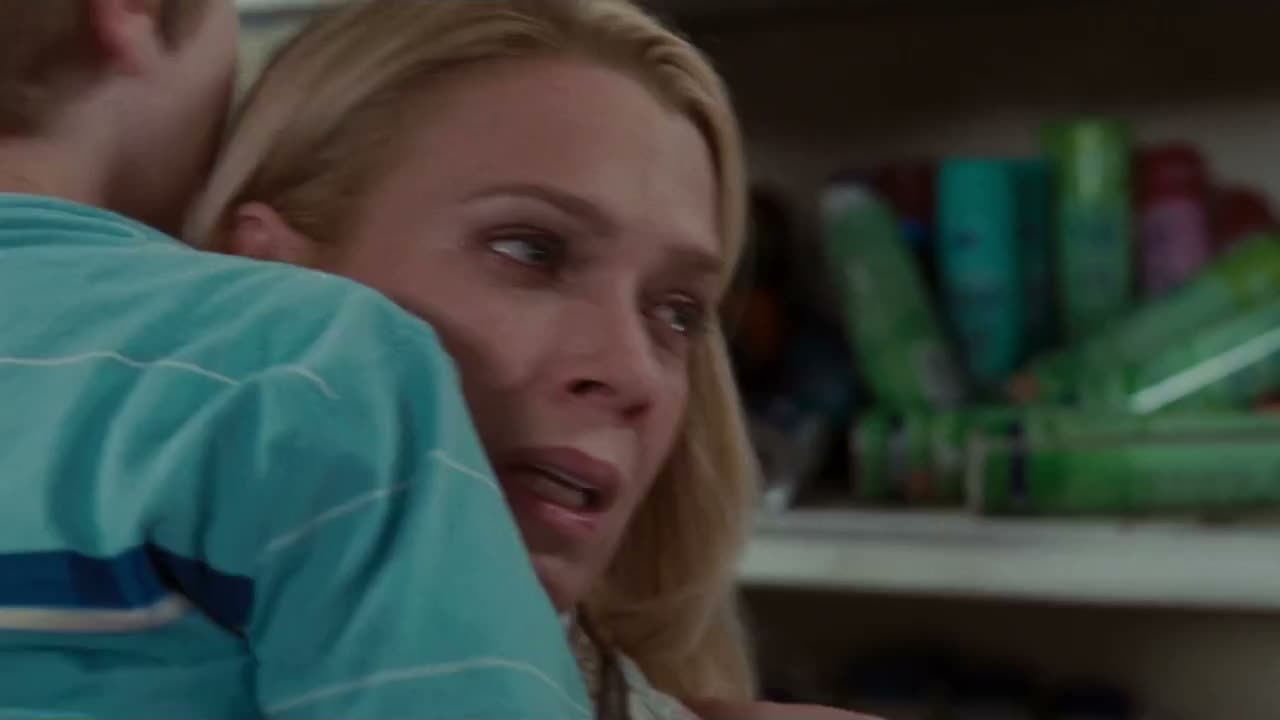
Strip away the monsters and the scene is about what holds a society together once the lights go out. One character insists, "My God, David, we're a civilized society." The reply treats civilization as a fragile agreement instead: "As a species, we're fundamentally insane." From there, politics and religion are recast as inventions for managing a volatile, irrational species. That is why the preaching lands so well on a frightened room — fear wants a story, and whoever supplies one gains power. The people who keep their heads are the ones asking what can actually be done next, not what it all means. In the dark, civilization is not a given; it is something the room has to keep choosing.
A1–C2 es la escala MCER. Las tarjetas por encima del nivel elegido se atenúan y la reproducción no se pausa en ellas.
“As a species we re fundamentally insane”
It relocates the horror from the monsters to human nature itself.
Neutral
“Why d you think we invented politics and religion”
A rhetorical question that frames politics and religion as machines for taking sides.
Informal
“My God David we re a civilized society”
It names civilization as an assumption that only holds while the machines run.
Informal
“You don t have much faith in humanity do you”
It lifts a practical argument into a question about human nature and uses a tag question to force a stance.
Neutral
Sure, as long as the machines are working. But you take those things away, you throw people in the dark. You scare the shit outta them, no more rules. You'll see how primitive they get. If you scare people badly enough. You can get 'em to do anything. They'll turn to whoever promises a solution. Or whatever.
As a species, we're fundamentally insane. Put more than two of us in a room, we pick sides and start dreaming up reasons. To kill one another. Why'd you think we invented politics and religion?
 Siguiente · 08leave well enough aloneLa escena: Carmody Blocks the Pharmacy Run
Because she offers certainty in a situation with none. When no one can explain the mist, a person who claims to know God's plan becomes the most confident voice in the room.
It means following a dangerous belief without questioning it. The phrase comes from the Jonestown mass suicide, and here it warns that the crowd is surrendering its judgment to a leader.
It is sincere in the moment, which is what makes it sting. The speaker wants it to be true, but the film keeps showing how quickly that agreement falls apart under pressure.
The film sides with the pessimist and the pragmatist at once: people are not reliably good, but survival still depends on the few who keep working the problem instead of waiting for a sign.