
“The underlying order is chaos, man.”
Por qué es buena
It flips the expected order into chaos in one short, confident line.
Registro
Informal
Úsala tú
The underlying order in this office is pure chaos.
Capítulo 19 de 22 · 4'24"
A talker explains that the underlying order is chaos, that there is no tunnel or wall, and that even looking at something changes it. Later, friends at a table draw cards with philosophical sayings and end up arguing that children's cartoons teach bribery and herd safety.
❝ Monólogo · 16 frases The Underlying Order Is Chaos
Repetition Is a Form of Change
❝ Monólogo · 22 frases the Smurfs as a family
He turns a children's cartoon into a lecture on bribery, belonging and belief.
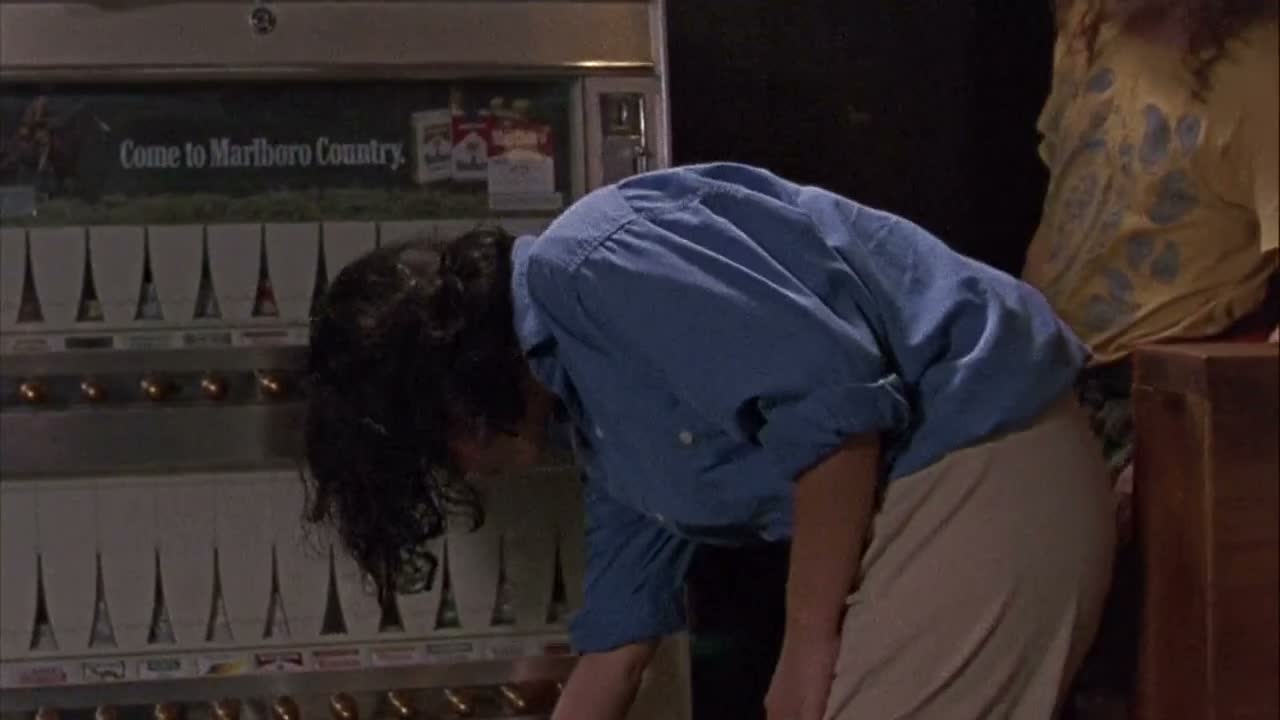
One character explains his new worldview: the wall does not exist, the tunnel has no light, and the underlying order is chaos. He brings in the butterfly effect and the idea that observation changes what it observes. The film then cuts to a table where friends draw cards of sayings and talk about Scooby-Doo and the Smurfs.
The scene is two separate conversations that the film lets rhyme. First comes a monologue about chaos and new physics, delivered by someone who is either enlightened or simply high, and the film refuses to decide. "The underlying order is chaos, man," he says, then reaches for the butterfly effect and quantum observation as proof. Later, at a table, the same spirit shows up in a smaller key: people draw cards with sayings and use them to think about cartoons. The best exchange turns Scooby Snacks into a lesson in bribery and the Smurfs into "safety in numbers," which is exactly the kind of half-serious theory the whole film runs on. Nobody is mocked and nobody is confirmed; the talk just keeps moving, the way it does in Slacker.
A1–C2 es la escala MCER. Las tarjetas por encima del nivel elegido se atenúan y la reproducción no se pausa en ellas.
“The underlying order is chaos, man.”
It flips the expected order into chaos in one short, confident line.
Informal
“I mean, it's new physics. You can't look at something without changing it.”
It turns a physics idea into a plain statement about attention and change.
Neutral
“All right. But I don't know. Sounds like you're plugging for Scooby Snacks to me.”
It answers a grown-up request with a cartoon joke about being bribed.
Informal
“"Repetition is a form of change."”
A self-contradicting maxim turns going in circles into a kind of progress.
literary
it's like I've had a total recalibration of my mind, you know. I mean, it's like I've been banging my head against this 19th-Century-type, uh - What, thought-mode, construct, human construct? Well, the wall doesn't exist. It's not there, you know. I mean, they tell you to look for the light at the end of the tunnel. Well, there is no tunnel. There is no structure. The underlying order is chaos, man. I mean, everything's in one big ball of fluctuating matter... a constant state of change, you know. I mean, it's like across that gray quantum divide is this new consciousness. I don't know what that's gonna be like, but I know that we're all part of it. I mean, it's new physics. You can't look at something without changing it. You know, anything. I mean, man, that's, like, almost beyond my imagination. Geez, it's like that butterfly flapping it's wings in Galveston... and somewhere down the road apace it's gonna - oh, hey- create a monsoon in China.
And then you got the whole other end of the realm where there's like the Smurfs... and then they've got their little colony group together... where everybody hangs, you know, in their one little group... and everybody's right together, everything flows real well. Any time any one of them tries to take off and do their own little individual trip... that's when Mr. Evil comes down off the hill and stomps on them. Well, like, Smurfs, you know. It's like a family system, like it's all - - Answering to Papa Smurf. - Yeah, it's safety in numbers. It's like, like the Smurfs are like Mom and Dad. And it's like they don't want your kids running off, you know. And that's the same thing as Smurfs. They don't want, like, some Smurf... leaving the hive colony at all, you know. Well, listen, like... a friend of mine has this real weird theory about Smurfs. But I've been thinking about it, and I think it's kind of cool. Actually, I kind of agree with it. It's like about Krishna. You know, like Smurfs are blue. And he's saying that Smurfs are, like, getting kids used to seeing blue people. And it's like, you know, with Smurfs being blue... kids see blue people, they, like, relate to Smurfs. And they relate to blue people when Krishna comes about, you know. And, I don't know, I kind of agree with that.
 Siguiente · 20ebb and flowLa escena: Talking About the Fear of Rejection
He says the underlying order of things is chaos, that there is no wall or tunnel, and that the new physics shows you cannot observe something without changing it.
They are cards with sayings on them, like "Repetition is a form of change." The friends read them out and use them to start conversations.
They say the show teaches children bribery: Shaggy and Scooby offer a Scooby Snack to get the bad guy beaten up.
They argue the Smurfs teach "safety in numbers," a closed group where every Smurf answers to Papa Smurf and nobody is allowed to leave.
It means you are safer as part of a group than on your own. They use it to describe the Smurfs' little colony.