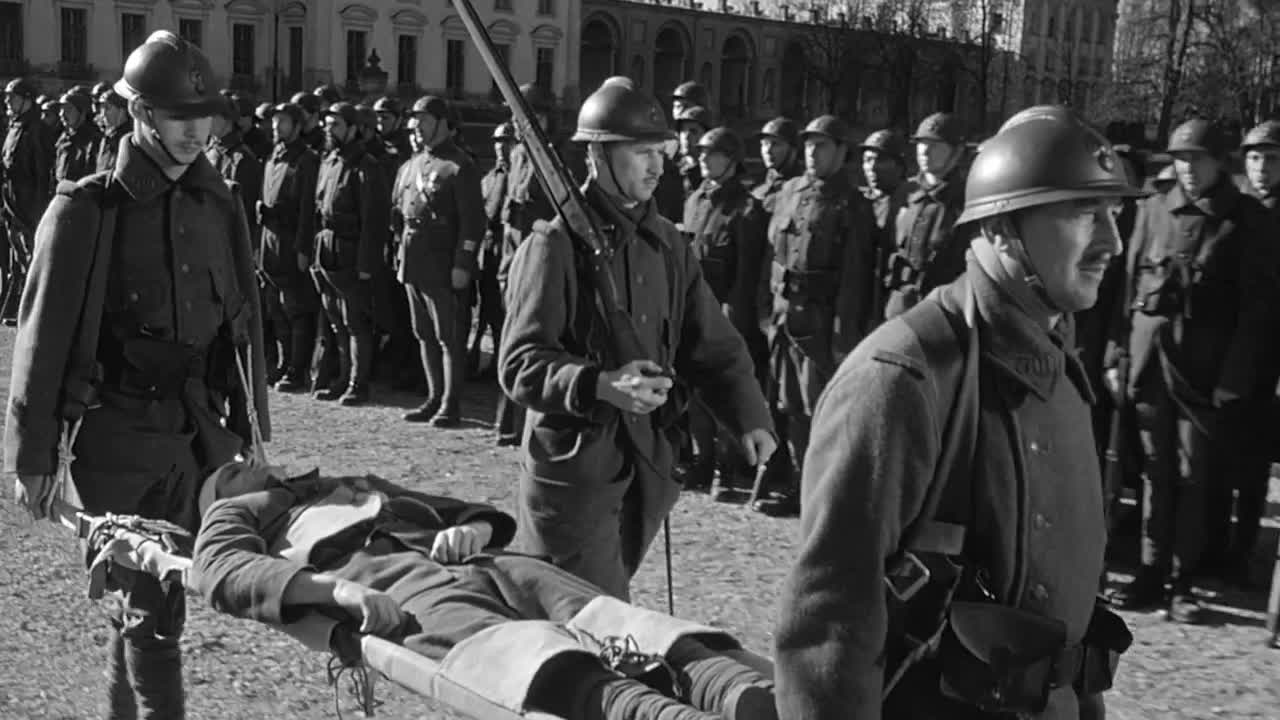
“Now, how can you understand that and allow these men to be shot tomorrow?”
One question exposes the contradiction: you understand it and still let them die.
Neutral
Capítulo 15 de 17 · 3'58"
Dax visits Broulard at night and asks how he can let the men be shot, but Broulard defends the executions as good for discipline — "a perfect tonic for the entire division." Dax's answer is to produce sworn statements that Mireau ordered artillery fire on his own trenches. Broulard calls it blackmail; Dax calls it a difficult position.
Broulard Calls Executions a Tonic
❝ Monólogo · 7 frases Dax reveals the artillery order
He lays out the case step by step until the general traps himself.
Dax Turns the Tables on Broulard
At night, Colonel Dax visits General Broulard at his headquarters to plead for the three condemned soldiers. Broulard deflects with cigars and conversation, argues that the executions will be a tonic for discipline, and refuses to interfere. Dax then produces sworn statements that Mireau ordered his artillery to fire on his own trenches.
Two conversations are happening at once. On the surface, Dax is asking a general for mercy; underneath, he is building a case. Broulard knows exactly what kind of meeting this is, which is why he keeps it soft and social — cigars, the dress party downstairs, an apology for not inviting him. His most revealing line is his defense of the executions: "a perfect tonic for the entire division." He is not evil in a cartoonish way; he simply believes that morale is managed with examples, and that three lives are a reasonable price. Dax's counter is the whole point of the scene: he has sworn statements showing Mireau ordered artillery fire on his own trenches, so he can trade one scandal for another. Broulard names it, and Dax answers that the only question is who gets hurt.
A1–C2 es la escala MCER. Las tarjetas por encima del nivel elegido se atenúan y la reproducción no se pausa en ellas.
“Now, how can you understand that and allow these men to be shot tomorrow?”
One question exposes the contradiction: you understand it and still let them die.
Neutral
“These executions will be a perfect tonic for the entire division.”
Calling executions a tonic is the most chilling irony in the film.
Formal
“Colonel Dax, are you trying to blackmail me?”
The accused names the crime first, and the word shows who is cornered.
Formal
“Sir, that's an ugly word, but you are in a difficult position.”
He refuses the word but keeps the leverage: polite, exact, and merciless.
Formal
“Too much has happened. Someone's got to be hurt.”
He prices the killing like a bill: someone has to pay, and it need not be him.
Neutral
“General, what would your, uh, newspapers and your politicians do with that?”
He names the general's two fears, the press and the politicians, and ends the argument.
Formal
Oh, by the way, sir, have you heard that General Mireau... ordered his own battery commander, Captain Rousseau... to open fire on his own positions during the attack? Well, of course the captain refused without a written order... but General Mireau demanded that he commence firing on our own trenches. Again Rousseau refused without an order in writing... but again he was ordered, and again he refused — all in front of witnesses.
Siguiente · 16brace yourselfLa escena: The Priest Comforts the Condemned MenTo stop the executions. He asks how Broulard can allow the men to be shot, then tries to force the issue with evidence instead of argument.
He says they will be a perfect tonic for the division and that troops need discipline, comparing soldiers to children who want their father to be firm.
Sworn statements from officers involved, showing that Mireau ordered his artillery to open fire on his own trenches during the attack.
Broulard uses it to accuse Dax of threatening to expose the Mireau scandal unless the executions are stopped. Dax does not deny the pressure, only the word.
He wants the General Staff to intervene and stop Mireau's attempt to have three innocent men shot to protect his own reputation.