
“It's about the boy. He's a good kid.”
Por qué es buena
It cuts through the ego fight and names the only thing that matters.
Registro
Neutral
Úsala tú
It's about the team, not about who gets the credit.
Capítulo 20 de 21 · 4'27"
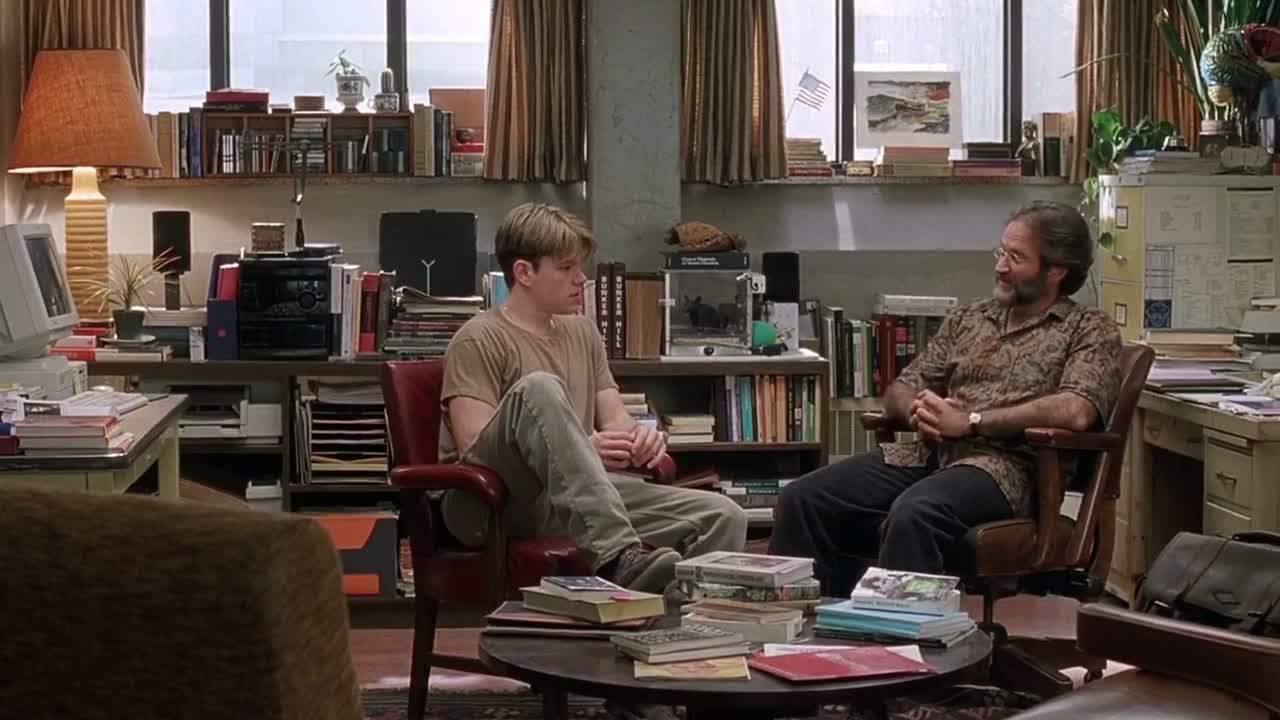
After fighting with Lambeau over how to handle Will, Sean sits him down and offers his own worst memory as proof he understands. Then he repeats one sentence until it gets through: "It's not your fault." Will argues, deflects, and finally breaks, which is the breakthrough the whole film has been building toward.
❝ Monólogo · 4 frases Sean's Story About His Father
Sean and Lambeau clash over whether Will should be pushed, and Sean warns that Lambeau is treating the boy as a version of himself. Once alone with Will, Sean describes his abusive father and the nights he took the beatings to protect his mother and brother. He then tells Will, over and over, that what happened to him was not his fault.
The breakthrough works because Sean does not argue Will out of his defenses; he simply outlasts them. First he answers Will's question about personal experience with his own history, a father who came home looking for someone to beat and a boy who volunteered to be that someone. "Interesting nights were when he wore his rings" turns years of violence into a single domestic detail, which is how Sean talks about pain without performing it. Then he repeats the same sentence until it stops being information and becomes something Will has to feel: "It's not your fault." Will's resistance, and the way it collapses into tears, is the point. He has spent the film proving he needs no one; here he needs a sentence, said by someone who has earned the right to say it.
A1–C2 es la escala MCER. Las tarjetas por encima del nivel elegido se atenúan y la reproducción no se pausa en ellas.
“It's about the boy. He's a good kid.”
It cuts through the ego fight and names the only thing that matters.
Neutral
“Interesting nights were when he wore his rings.”
The calm wording hides the violence and makes it land harder.
literary
“I won't see you make him feel like a failure, too.”
It protects the boy while quietly admitting the speaker has felt the same shame.
Neutral
“This is not your fault.”
The heaviest line in the film, repeated until it finally gets through.
Neutral
My father was an alcoholic. Mean, fuckin' drunk. He'd come home hammered, lookin' to whale on somebody. So I'd provoke him so he wouldn't go after my mother and little brother. Interesting nights were when he wore his rings.
 Siguiente · 21set someone up withLa escena: Sean Says Goodbye to Will
Will refuses to talk about his past unless the other person has earned the right. By describing his father's beatings, Sean shows he is not just a professional reading a file.
The first times, Will brushes it off with "I know." Sean keeps going until the words get past his defenses, which is when Will finally breaks down.
It is Sean's way of saying his father beat him harder on certain nights. Instead of naming the violence, he gives one concrete detail.
About whether to push Will. Lambeau believes pressure made him who he is; Sean argues that Will is not Lambeau and could be crushed by the same treatment.
Will resists the sentence and even accuses Sean of messing with him, but his collapse shows the truth has landed. The embrace is the first time he lets someone in.