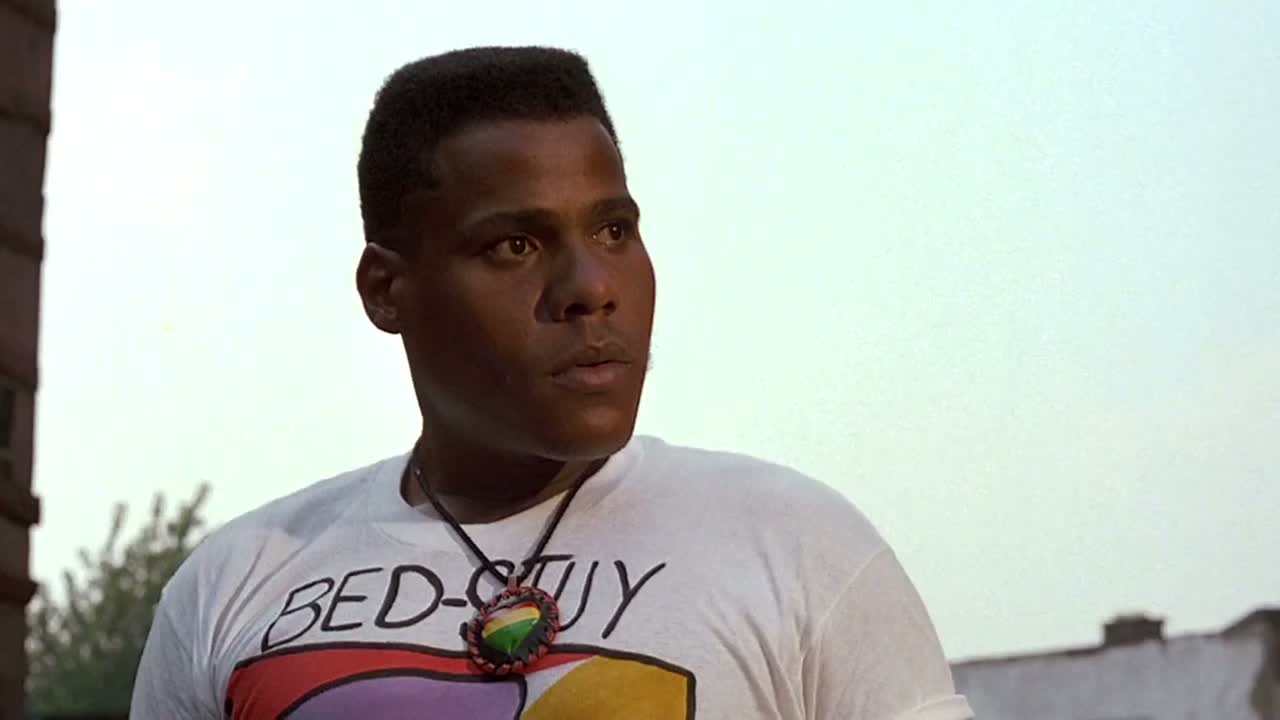
“I'm not kicking you. You're kicking yourself out.”
It hands the blame straight back without raising its voice, leaving the other man nothing to say.
Neutral
Capítulo 4 de 20 · 2'09"
Buggin Out wants Black faces on Sal's wall of fame. Sal answers, "This is my pizzeria," and the argument turns on who gets to decide what belongs on a wall paid for by someone else's money. "Since we spend much money here, we do have some say."
❝ Monólogo · 5 frases Buggin Out Asks Sal Why the Wall Has No Black Faces
At Sal's Famous Pizzeria in Brooklyn, Buggin Out looks at the wall of celebrity photos and asks Mookie why there is not a single Black face on it. Mookie tells him to take it up with Sal. Sal refuses, saying the wall honors American-Italians only, and the two argue until Sal orders Buggin Out out of the store.
The fight is not really about photographs. Buggin Out is testing a simple idea: if Black customers keep Sal's in business, they should have a voice in how the place represents them. Sal hears that as a challenge to the only thing he feels he owns, and answers with property: "Get your own place. You can do what you wanna do." Mookie, caught between his boss and his friend, tries to defuse things and lands the scene's sharpest line: "I'm not kicking you. You're kicking yourself out." The scene stages the film's central tension in miniature, who belongs in the neighborhood, and who gets to decide. Buggin Out leaves calling for a boycott, planting the idea that returns later.
A1–C2 es la escala MCER. Las tarjetas por encima del nivel elegido se atenúan y la reproducción no se pausa en ellas.
“I'm not kicking you. You're kicking yourself out.”
It hands the blame straight back without raising its voice, leaving the other man nothing to say.
Neutral
“Get your own place. You can do what you wanna do.”
It draws the line between wanting change and owning the place, all in one breath.
Informal
“So since we spend much money here, we do have some say.”
It turns money spent into a claim on the place, casual and confrontational at once.
Informal
“Rarely do I see any American-Italians eating in here.”
An inverted sentence turns a simple observation into an argument: rarely do I see any American-Italians eating in here.
Neutral
You want brothers on the wall? Get your own place. You can do what you wanna do. You can put your brothers and uncles and nieces and nephews, your stepfather, stepmother, whoever you want. See? But this is my pizzeria. American-Italians on the wall only.
Siguiente · 05hell to payLa escena: Fire Hydrant Soaks a CarThe wall is covered with photos of Italian-American celebrities, while most of Sal's customers are Black. Buggin Out sees the wall as a sign of who the neighborhood is told counts, and wants it to include people who look like the people who eat there.
Sal says the wall shows American-Italians only because the pizzeria is his. He is proud of his family's place and sees the demand as an attack. The movie lets both sides speak, so the scene is less about one villain than about who gets to control a shared space.
Here brothers is not about siblings. It is Black slang for Black men, roughly "my people" or "Black brothers." Buggin Out wants photos of Black figures, not just his own relatives, on the wall.
Buggin Out leaves shouting "Boycott Sal's" and keeps pushing the idea of a boycott on the street. The anger over the wall and the way it is handled builds through the day and feeds into the film's explosive ending.