“Just say whatever you want to say and spare me the propaganda.”
It hands the floor back and refuses the script in one breath, so the refusal lands politely but hard.
Informal
Capítulo 5 de 14 · 3'03"
Carolyn needs a husband on her arm for a business party — 'How'd it look if I showed up with no one?' — and Lester agrees to come, but not to perform. Before the guests he tells her to 'spare me the propaganda'; at the party he quietly refuses to be the polished version of himself.
Lester Refuses to Act Happy
Lester Crashes the Business Party
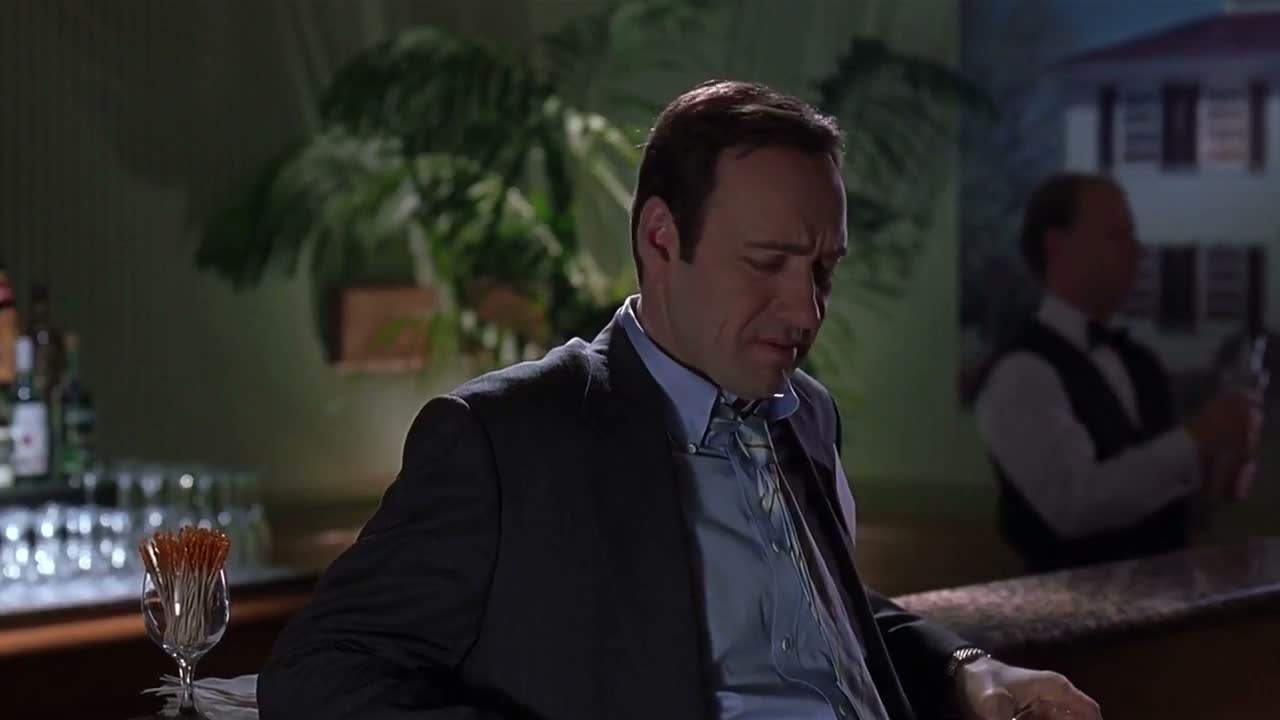
At home, Carolyn asks Lester to attend an important business function and tells him to act happy. He comes along, but at the party he quietly undercuts every social ritual — when a colleague doesn't remember meeting him, he shrugs, 'It's OK. I wouldn't remember me, either,' then heads straight for the bar.
The marriage here is a performance, and Carolyn says so out loud: 'my business is selling an image and part of my job is to live that image.' Lester's reply — 'Just say whatever you want to say and spare me the propaganda' — is not a fight so much as a refusal. He has stopped believing the script, but he still attends. That is what makes the scene uncomfortable: he doesn't storm out, he just stops pretending. Buddy breezes in, doesn't remember meeting Lester last year, and Lester takes the slight as a joke rather than an insult. The couple's claim that they 'have a very healthy relationship' lands as the opposite. Nobody is shouting. Everyone is acting.
A1–C2 es la escala MCER. Las tarjetas por encima del nivel elegido se atenúan y la reproducción no se pausa en ellas.
“Just say whatever you want to say and spare me the propaganda.”
It hands the floor back and refuses the script in one breath, so the refusal lands politely but hard.
Informal
“Everyone's with their spouse. How'd it look if I showed up with no one?”
She turns a personal favor into social pressure by asking how it would look, not what she wants.
Neutral
“As you know, my business is selling an image and part of my job is to live that image...”
She explains her vanity as a job requirement, and the calm certainty is what makes it chilling.
Formal
“It's OK. I wouldn't remember me, either.”
He beats them to the insult with a joke, so the snub loses its sting.
Informal
Siguiente · 06pick your brainLa escena: Lester Quits His JobBecause the party is a business function, and her business is image. Arriving alone would look wrong to clients and colleagues. She isn't asking for company; she's asking him to complete the picture.
He's being honest in a way that embarrasses her. He agrees to attend but refuses to act happy or remember rehearsed lines. The scene keeps both readings alive: petty payback, and a man finally done pretending.
It's an old phrase for the person who thinks he runs the place — the big shot. Here it comes from the war movie the family is watching, not from a real conversation, and it mocks the self-important type Lester is surrounded by.
Because he's decided to endure the evening on his own terms. If he has to be there, he'll be there as himself — drinking, cracking jokes, offending no one important enough to matter. It's passive rebellion.
No. Lester has to remind him they met at Christmas last year, and Buddy clearly doesn't place him. Lester's shrug — 'I wouldn't remember me, either' — turns the snub into a joke instead of a wound.