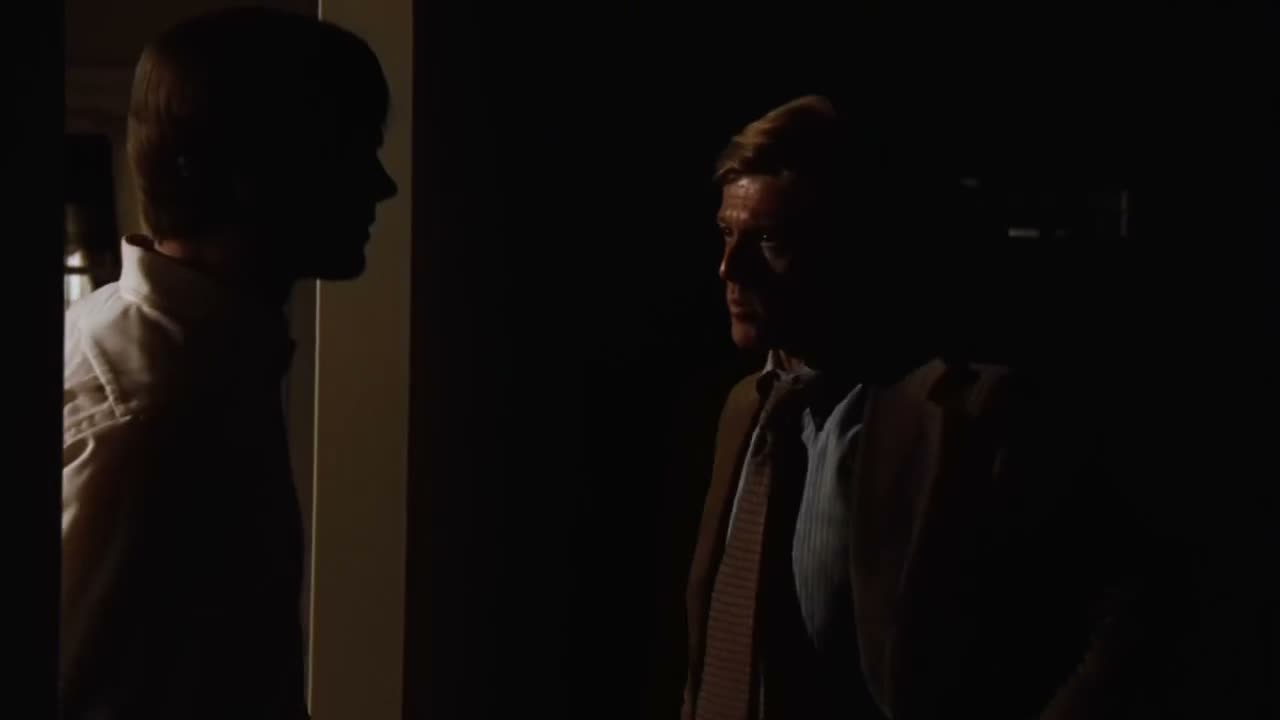
“I guess I don't have the taste for the jugular you guys have.”
It turns newsroom toughness into a taste for blood, half self-mockery and half rebuke.
Informal
Capítulo 16 de 18 · 3'36"
On the surface it's a routine source check: Sally Aiken says Ken Clawson confessed to writing the Canuck letter. But the reporters turn the room into an interrogation, then call Clawson, whose reply is a masterpiece of evasion — "We were shooting the breeze about the election." Nothing he says denies anything; that's the whole point.
Clawson's Non-Denial Denial on the Phone
❝ Monólogo · 12 frases Clawson Begs Sally to Stay Quiet
Sally Aiken walks into the Washington Post newsroom with a tip: Ken Clawson, a White House communications official, told her he wrote the Canuck letter that damaged Muskie's campaign. Woodward and Bernstein press her on when, where, and what else was said, then phone Clawson. He denies nothing directly; the reporters call it a non-denial denial.
This scene is about the machinery of denial, not the truth of the rumor. Sally Aiken comes forward reluctantly — "I guess I don't have the taste for the jugular you guys have" — and the reporters immediately test her, asking whether Clawson was just trying to sleep with her, and why she waited two weeks. When they finally get Clawson on the line, every answer is designed to be quoted safely. "We were shooting the breeze about the election," he says, and when pressed he snaps, "That is a question straight out of Wichita, Kansas." He never says he didn't write the letter. Woodward and Bernstein catch the trick instantly: it's a non-denial denial — a statement that sounds like a denial but concedes nothing. In Washington, that distinction between what is said and what is admitted is everything.
A1–C2 es la escala MCER. Las tarjetas por encima del nivel elegido se atenúan y la reproducción no se pausa en ellas.
“I guess I don't have the taste for the jugular you guys have.”
It turns newsroom toughness into a taste for blood, half self-mockery and half rebuke.
Informal
“We were shooting the breeze about the election.”
Calling it shooting the breeze shrinks a damaging admission into small talk.
Informal
“I don't care where it happened. What happened is what counts.”
It cuts through the squabble over place and forces the focus back onto what was actually said.
Neutral
“Sally, I have a wife and a family and a dog and a cat.”
Listing his ordinary household makes the plea clear: exposure would cost him everything.
Informal
Sally, for chrissakes, don't tell them I came to your place. Why not? What's wrong with coming over for a drink? You and me, in your apartment? Well? Jesus Christ, you just shot me down. If that appears in the papers, that I'm over at your house having a... - Well, do you know what that does? - Well, I don't see why. You don't? You don't? - But there's nothing bad about it. - Well, there sure is. Jesus Christ. This is just incredible. Well, I have a clear conscience. Sally, I have a wife and a family and a dog and a cat.
Siguiente · 17fair gameLa escena: Woodward and Bernstein Name HaldemanShe says she doesn't have their instinct for the kill — "the taste for the jugular." She's a source, not a hunter, and coming forward puts her own reputation and privacy on the line.
He never denies it outright. He calls the conversation small talk and attacks the reporters' question, but he never flatly says he didn't write the letter — which is exactly what makes it a non-denial denial.
Sally says he came to her apartment. Clawson insists it wasn't in her apartment, but by arguing about the location he concedes the meeting happened — the reporters jump on the contradiction.
They need to know her account will hold up. Whether Clawson was trying to impress her or sleep with her changes how reliable the tip is, so they test her before they run with it.
It means casual, aimless small talk. Clawson uses it to frame his conversation with Sally as harmless chatter rather than a confession about the letter.