
“That's how I know we were set up.”
Por qué es buena
One short line turns scattered details into a verdict of betrayal.
Registro
Informal
Úsala tú
That's how I know the email was fake.
Capítulo 6 de 22 · 2'14"
The men try to reconstruct the robbery, and the fight is over timing: did the police arrive right after the alarm, or only after Mr. Blonde opened fire? For one of them the order settles everything — "That's how I know we were set up."
Reconstructing the Botched Robbery
They Realize the Job Was a Set-Up
Escaping Through the Gunfire
In the warehouse, the crew replays the heist step by step. One account has the alarm trigger the police instantly; another corrects it, insisting the cops only moved after Mr. Blonde started shooting. That sequence, one of them argues, proves the job was betrayed from inside — a set-up rather than bad luck.
The scene is a room full of men trying to turn chaos into a story they can act on. Nobody has the full picture, so they argue over small facts — when the alarm went off, when the police appeared — because those details decide the bigger question: was this a raid they could have escaped, or a trap? The line "That's how I know we were set up" shows how thin the evidence really is, yet the conclusion is treated as certain. There is also an unspoken rule running under the argument: keep using the colour names, and do not say your real name. When someone snaps, "Enough of this Mr White shit!" the others shut it down fast, because in their world knowing a name is dangerous.
A1–C2 es la escala MCER. Las tarjetas por encima del nivel elegido se atenúan y la reproducción no se pausa en ellas.
“That's how I know we were set up.”
One short line turns scattered details into a verdict of betrayal.
Informal
“Wait, wait. Don't tell me your fuckin' name. I don't wanna know it.”
Refusing a real name says more about trust than any promise could.
Informal
“I shot my way out. Everybody started shooting, so I blasted my way out of there.”
The repeated way out gives the sentence the forward push of a firefight.
Informal
“I turn around and all these cops are outside.”
One turn of the head and the scene flips—compact, visual and easy to reuse.
Informal
“They didn't let their presence be known until after Mr Blonde became a madman.”
didn't ... until after ... pins the timeline down and kills the other version with one clause.
Neutral
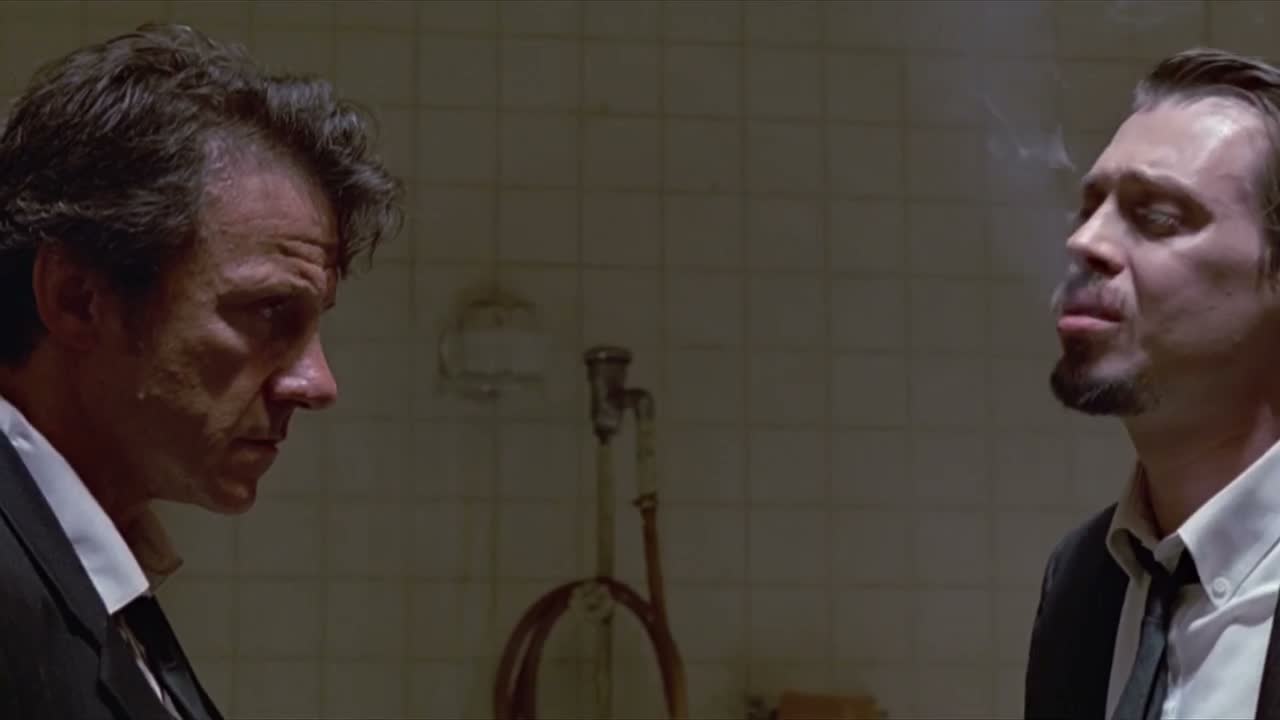 Siguiente · 07null and voidLa escena: The Crew Debates Mr. Blonde's Rampage
Because of the timing. They argue the police stayed hidden until Mr. Blonde started shooting, then moved in — a delay that, to them, only makes sense if someone inside tipped the cops off.
To arrange a situation so someone is blamed or trapped without knowing it. Here the men believe a traitor planned the raid so they'd be caught.
Because names are dangerous. If one man is caught and knows nothing, he can't give the others away. That's why someone says he doesn't want to know a real name at all.
He suspects someone inside the crew betrayed them. His proof is the police timing, and he pushes the others to admit the job was compromised from within.
He started shooting everyone after the alarm. The others say the police only moved in after he 'became a madman,' making his violence the trigger for the ambush.